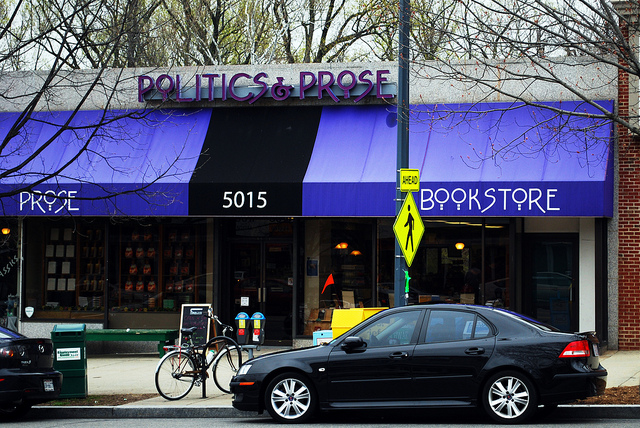
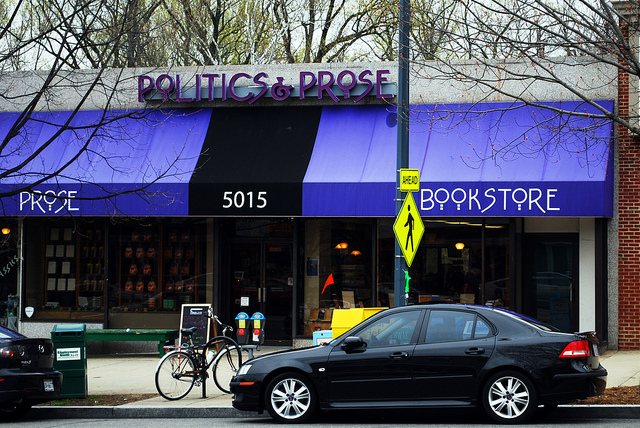
 Photo by Michael T. Ruhl
Politics & Prose might pride itself on being a thoughtful marketplace of ideas, but after an incident at a reading at the Chevy Chase bookstore last night, it might not be seen as the most hospitable place for music aficionados.
The author Natalie Hopkinson was at Politics & Prose last night promoting her new book Go-Go Live: The Musical Life and Death of a Chocolate City (Duke University Press, $22.95), a history of black Washington in the latter half of the 20th century as told through go-go music and culture.
For the prelude to last night’s reading, Hopkinson provided the bookshop with a mix CD of some of her favorite funk and go-go tracks. It led off with a title track—Parliament’s “Chocolate City.” But the beats didn’t last very long. As Hopkinson recounts on her blog today, almost as quickly as George Clinton’s vocals started up, they were shut down by a customer complaint:
A few minutes before my reading, store employee Marshall popped in my CD. Not 30 seconds into my go-go playlist, a white woman went to the cashier to complain. The song in question wasn’t even a go-go song. It was Parliament’s 1970s funk classic “Chocolate City”—a song that took on a moniker that was being used by Washingtonians celebrating the city’s first elected mayor, a black man named Walter Washington.
Hopkinson goes on to write that the woman complained to the store clerk that she found “Chocolate City” to be “racist” and asked that the song be turned off. The store, to Hopkinson’s alarm, complied with the request and shifted to the next track. But, Hopkinson writes, Chuck Brown’s “Run Joe” was no less displeasing to the woman. After a few seconds of the late Godfather of Go-Go, that music was shut off, too.
“A bookstore is a place of ideas,” Hopkinson writes. “It is not the place where I expect a random, apparently uninformed person to be handed a gavel to judge what constitutes appropriate racial discourse.”
Before the reading, Hopkinson had joked on Twitter that she was curious if Chevy Chase, one of the most overwhelmingly white neighborhoods in D.C., would be “ready” for her go-go blend, which also featured cuts by Little Benny, Trouble Funk and the Backyard Band.
Apparently, at least one part of Chevy Chase—its famed bookstore—was not. Hopkinson writes that she was not surprised to encounter people with a distaste for D.C.’s homegrown musical style, but that Politics & Prose complied with one person’s demand. “With a wave of a white hand, an Other’s culture is erased,” she writes.
Not surprisingly, Politics & Prose’s decision to turn off an appropriate soundtrack for Hopkinson’s reading has been met with some incredulity:
OH FOR FUCKS SAKE,
@politics_prose nataliehopkinson.com/2012/07/30/go-…— Dan Kois (@dankois) July 31, 2012
But for Hopkinson, there is a silver lining in her subject matter: Go-go wouldn’t care—”give a shit,” in her words—if Chevy Chase is ready for it. It has existed on its own whims:
It has never begged any outside institution to give it a voice. Since 1976 when Chuck Brown developed the sound, it’s been black owned and operated, going, going. And going. In backyards and firehouses. At high school proms and rec centers. In parks and nightclubs. In black-run government buildings. It has neither sought nor been granted approval from anyone outside the community that created it. Gentrification may be pushing it out of the city limits. But it’s still here, daring anyone to try to snatch the mic.
The reading, Hopkinson concludes, ended up going quite well, with many customers exposed to go-go for the first time in their lives. And plenty of them asked Hopkinson for the full playlist. Perhaps what Hopkinson writes was correct: That despite one person’s prudishness and one store’s weak-willed obedience, the go-go went on.
Or, as the song goes, “Chuck baby don’t give a fuck.”
UPDATE, 2 p.m.: Politics & Prose owners Bradley Graham and Lissa Muscatine released a statement today in response to the uproar about what happened last night. In it, they say that the insinuation that their store had banned go-go music is untrue.
“The incident that has generated controversy involved music being turned off for a few minutes immediately before the event while we conferred with a customer who had complained,” they say. “Ms. Hopkinson did play a song from her playlist during her talk, and the full playlist, which we had welcomed her to bring, was turned back on as soon as the event ended and continued through the rest of the evening.”
Graham and Muscatine go on to say that their shop “does not censor or ban music or books, nor does the store allow one person’s point of view to silence a group discussion” and that they regret Hopkinson’s music was switched off.
Still, it was. And even though Hopkinson’s reading was deemed a success by author and store alike, the evening was marked by this early disruption.