Gore Vidal, the author, cultural critic and man-about-the-world who penned 25 novels and thousands of essays dealing frankly with all facets of American culture, died yesterday at his home in Los Angeles at 86. The cause was pneumonia, his family said.
To couch Vidal as simply a novelist and essayist, though, hardly begins to illustrate the life and career of a man who is considered one of the finest writers the United States has ever produced. Vidal sparkling prose, deeply acerbic but always illuminating, cut deep at the pillers of American society, from the founding fathers to Abraham Lincoln to modern-day sexual mores to America’s role in the world abroad. No subject was beyond his grasp.
His social life was just as legendary, even when it wasn’t engrained into his writings. Vidal boasted of having nearly 1,000 sexual partners—men and women—before his 25th birthday. And throughout his life, one of his favorite topics was tearing down sexual definitions. “There is no such thing as a homosexual or a heterosexual person,” he repeatedly said. “There are only homo- or heterosexual acts. Most people are a mixture of impulses if not practices.”
Still, for as much time as he put into his romantic encounters, Vidal never tired of the page. His first novel, Williwaw, published in 1946, was drawn on his experiences serving on a U.S. Army supply ship during World War II and was considered one of the first great pieces of literature about the great conflict.
But it was his 1948 volume, The City and the Pillar that made Vidal a figure both beloved and reviled. A wartime story of a young man discovering his own homosexuality, the novel was hailed as one of the first gay novels to defy literary conventions (which often meant the killing off of homosexual characters) and one not written from an effeminate point-of-view. Vidal was also exiled by many literary circles for exactly the same reason.
The City and the Pillar has its emotional origins at the St. Albans School in Washington, where Vidal was briefly a student in the early 1940s. Vidal dedicated his book to Jimmy Trimble, a classmate and star pitcher for the prep school who he later described as the only true love of his life; their affair was recounted last year by Washington City Paper. But with the entry of the United States into World War II, Trimble left school for the Marines and died at Iwo Jima. Vidal later graduated from the Phillips Exeter Academy in New Hampshire.
Eugene Luther Gore Vidal was born in 1925 in West Point, N.Y., where his father was an instructor at the United States Military Academy. He was the grandson, on his mother’s side, of Sen. Thomas Gore, a Democrat from Oklahoma. It was through his parents’ divorce and remarriages that Vidal wound up spending much of his childhood in D.C.
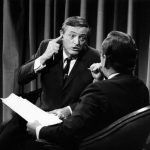
When not pumping out novels and essays, Vidal dabbled in screenwriting (he contributed to the script for Ben-Hur) and was a prominent political commentator. Perhaps no moment defined his role as a shaper of public opinion more than an on-air feud during the 1968 Democratic National Convention with William F. Buckley, his intellectual equal but philosophical counterweight. Vidal called Buckley a “crypto-Nazi.” Buckley replied, “You queer.”
That same year saw the publication of Myra Breckenridge, Vidal’s satirical novel about transsexuality and Hollywood.
Many of Vidal’s novels inspired outrage for treating beatified American figures as comical boobs. Burr, his fictional memoir of the third vice president, painted George Washington and Thomas Jefferson as idiots. Among the book’s detractors was Michele Bachmann, who told supporters of her short-lived presidential bid that reading Vidal’s depictions of the Founding Fathers turned her from a liberal Democrat into the firebrand Republican she is today.
In his later years, Vidal’s politics verged into the conspiratorial. He was a jailhouse correspondent with Oklahoma City bomber Timothy McVeigh and even defended McVeigh in an essay that appeared in Vanity Fair. He also wrote that he believed the George W. Bush administration had advance and thorough knowledge of the 9/11 terrorist attacks. That claim earned him the derision of some of his most notable admirers, including his felow contrarian Christopher Hitchens.
For all his social and sexual escapades, Vidal’s longest-term companion was Howard Auster, with whom he lived for more than five decades, including a long spell in Ravello, Italy. However, Vidal often said the secret to their enduring relationship was “no sex.” Auster died in 2003, shortly after the pair moved back to Los Angeles. Auster was buried in Washington, at Rock Creek Cemetery. Vidal bought the adjacent plot for himself.
Among the other boldfaced names in Rock Creek Cemetery are Alice Roosevelt Longworth, daughter of Theodore Roosevelt; Supreme Court Justice John Marshall Harlan; and Frank Hatton, one of the first editors of The Washington Post.
Jimmy Trimble is buried there, too.