Martin Austermuhle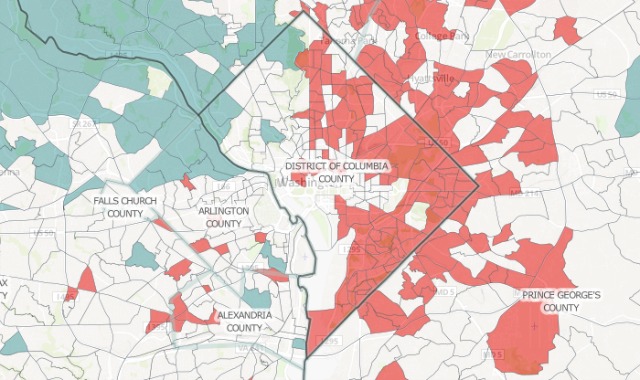
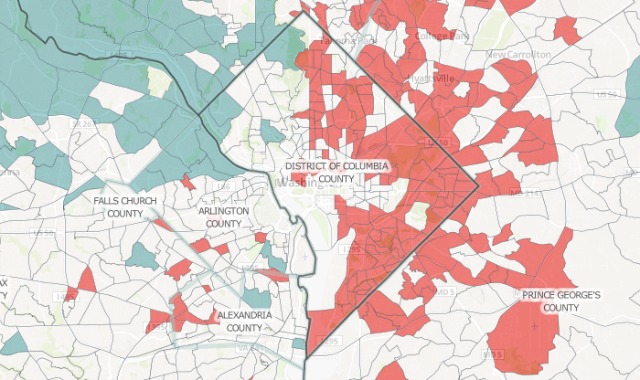 Red is low-income, blue is high-income and gray is mixed-income areas in 2010.
Of little surprise to anyone is the following conclusion: rich people like to live around rich people, and less rich people often have little choice but to live around other less rich people. But what a new report from the Pew Research Center finds is that that type of income segregation has gotten worse in many metropolitan areas over the years, Washington included.
As of 2010, the report found, 28 percent of low-income households (defined as those making $34,000 or less) were located in low-income tracts, up from 23 percent in 1980. As for upper-income households ($104,000 or more a year), 18 percent are now in upper-income tracts, double the percentage in 1980. Says the report:
These increases are related to the long-term rise in income inequality, which has led to a shrinkage in the share of neighborhoods across the United States that are predominantly middle class or mixed income—to 76% in 2010, down from 85% in 1980—and a rise in the shares that are majority lower income (18% in 2010, up from 12% in 1980) and majority upper income (6% in 2010, up from 3% in 1980).
As for Washington, in 2010 31 percent of low-income households were in low-income tracts, putting us seventh among the top 10 metropolitan areas in the country. (New York led the charge with 41 percent, Atlanta stood last at 26 percent.) As for upper-income households, 15 percent were in upper-income tracts, again putting us in seventh place. (Here Houston led with 24 percent, while Boston only came in at eight percent.)
When added together, the Washington metropolitan area scored 47 on the Residential Income Segregation Index, four points higher than in 1980. That’s not bad when compared to Miami’s 20, Dallas’ 21 and Houston’s 29. The national average stands at 14, with the southwest showing the highest numbers, followed by the northeast.
The conclusion? We’re right back where we started: “Residential segregation by income has increased during the past three decades across the United States and in 27 of the nation’s 30 largest major metropolitan areas.”