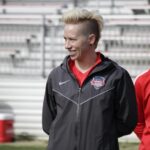
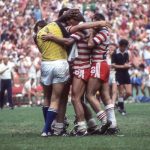
Paul Cannell in 1976.
It’s the title of former Washington Diplomats goalscorer Paul Cannell’s self-published memoir, and it’s also how I greet him when he met me at the Black Rooster on L Street NW last night. It’s a slogan that was chanted at him over his career as a player for Newcastle United in the English Premier League, and I’m sure he never hears it anymore… right?
“Paaaah-blo,” he says in a proper Geordie accent. “Nice to meet you.”
Long before there was Major League Soccer, there was the North American Soccer League. Founded in the late 1960s, the NASL briefly rose to prominence in the late 70s as the United States, at least for a while, embraced the world’s game. Fueled by the likes of soccer gods like Pelé, Franz Beckenbauer, Carlos Alberto, Johan Cruyff, George Best and Hugo Sanchez, the league grew rapidly. Too rapidly, in fact. With 24 franchises at its peak, the league collapsed completely in 1984—a result of over-expansion and mismanagement—creating a void in U.S.-based professional soccer that wouldn’t be filled until Major League Soccer was formed in 1996.
D.C. had it’s own NASL franchise, the Diplomats, or “Dips” for short. Featuring the likes of Cryuff and Guus Hiddink, the squad played its games at Robert F. Kennedy Stadium, except in 1976, when they played at W.T. Woodson High School in Fairfax County.
Cannell originally came to the Dips in ’76 on a loan. “I’d always been a stay-at-home lad,” he tells me. “If I played for Leeds, for Liverpool, for anybody, I’d always have to come back to Newcastle at the end of the day. I thought: if I go to America, I can’t go home quite as easily.” He took to his new surroundings quickly: “I fell in love with it. I fell in love with the country. People have said I’m all ‘Uncle Sam’d up.'”
After his appearance with D.C., he returned to England for two seasons, but the seed had been planted. After a falling out with then Newcastle United manager Bill McGarry, Cannell jumped ship for good. He recalls what he said to a friend at the time, with regard to McGarry: “If I was standing on the Tyne Bridge, threatening to jump and [McGarry] came to talk me down, I’d aim for the fucking pavement below, not the water!”
By 1978, when Cannell arrived for his second stint in the NASL, the league was at the height of it’s popularity. “When I came here, the league was described as ‘rock ‘n’ roll’,” he says. “The Philadelphia Fury were owned by Mick Jagger and Carly Simon, and the game wasn’t portrayed as a rival to the NFL or the NBA. It was more of a sports and rock ‘n’ roll venture. So when I got here, I scored a couple of goals and got sent off in my first game, and that was it. I rolled with it.”
About 30 minutes into our conversation, Cannell steps out of the bar to have a quick smoke. As I order another round of drinks, I notice the warning on the pack of Lambert and Butler cigarettes that he’s brought with him: smoking seriously harms you and others around you. It’s a statement that, in this case, might as well be describing the person consuming the product, not the tobacco. During his time in the NASL, Cannell was widely regarded as the game’s roughest player, and his stories match the record.
I ask him what it was like to play against Beckenbauer—”Der Kaiser”—widely regarded as one of the greatest soccer players ever. Cannell was not starstruck. “I spent 90 minutes of that game trying to kick him,” he says. “I couldn’t get near him! I was so frustrated. I thought that if I can’t score on him I’ve got to try and get a bit of action somewhere.”
One of his encounters with Pelé and his New York Cosmos was no less violent. “We played the Cosmos in ’76 at Woodson High School. Bob Rigby was their goalkeeper—he was the U.S. national team goalkeeper as well—I put him and the ball in the back of the net. He got carried off. Pelé scored a wondergoal, but both he and I got a yellow card because we had a tussle afterwords.” Rigby would miss the rest of the season after his encounter with Cannell.
The real source of the Cannell’s notoriety, however, was off the field. Once dubbed “Cocaine Cannell” by the Newcastle Evening Chronicle, his extra-curricular activities are the stuff of legend. “After training,” he says with a smile, “it was straight to the Sign Of the Whale. I had a change of clothes there, even. If I didn’t, I’d go next door and buy one.” Cannell writes openly about his cocaine use in his memoir, but insists that drugs never made their way into the locker room. “We never partied the day before the game,” he writes. “Of course there were no drug tests then, but still.”
 Paul Cannell shares a laugh with an opponent.
He next tells me about his encounter with Susan Ford, daughter of then-President Gerald Ford: “There was a bar called Winston’s—it was the place to be in those days. I get in there with a couple of other lads and we’re just hammered. And I notice there’s a lot of attention around this blonde girl. I walked up to her, shitfaced, and said, “Fancy a dance?” Just like that. I noticed there were some people around her in suits who didn’t seem too happy about it!” Cannell takes a swig of his beer and continues: “I was telling her about soccer and what not. She said, “I love your accent!”, and of course when she says that I become 100 percent more English. The accent thing—IT WORKS.”
Cannell met her a few days later for dinner, but it was just too awkward. He blames his sobriety, at the point, for his failure to “close the deal.” The Secret Service didn’t help, either. “The goon squad was horrible,” he says. “The thing that really struck me was—why do the fucking Secret Service have Secret Service written on their cars? How stupid is that?”
 The Diplomats’ cheerleaders, affectionately known as the “Honeydips.” I didn’t ask, but I think it’s safe to say Cannell may have interacted with one or more of these ladies.
He next reminisces about being detained briefly at Dulles for “smuggling” Black Pudding into the U.S., waxes nostalgic about dropping his pants at a referee during a game against the Tulsa Roughnecks and boldy claims—that he was the first soccer player to be signed to an endorsement deal by Nike. Guess what: it’s true. At one point, the shoe company caught wind of an appearance Cannell was to make on a magazine, and they rushed him a fresh pair of disco dancing shoes.
The former Dips star is 58 now, and his wild days seem to be behind him, for the most part. He lives in North Shields, just east of his old stomping grounds in Newcastle. As our conversation draws to a close, I can’t help but talk a little soccer with him. I ask him what he thinks of the future of the game here.
“I made a bet with a mate of mine,” he says, “that the U.S. will win the World Cup in the next 20 years, and I believe that.” He tells me that he considers former Diplomat star and Russia Head Coach Guus Hiddink to be the most talented player he’s ever shared the pitch with. “You could just turn, and run, and you wouldn’t have to look back. He’d just put it right in front of you. And he’s the best manager in the world.”
When it comes to MLS, Cannell sees a bright future for the league, but also thinks its lacking in certain departments. He attended D.C. United’s season opener last year, and came off a bit underwhelmed.
“It was alright. It didn’t blow me bollocks off,” he says. “What I saw were two teams, but there didn’t seem to be any individual flair. That’s what the league lacks. You’ve got the likes of Thierry Henry, who can really do a little bit of magic, but I didn’t see any magic in D.C. or Columbus. They need goalscorers, people to go past players, you know what I mean? You can’t just knock the ball around, the other team will always just drop back. You need players who’ll take other players out of the game by going past them.”
Cannell’s reputation, however, is tough to get around. And he’s embraced that. “The Mayor of Georgetown,” as he was once called, shares one final story. “One night, at the peak of it all, I found myself at Tramp’s Disco—sort of the Studio 54 of D.C.—at a table with Pele and Christiaan Barnard, who’d performed the world’s first heart transplant. We were quite shitfaced.” I asked him to elaborate on the encounter.
“Well, I remember that the two of them pulled, and I didn’t,” he says with a smirk. “I was gutted.”
“Fuckin’ hell,” I think to myself. “It’s Paul Cannell.
Paul will be at the Black Rooster this evening at 5:30 p.m., signing and selling copies of his book. He’ll donate $5 for each copy of the book sold to the Sir Bobby Robson Foundation. Stop by and say hello! (Also, buy the man a beer.)