 Photo by Kyle Walton
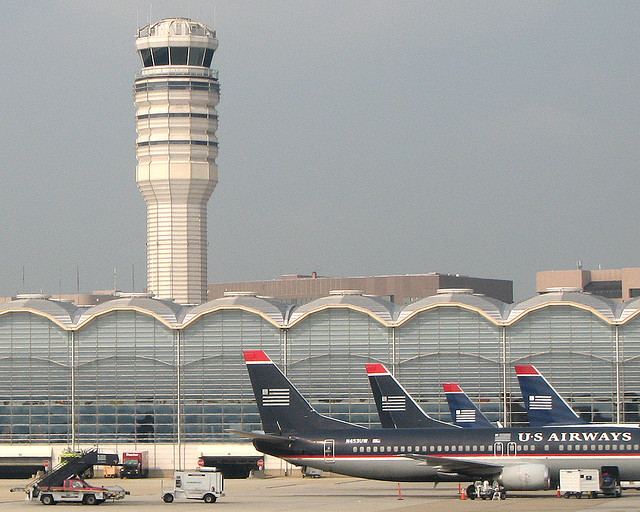
Air traffic controllers at Reagan Washington National Airport nearly caused a horrific midair accident when they accidentally cleared two departing planes to launch in the direct flight path of a third aircraft coming in for a landing, federal transportation officials said.
The near-disaster, which involved three commuter jets operated by U.S. Airways, was first reported by The Washington Post. About 2 p.m., with several planes lining up in the skies above Mount Vernon, Va. to land at National, air traffic controllers in nearby Warrenton ordered pilots to reroute their aircraft over Rosslyn, heading south along the Potomac River.
But when Warrenton relayed the order to the control tower at National, the message was not rebroadcast to everyone who needed to hear it, the Post reported. “The tower agreed, but they didn’t pass it on to all the people they needed to pass it on to,” a federal aviation official told the Post.
That included the inbound pilot, who was not aware he had to change his landing pattern. At the same time, the two other commuter jets had just left the ground. With a combined speed of 436 miles per hour between the inbound plane and the first of the outbound flights, the two aircraft were just 12 seconds from closing the 1.4-mile gap between them. The transcript between the control tower and the pilot of the inbound flight is harrowing:
“Are you with me?” the tower controller asked the inbound pilot, checking to see whether he was tuned to her radio frequency. When the pilot acknowledged her, she ordered him to make an abrupt turn to the south to avoid the other two planes.
“We were cleared [for landing] at the river there,” the pilot said after breaking off the approach northwest of the airport. “What happened?”
After a pause, the controller said, “Stand by, we’re trying to figure this out.”
As she directed him to make a loop around the airport for a second landing attempt the pilot cautioned: “We really don’t have enough fuel here for this. We have to get on the ground pretty quick.”
The federal official who spoke to the Post called the incident “a pretty big screw-up” for the nation’s 26th-busiest airport.
But this is far from the first time National has been troubled by air traffic control mishaps. Last year, multiple planes made landings without anyone present in the control tower, compelling airport officials to installing a second controller. Air traffic controllers at National and other airports were fired last year after being caught sleeping on the job.
More jarring, still, about the Post’s report is that although the number of flights is decreasing, the number of operational errors is on the rise. The Federal Aviation Administration recorded 1,234 errors in 2009; the following year, even though there were 1 million fewer flights, the FAA recorded 1,887.