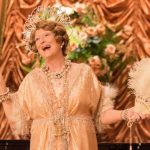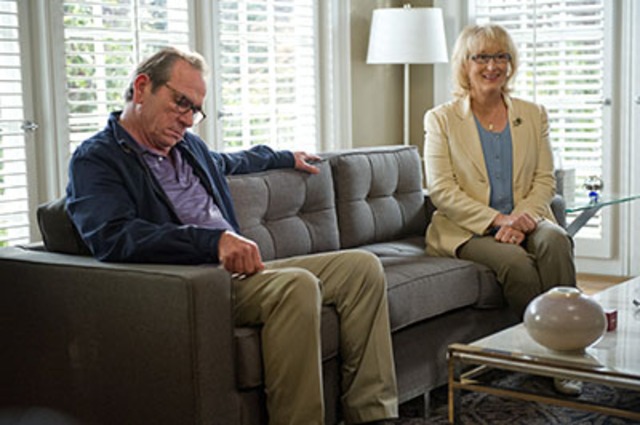
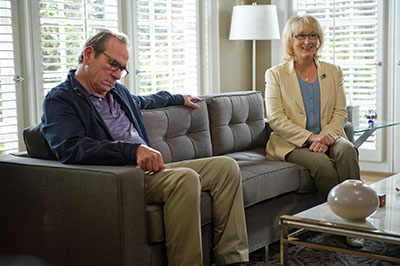
 Tommy Lee Jones and Meryl Streep (Barry Wetcher/Sony Pictures Entertainment)
Somewhere in Omaha, Kay (Meryl Streep) readies herself in front of a mirror. It’s a scene that might reference Persona or Boogie Nights, where characters look at themselves to prepare for a public appearance, but Kay’s audience may be the least receptive of all: her husband. Arnold (Tommy Lee Jones) sleeps in a separate room, his nose always buried in a Golf magazine with ads like “Hit it bubba long,” the club as a not so subtle sublimation of what we presume is Jones’s lost passion. Sadly, Kay doesn’t pass the audition. They’ve been married 31 years.
Routines are established. Kay makes bacon and eggs as a slump-shouldered Arnold carries his briefcase into the eat-in kitchen to silently read the paper. These are the motions of a marriage that has long lost it’s spark. Longing for the passionate marriage she once had, Kay visits the local Barnes and Noble, a comfortable reminder to the target generation and, well, to me – that brick and mortar stores still exist. The reassuring face of Dr. Feld (Steve Carrell) calls to her from the relationship aisle, and his book inspires Kay to tap her savings and book a week-long intensive couples therapy session in a little Maine resort town called Great Hope Springs.
Screenwriter Vanessa Taylor may just be in her 30s, and she told The New York Times that the characters were the age of her parents, who divorced before she was out of preschool. As such it’s a kind of fantasy of wrongs righted. If the screenplay is in some ways a wish fulfillment, it’s one that for the most part respects its characters. There is an uncomfortable humor to middle-aged fantasies of public sex, but these are also the human desires of a couple who may love each other but are afraid to express affection.
Jones and Streep play types: He is the cantankerous bean counter, she the neglected wife, but director David Frankel (who last directed Streep in The Devil Wears Prada) gives them room to build real people. It helps that Jones isn’t wearing five pounds of makeup, which in Men in Black III made him look like one of the aliens he hunted. Both actors make full use of their bodies, and their interplay is that of a couple people who are no longer at home in their own bodies.
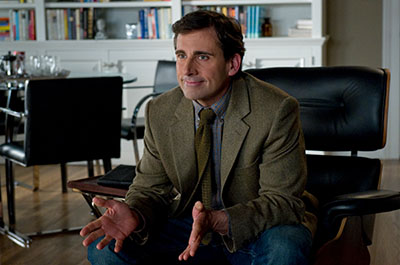 Steve Carrell (Barry Wetcher/Sony Pictures Entertainment)
The script treats its characters with respect. The relentless music is another matter entirely. The soundtrack —both Theodore Shapiro’s sentimental score and a Starbuck’s-appropriate collection of comfortable pop music—cheapens scenes that would have been far more effective without any music at all. Arnold suffers from fear of intimacy, and, ironically, so does the film. It’s afraid to let its accomplished actors do what they were hired to do: act. Kay recalls a tender moment, and this is punctuated by a polite piano score. A devastating montage of a marriage falling apart is marred by Annie Lennox gratuitously reminding audiences of the emotion that Streep and Jones are more than capable of conveying on their own. It’s patronizing to both the actors and the audience. Why hire actors at all? Why not just pull the personalities out and let the music do all the feeling for you?
Last week movie critic Roger Ebert tweeted a quote from Norma Hermann, wife of the great film composer Bernard: “it didn’t matter what was on the screen—his music would tell you what you were thinking deep down.” Hermann was a master at establishing a cinematic mood in music. Hermann’s score for DeNiro’s obsessive, psychotic break in Taxi Driver conveyed the brooding anger of the character but also the misguided romanticism that drove him. It’s what music for the movies does at its best. But too often we hear movie music at its worst. “Tell you what you were thinking” is exactly what James Newton Howard does with his obvious scores for Larry Crowne and Snow White and the Huntsman, and even art-house favorite Beasts of the Southern Wild doesn’t quite believe in its own triumph enough to let it stand without a swelling musical fanfare to remind audiences what to feel. Film music is just one part of the collaborative effort that makes a movie. It may not be enough to make or break a film. But it sure can damage it.
Hope Springs isn’t just a charming resort town in Maine or a metaphor for Tommy Lee Jones’s rejuvenated issue. It could have been an effective domestic drama for the sexagenarian set, and if there’s any chance of a DVD release that allows viewers to turn off the music, it would be a a moving two-hander. But leave it to Hollywood to take a pair of aging pros, pair them up with a more marketable younger actor (Carrell) and pepper it with great songs used for signposts as obvious as the Thomas Kinkade cottage that looks over the couple’s unused motel room bed. It sends a good message for serious relationships of any age: trust, openness, spice, commitment. But the movie itself does not trust its performers to convey the emotion that earns their keep.
—
Hope Springs
Directed by David Frankel
Written by Vanessa Taylor
With Meryl Streep, Tommy Lee Jones, and Steve Carrell.
Running time 100 minutes.
Rated PG-13 for mature thematic content involving sexuality