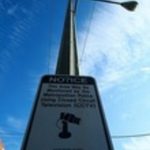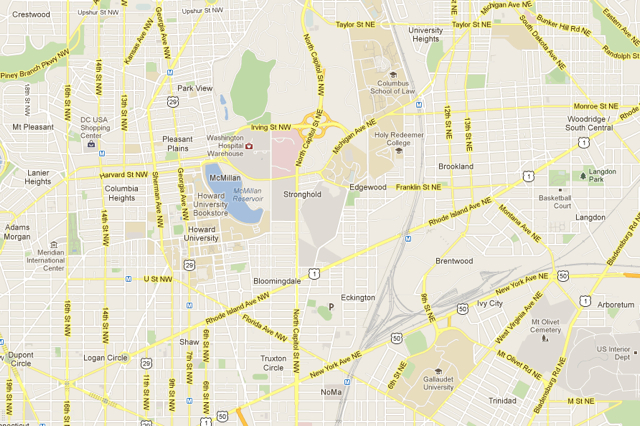
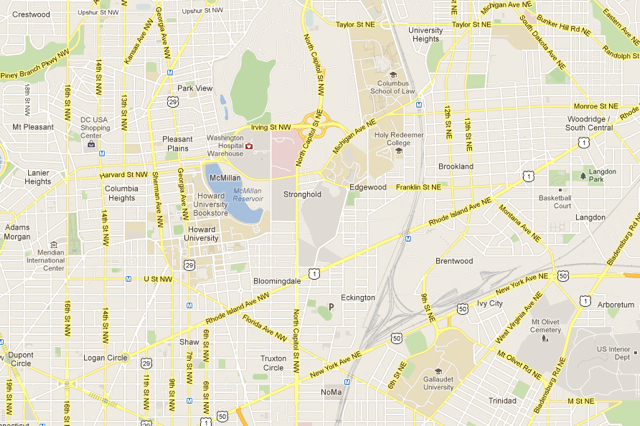
 As the District grows in both population and number of emerging neighborhoods, city authorities are faced with the demand to shift their resources. Perhaps no agency feels this pressure more than the Metropolitan Police Department, which needs to keep track of crime citywide, but is surely feeling the effects of surges in previously underpopulated pockets of town like NoMa, Bloomingdale and the H Street Corridor.
The Washington Post last week spoke with D.C. Police Chief Cathy Lanier, who says she is analyzing crime statistics in 14 “up-and-coming” neighborhoods to create predictive models tracking and hopefully preventing robberies, assaults and other crimes in these areas.
“Even a subtle change in a neighborhood can change crime,” Lanier told the Post.
And while overall crime has tended to drop in gentrifying neighborhoods, demographic changes haven’t meant the eradication of all crime. Rather, the types of crimes seen in these places have shifted, the Post reported:
Residents say they understand that revitalization doesn’t wipe out crime completely or for good. The prostitutes and corner boys who pushed crack are gone, neighborhood residents say, but there are other fears — robbers preying on patrons rendered vulnerable by alcohol and dangers associated with late-night crowds, for example.
“We traded one type of crime for another,” said Pia Forstrom, who is in her early 40s and nine years ago moved with her husband from San Diego to a townhouse just south of H Street.
As these neighborhoods become increasingly mixed between residential and commercial properties, especially the kind that attract middle- and upper-income denizens, people want to know they’ll be safe. Lanier told the post she is developing a plan to better police those neighborhoods, but it’s a five-year agenda.
Not everyone wants to wait for MPD, though. Caitlin Dewey, who lives in Ledroit Park read the Post’s article and decided to come up with her own survey of how safe her neighborhood and others feel. She built a Google questionnaire and is soliciting people’s takes on how comfortable they are walking around at night in places like Shaw, H Street, U Street NW, Columbia Heights, Fort Lincoln and others—14 neighborhoods in total.
Dewey is also asking basic, but important demographic questions too—age, race, income level, how long someone’s lived in D.C.—and hopes to create “heat maps” of each neighborhood that show how much security they appear to offer.
She’s hoping for at least 50 responses for each neighborhood. “I’m not a mathematician or a demographer or anything like that, so I’m not trying to take a statistically valid sample,” she says. “At the same time, I want to end up with a legitimate snapshot of how people feel about these neighborhoods. Obviously, more is better.”
As for her own digs, in Ledroit Park, Dewey says she feels fine walking around at night. “My parents hate it, but I’ve never had any problems,” she says. But she’s been there = about a year and is preparing to extend her lease.
But Dewey, 22, admits she’s only seen a bit of Ledroit Park’s and Shaw’s histories. Still, she’s cognizant of the perception of crime. “To me, at least, it seems like there have been more reports of shootings and muggings in the past six months than there were when I first moved,” she says. “But in reality, that’s not the case.”
Dewey’s survey is available through this link. She says she’s taking responses through the end of the week, and is hoping to have the maps ready by August 24.