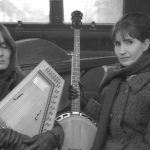
Emmylou Harris.
 Nowadays we have a label, Americana, for a sound that draws from the various streams of American roots music, including blues, bluegrass, country, rockabilly and rock n’ roll. The term didn’t exist in the late 1960s, when Emmylou Harris began her career. Nonetheless, she embodies the genre. The 12-time Grammy winner has taken home trophies in the Country and Contemporary Folk categories, but over the dozens of albums Harris has under her belt, her sound has gone much further.
Many people don’t realize that Harris’s distinguished career got its start in Washington, D.C. during the late 1960s and early ’70s. Her father was a military officer who settled the family in Woodbridge, Va. After graduating Gar-Field High School as class valedictorian, Harris went to the University of North Carolina for a short time before moving to New York to pursue a career as a folk singer. There she married, but unfortunately found herself the single parent of a young daughter. She moved back in with her parents, who by then had moved to Columbia, Md. With their support, she hit the trenches of D.C.’s club circuit, building a repertoire and performing as much as she could. Harris got her big break when she came to the attention of Gram Parsons, whose blend of country music with a laid back, West Coast sensibility would lay the foundations for the country-rock sound that became so popular in the ’70s.
Despite Parsons’ untimely death in 1973, Harris’s career flourished in that decade and into the ’80s. She had a number of singles and albums that topped the country charts, and also worked with the likes of Linda Ronstadt, Roy Orbison, Bob Dylan, Dolly Parton and a host of others. Harris’s music came to the attention of a whole new generation of fans in the 1990s. With Wrecking Ball (1995) and Red Dirt Girl (2000), her influences went far beyond her Alabama roots and mid-Atlantic upbringing. These recordings didn’t make many waves on the country charts, but Harris did attract younger fans, augmented by stints on Sarah McLachlan’s Lilith Fair tour, and through collaborations with Dave Matthews, Beck and Sheryl Crow.
Harris will be performing at Wolf Trap tomorrow, supporting her latest release, Hard Bargain. DCist took this opportunity to speak with Harris about what the District’s music scene was like during those early years.
How did you make your first forays into the D.C. club scene?
The Cellar Door was there, and because I’d played the Hootenannies there as a teenager—because my father had been stationed in Quantico, Va.—so I could come in and listen to the acts. One night after a show I met these two people, Bill and Taffy Danoff. I believed they had opened for the act, I’m not sure. They had a real following in the D.C. area, and they kind of took me under their wing, you know, and introduced me to club owners that hired local talent. And that’s kind of how I really got my start, from Bill and Taffy.
What were some of the clubs you played in, back in those days?
Well, there was Mr. Henry’s. Let’s see, there was The Assembly, down near the Capitol. Clyde’s was big, and then eventually after I got my little country band together, The Red Door in Bethesda. So, you know, it turns out that I’d work about six nights a week, for not much money, but enough to get by. I was young enough to think that I was doing okay, not thinking about the future so much. Of course, I never could’ve foreseen that I’d run into Gram Parsons in that club scene and eventually that would carry me over to a national stage.
So, were you playing predominantly country music at this time?
Well, actually, no. I was a folk singer and very purist. I would play Simon and Garfunkel and Bob Dylan—I was a huge fan of Dylan, Joan Baez and Judy Collins—and I’d play old folk-blues, that kind of thing. In fact, I was solo at first and then I got a bass player named Tom Guidera and a guitar player named Jerry Mule. We had a little trio, and I’d actually play country music almost as a joke because my brother has always been a huge country fan, way before it was cool. So I kind of was aware of country, but I suppose I should be embarrassed to say that I played it sort of tongue-in-cheek. I kind of threw it away, before I gained a real appreciation and understanding of it, and love of it, through my work with Gram.
These days, I don’t exactly think of D.C. as a folk music or country music sort of town, but was that the case back then?
It was considered, still, the bluegrass capital of the world because you had The Shamrock, which I never went to, to see the country shows, but my brother did. Of course, later on I hooked up with The Seldom Scene, who, even though they had national fame, they stayed local. They all had day jobs, and it was real eye-opening to see that you could have those two things in your life. You could have one kind of job and then you could play music just for the sheer love of it.
In D.C.’s music scene today, there’s a lot of cross-pollinating. You’ll see a hip-hop artist collaborate with a jazz band or a classical cellist play with a rock group. Was it the same way then, or was it more segregated?
I don’t know if segregated is the word I would use. There might have been more of that going on than I was aware of. The music that I was playing, even after I got inoculated with country, and to this day, would always come from a folk background. Very lyric oriented and story oriented. But it wasn’t like, “you could only play this in this club.” I think the clubs were open to any kind of music being played on any particular night. I mean it was really a fertile ground for music and a wonderful place for an artist to develop their own style and to develop a following because you didn’t have the pressure of being in a music business town. It was more pure, in a way.
Beyond the music scene, what was your perception of D.C. as a whole at that age, as a young person? What was the city like?
I loved it, probably because of the fact that it’s got so many colleges, so many people with different interests, who come with an open mind and an open heart. I remember when I was living over there near Dupont Circle, this wonderful little store opened up. I think it was the first hippie grocery, called The Stone Stoop. They catered to the college crowd but they also carried things for people in the surrounding neighborhoods. They were really open to all different cultures and all different tastes. I think there was, sort of, the best of the sixties, but people were getting down to the business of working, and going to school, and getting jobs, and raising families. But they still had that outlook of optimism that made you believe that good things were possible on a world stage. Obviously, I think music is a very important part of that.
Turning to the show, what can the audience expect from your concert at Wolf Trap?
I’m still doing material that goes all the way back to my first album, but obviously I have a new album that came out last year. We’re always putting more stuff into the soup. I have a wonderful band, called The Red Dirt Boys. The drummer is Bryan Owings, the keyboard player is Phil Madeira, Will Kimbrough is the guitarist and the bass player is Chris Donohue. And people might know Rickie Simpkins, he’s a fiddle superstar. He lives in Laurel, Maryland.
If there’s one story or experience that sums up your time in D.C., what would it be?
Oh, God, I don’t know. There are so many things and so many people that were important to me in those early days. I came to D.C. feeling a bit defeated. There’s not one particular story, but it brought back my faith in music. All the different artists who were playing their own kind of music and making a living at it without a record deal. The whole experience of being able to get out there and really make your living as a working musician without the trappings of the music industry, that’s an invaluable thing. It’s not about hype. It’s about getting people to actually listen—by persistence. I think it’s a skill that is priceless, really, and it serves you so well down road.
Emmylou Harris & The Red Dirt Boys perform with John Prine at Wolf Trap tomorrow. 7:30 p.m. $25-$45 + fees.