Martin Austermuhle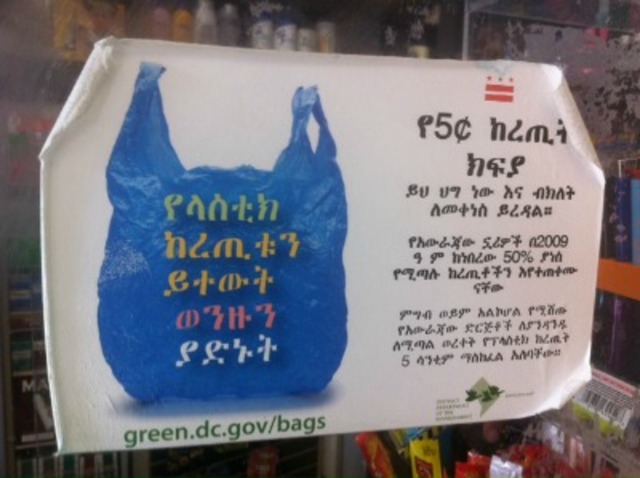
 A sign in Amharic explaining the five-cent D.C. bag fee.
D.C. is home to groups of residents hailing from at least 25 different countries that speak some 10 different languages. And though a 2004 law mandates that D.C. government agencies proactively work to offer documents and services in a number of languages, many non-English speakers remain unaware of their own rights.
This week, the D.C. Office of Human Rights has launched a public service campaign that seeks to inform residents that speak Amharic, Chinese, French, Korean, Spanish, or Vietnamese D.C. agencies have to provide interpretation services upon request. As part of the campaign—which includes eight videos in those respective languages—the office produced wallet-sized “I Speak” cards that residents can use to request an interpreter in their language.
“Our Language Access Program’s on-the-ground work with community advocates reveals the complications in accessing critical government services for those who speak limited or no English,” said Office of Human Rights Director Gustavo Velasquez in a statement. “The ‘I Speak’ cards aim to make the connection between constituent and District services easier, as well as encourage those not fluent in English to contact the D.C. Office of Human Rights when interpretation services or translated materials are not made available.”
In an April report titled “Access Denied: The Unfulfilled Promise of the D.C. Language Act,” the D.C. Language Access Coalition and American University’s Washington College of Law found that despite the progressive 2004 law, 58 percent of non-English speakers surveyed reported language-related difficulties at D.C. agencies. (Speakers of Vietnamese and Mandarin reported the most difficulties; Amharic speakers also had trouble.) Of those, 74 percent said interpretation services were not provided and 50 percent said that documents or signs in their language weren’t available.