Martin Austermuhle
 Photo from Shutterstock
It can be tough-going for many adults in D.C., but it’s the kids that are even worse off.
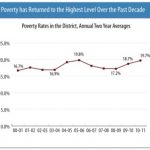
According to “Capital Kids,” a new report on the state of children throughout the Washington region, the childhood poverty rate in D.C.—those kids living in a family of four taking in just $22,000 a year—stands at 30.4 percent, higher than Mexico’s rate. The Washington suburbs as a whole stand at 14 percent, below the national average of 21.6 percent. Still, even there, trouble spots exist: childhood poverty jumped in both Montgomery County and Alexandria from 2005 to 2010. (The Post recently reported that family homelessness jumped 74 percent during the recession, and it similarly rose in the suburbs.)
The report attributes the jumps in poverty to a number of factors, including an increase in the number of households led by single mothers. According to the report, 35 percent of births in the region in 2010 were to single mothers; the income differential between single-parent homes and married couples is stark, $42,761 to $127,285. (The difference is most dramatic in D.C., standing at $22,934 for single mothers and $151,152 for married couples.)
On education, the report finds that in 2010 43,000 children between the ages of five and 19 were not enrolled in school. As percentages, Alexandria and Prince William County fared worst, at 9.8 and 9.6, respectively. Montgomery County stood third at 7.2 percent, and D.C. fourth at 7.1 percent. There are also 14,000 “opportunity youth” in the region—youth that are not in school or employed—the largest number in Alexandria.
In terms of the achievement gap, the report found that African American boys remain behind many of their peers:
On several key indicators, from the early elementary years through young adulthood, African-American males in the National Capital Region lag behind both their non-black peers and African-American females in ways that endanger futures and negatively impact future generations. As young boys, they are behind in reading and academic achievement. As young men, they are more likely to drop out of school, be incarcerated and be non-resident parents to their children.
The report also delves into immigration, showing how extensive it is in the region. According to the report, 41 percent of children under 18 in the region have a parent that was born abroad, and the majority of them live outside D.C. Within D.C., those children are most likely to live in ward 1, 2 and 4. In Arlington, Alexandria and Fairfax, one in five students is an English learner.
The report bills itself as the “first comprehensive look at the state of children and youth across the National Capital Region,” and says that regional solutions for the problems it raises need to formulated. “In an era of diminishing resources, investing in our children makes good sense and provides a strong return,” it says. “When our young people fail to reach their full potential, we all pay a price.”