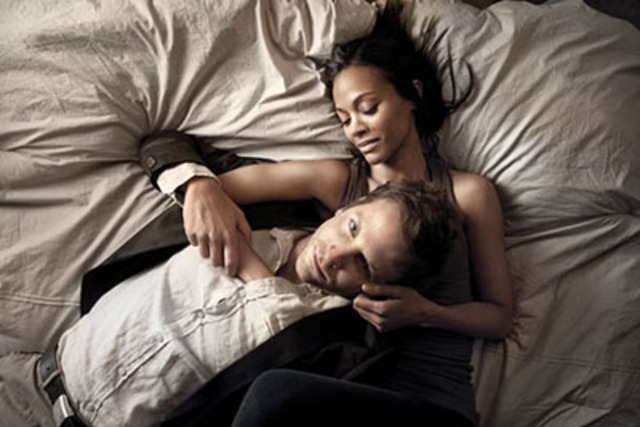
 Zoe Saldana and Bradley Cooper (Jonathan Wenk/CBS)
“He loved her. He loved New York. But at night, when the city was finally quiet, he wrote.” This trite prose is part of a novel called The Words in the movie of the same name, and the movie strains credibility by hiring out such lousy writing as the fount of a literary powerhouse. But credibility goes out the window in the movie’s first scene, when the actor who plays would-be-man of letters Clay Hammond opens his mouth: Dennis Quaid.
A literary melodrama that can’t get the literate part right should be doomed from the start, and The Words starts terribly. I spent the first half hour counting off clichés and rolling my eyes at the clumsy book design, the awkward camerawork, the banal TV-movie soundtrack. I can’t go so far as to borrow the novel-within-the-novel-within-the-movie’s prose and qualify this with, “yet, Colette thought Jack’s goofy dancing was perfect.” But there is a watchable melodrama buried in this blandly nested narrative.
Quaid’s reading, which we are to believe is a Major Literary Event, frames a story that starts out with little promise, but it gets better. Rory Jansen (Bradley Cooper, who is what I imagine Stephen Merritt would look like if he were a frat boy) is a struggling writer whose first manuscript is rejected. On a trip to Paris with his girlfriend Dora (Zoe Saldana), she buys him an old leather satchel in whose pockets he discovers a manuscript. He stays up all night mesmerized by it, and in order to immerse himself further in the words, he commits an act of literary ventriloquism and keys the entire manuscript into his laptop. Dora finds and reads the file, and taking it for bold new work by Rory, urges him to show it to his boss at the publishing house where he works. Riches await him, but so do conscience and consequences.
We all know what it’s like to find a book so good we lose track of time, and The Words wants desperately to convey that sense of being lost in the printed page. But what you see of the prose in the found manuscript makes Fifty Shades of Grey look like Finnegans Wake. When you catch the final lines, “It was the sweetest thing he had ever seen in his life,” you hope you’ve happened upon a vicious satire of the sorry state of literature. Alas! You’re supposed to take this seriously.
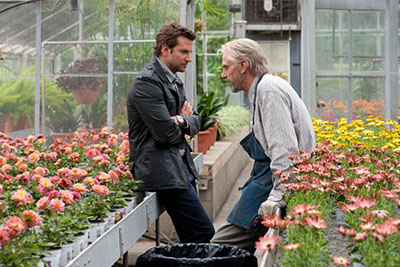 Bradley Cooper and Jeremy Irons (Jonathan Wenk/CBS)
The story within the story finally becomes compelling, thanks largely to a fine performance by Jeremy Irons as the never-named old man who stands in the rain outside the literary reading-within-the-literary-reading and finally confronts Rory with … well you can see what’s coming. Bradley Cooper is perpetually callow, but that works in the context of a movie where he’s a writer who has to find his voice through somebody else’s. But Irons’ wattle alone acts rings around the pretty-boy bankroll, a more impressive feat when you listen to his folksy lines and begin to suspect that they were really meant for Wilford Brimley.
Writer/directors Brian Klugman and Lee Sternthal previously worked on Tron: Legacy, but for all that movie’s flaws, its pulp vision was more credible than this attempt at serious drama. The Jeremy Irons’ subplot makes the central part of The Words watchable. But it’s not enough to carry the movie. The framing device with Dennis Quaid and his mysterious admirer (Olivia Wilde) is completely unnecessary, and tossing out all of those scenes would make this a better movie. But you still have the problem of a supposedly literary film based upon the fictional equivalent of vanilla pudding. If you can imagine Jeremy Irons writing lines about “goofy dancing,” then you can suspend the level of disbelief necessary for The Words to work. Most viewers would be better off reading a book.
—
Written and directed by Brian Klugman and Lee Sternthal
With Bradley Cooper, Zoe Saldana, Jeremy Irons, Dennis Quaid, Olivia Wilde.
Rated PG-13 for brief strong language, smoking and terrible writing.
Running time: 96 minutes
Opens today at The Avalon and area multiplexes.