Martin Austermuhle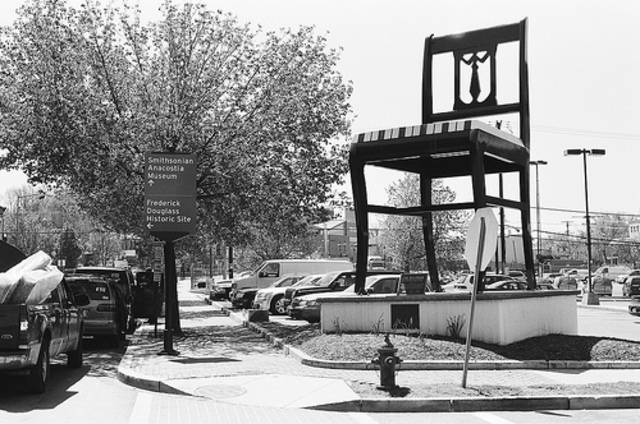
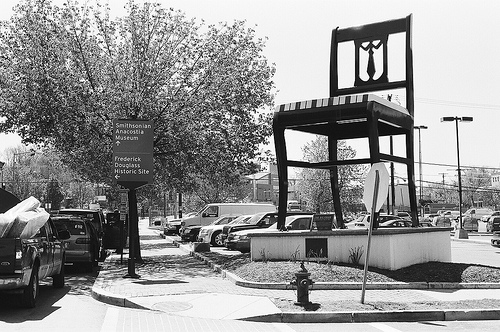 Anacostia’s Big Chair along MLK Avenue. Photo by sally henny penny
By DCist contributor Tracey Ross
A few weeks ago, I arrived in Anacostia to meet with Duane Gautier, CEO and President of Arch Development Corporation (ADC), to discuss the work his organization is doing to help revitalize the historic neighborhood.
Before arriving at his office, I found him at the intersection of Martin Luther King Jr. Avenue and Good Hope Road, talking to a French news crew that was touring the area. The news crew was interested in hearing about the crime often associated with Anacostia, but Gautier had nothing to report.
“There’s more crime in Georgetown,” he told me as we stepped into his office where his brown lab Ariel, a rescue, lay on his couch.
Gautier started ADC in 1983, branching off of a program Pepco initiated to train local residents to perform energy efficiency measures. In 2004, the organization shifted its focus to using arts, culture, and the creative economy as a means of revitalizing Anacostia. “The great thing about using arts and culture as a means of regenerating a neighborhood—it is compatible with almost any other sort of development,” he said.
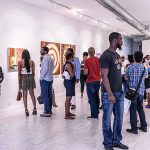
In 2007, ADC opened a contemporary art space called the Honfleur Gallery, current host to the Sixth Annual East of the River Exhibit, showcasing the work of artists with connections East of the Anacostia River. “We’ve been very careful and deliberate with the types of art galleries and artists we’ve brought in,” he said. This fall, ADC will also be hosting Anacostia Fotoweek, featuring local area photographers.
Other art venues ADC has created include Blank Space, a creative rental space, and the Gallery at Vivid Solutions, a photography and digital arts exhibition space. Organizations outside the area are finding creative ways to celebrate Anacostia as well, as seen through the recent summer program at the Building Museum, “Investigating Where We Live: Connecting With Anacostia,” where teens explored the neighborhood’s built environment through creative expression.
While Gautier is working hard to turn Anacostia into an arts destination, he understands the concerns that gentrification causes. Still, he believes Anacostia is prepared for these changes. With lots of vacant, single-family homes in the area, there is a need for people willing to purchase and invest in the properties. Further, there seems to be consensus among community members and business owners that developing the area will be positive.
“We have sort of an advantage here over U Street etc., in that we actually have a community,” he said. And ADC works closely with the community in their strategic planning process, and strives to be “more of a catalyst than the be all and end all.”
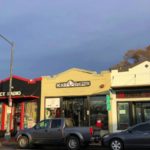
It was community members, through River East Emergent Leaders, who requested that ADC provide shared office space for businesses, leading to the creation of The Hive, the first business incubator east of the river, with private office space filling up in only three weeks. In addition, ADC started the Eat, Shop, Live Anacostia (ESLA) campaign that works on expanding the business of existing merchants, in addition to attracting new ones. Currently, the ESLA website features Grubbs, a new pharmacy and mini-mart as well as American Shottas, which boasts having “the Largest Go-Go Archive in the city.”
While ADC is working to promote local businesses, some issues are out of their hands. Recently, the Uniontown Bar & Grill, one of the few restaurants in the area, was shut down after the owner, Natasha Dasher, pleaded guilty to possession with intent to distribute cocaine and a charge of conspiracy, and was evicted from the restaurant location for back rent.
Despite the closing of a business many hoped would attract more people to the area, ADC’s strategy to make Anacostia an arts and culture destination seems to be working—the H Street Playhouse recently relocated to the area, and the Lumen8 Anacostia Festival attracted a reported 3,500 people, more than double what was expected. This growth is occurring at a time when plans for a streetcar in the area are underway, with tracks already laid down. Additionally, rumors of a fifth Busboys and Poets location abound, with Anacostia—and even the old Uniontown space—being pointed to as serious possibilities. Just this week a group of residents launched the “We Are Anacostia” campaign, seeking to attract businesses and artists to the neighborhood.
In the next three years, Gautier hopes to see five to six more art venues in the area, a couple restaurants, and a major business incubator. And he plans to engage the community along the way. While ADC staff want to focus on the arts, the community expressed a desire for more businesses. As a result, attracting merchants has become the number one priority in ADC’s strategic plan.
When I asked Gautier what he would tell someone who has misperceptions of the neighborhood, he replied, “Come here once, and see what we’re about, and you’ll come back.”