 By Contributor Luis Velarde
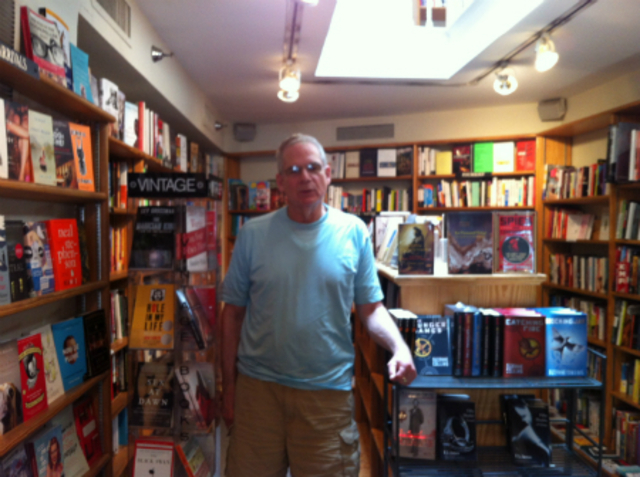
Philip Levy says he has had his “head in the sand” for following the same business formula for the past 32 years.
The independent bookstore owner from the Georgetown neighborhood is convinced that by selling books, and only hard copies, his focus has been on what “he knows how to do best.” And that is, sell books.
As more independent booksellers around the country and in Washington diversify their businesses to offer in-store cafes, e-books to book-printing machines, Levy thinks his approach is probably what has kept Bridge Street Bookstore, 2814 Pennsylvania Avenue NW, opened since June 27, 1980, even when a Goliath competitor, Barnes and Nobles, moved not too far away on M Street. The huge-chain bookstore closed at the end of 2011.
The Four Seasons Hotel, embassies and two universities nearby also played a role in the store’s success.
“They’re [Four Seasons] very important to our business”, Levy says. “We have the kind of bookstore that an international business clientele seems to agree with. We are a bookstore that appreciates humanities.”
Levy chatted with us after finishing his exercise routine to talk about what it takes to be an entrepreneur, a bookstore owner, as well as how to be confident, something he says is fundamental in retail.
Hometown: Georgetown, Washington, D.C.
When did you know you wanted to be around books?
You can say I’m a failed writer. In 1973, before coming back from England with my father, we had driven to Oxford because I wanted to see Blackwell’s… maybe the best bookstore in the English language. While I was in heaven plumbing the depths of Blackwell’s, [my father] gave me the strong impression of how much I love books.
How did you get into the book business?
[One of my brothers said] ‘I got a building to build in which they’re going to build a hotel next door. Why don’t you start a bookstore?’ At the time the last I wanted to do is have a business. I wanted to save the world. Make my footprint. But if we were going to go into business I didn’t think of a better thing to do than a bookstore.
What did you learn as an entrepreneur?
If you show any weakness customers will know.
How?
I learned how to be definite even if I wasn’t always correct. I learned that you better act like you know what you’re doing and deal with results. Even if you had the right answer and they weren’t convinced you had right answer, you didn’t get respect. It was good to learn self-confidence.
Did you always know you were going to be successful?
I had no idea whether I succeed. I was naïve enough and had a little bit of a safety net in a way with him [his father]. I didn’t think of making a lot of money. I wanted to create a good bookstore.
Why did you decide to only sell hard copy books?
In the mid-60s one of the best bookstores in downtown was on F Street. I walked in and I said ‘what happened?’ The whole front of the bookstore had things you would fill your library with and books were put in the back. So I always said ‘I’m going to have a bookstore that only focuses on books.’
And e-books?
Call security!
Come on!
Our customer base is maybe 50 years and older. We get a 10 percent of college students, the ones who still have a true love for books.
What is most satisfying aspect of being a bookstore owner?
Being around books and interacting with customers who come from all over the world.
Parting thoughts?
I feel like we’re an overnight success after 32 years.