Martin Austermuhle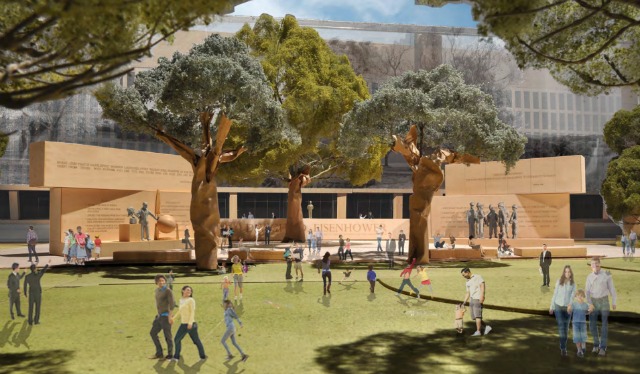
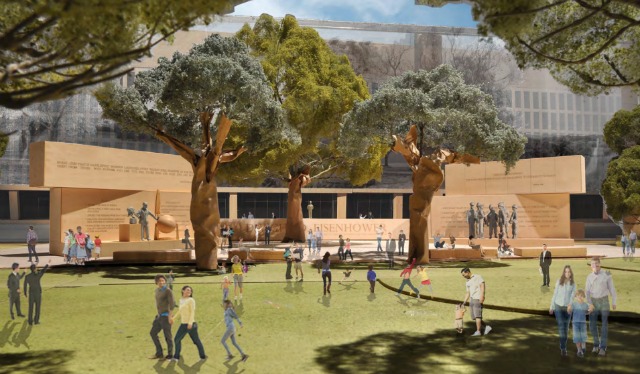 A rendering of what the Eisenhower Memorial will look like from the ground level, with the 80-foot-tall metal tapestries rising behind and around it.
The Eisenhower Memorial will remain mired in a bureaucratic no-mans land for at least another month, it seems.
Late last week the National Capital Planning Commission—which has to give the go-ahead for the memorial to be built—announced that it would not review the proposed Frank Gehry design for the memorial at its October meeting, and instead posted the 256-page-long design proposal on its website for the public to see. (The Commission of Fine Arts also has yet to approve the design.) This is the second such delay with the NCPC; in June, the Eisenhower Memorial Commission announced that it was pulling its proposal from the agency’s agenda so that Interior Secretary Ken Salazar could review models of Gehry’s design.
Gehry’s design has provoked strident opposition from Eisenhower’s family, some members of Congress and traditional-minded architects, forcing Salazar to intervene. According to Blake Androff, Salazar’s press secretary, Salazar “believes it is important to build a national memorial that appropriately honors the legacy of President Eisenhower and reflects the shared vision of his family, the Commission, and the American people.”
“As the Secretary has said, it is important to move forward as quickly as possible, but our priority must be to get it right. We will continue to work with the Eisenhower family, the Commission and the National Park Service toward a plan that everyone can be proud of and that will stand the test of time,” Androff said.
The main sticking point seems to be the 80-foot-tall metal tapestries that Gehry wants to use to frame the four-acre memorial site. Susan Eisenhower, the 34th president’s granddaughter, has likened them to totalitarian art, and other have expressed concerns over whether they will withstand the test of time.
In his design proposal, Gehry calls the stainless steel-woven tapestries a “unique method of memorialization” that will feature a “landscape of the Kansas plains.” The proposal also includes tests that were done on the cables that would be used for the tapestries, which found that a greenish hue could develop on some of them over time if not properly maintained.
Still, renderings in the proposal show just how imposing the tapestries will be: they will be almost as tall as the Department of Education that will stand behind one of them, and tower above the rest of the memorial.
In a statement, Right By Ike spokesman Sam Roche attributed the NCPC’s delay to the controversy over the tapestries. “This decision is a blow to the Eisenhower Memorial Commission’s effort to force through its controversial design and highlights just how experimental the proposed eighty-foot-tall hanging metal screens are. Clearly the NCPC is taking its responsibility seriously to certify the memorial’s durability and sustainability, as the law requires,” he said.
The memorial is set to cost $112 $142 million to design and construct, and it is slated to open to the public on Memorial Day 2015.