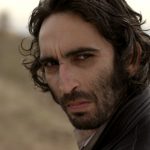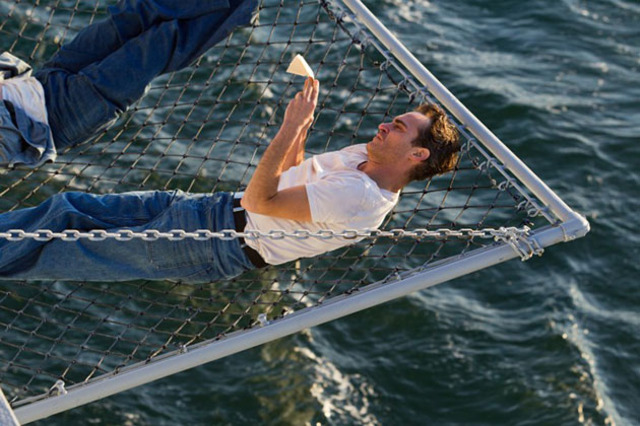
 Joaquin Phoenix (The Weinstein Company)
From the moment production was announced, director Paul Thomas Anderson’s The Master has been known as a project about Scientology. Those elements are there, but it’s is not simply about any specific movement. The film is critical of cults, but is at the same time more ambivalent about the power they wield. The title of the film suggests a power that can be applied to filmmaking itself, and how the stories we tell bring us together and wield power and influence over others, audiences and loved ones alike.
A fish-eye lens and light flares provide the visual distortions that open up Anderson’s latest study of a dysfunctional family. Our dysfunctions and distortions are part of what make us human, and part of what makes us vulnerable to personalities and cults like that of Lancaster Dodd (Philip Seymour Hoffman), a thinly veiled L. Ron Hubbard.
We meet Freddy Quell (Joaquin Phoenix) as he is literally at sea, a sailor on the way home from war. Freddy is figuratively at sea throughout the film, and the sense of being on watery, uncertain ground pervades the film even when it goes to the desert. Water and sand call to Freddy again and again. On shore leave, his fellow sailors sculpt a naked woman out of sand, and he is so taken by the figure that he fingers the sculpture’s grainy sex. The sand sculpture is a kind of earth goddess, her grains of sand a metaphor for film grain, a texture that is becoming more elusive. Freddy’s response to this symbol of fertility and, perhaps, cinema, is animalistic, but is this something to be tamed? After pleasuring himself into the sea, Freddy cuddles with the sand woman, her shape appealing but without a soul. This lost, wild soul is the vessel through which The Master finds his disciple.
Freddy’s civilian calling, at least initially, is as a department store portrait photographer. Thanks to cinematographer Mihai Malaimare Jr., the visions of mid-century America as seen through this fictional portraiture are among the most lush images in the film. Poised behind a Speed Graphic, Freddy flirts with a woman in another department, and seems to do all right until a confrontational encounter with a customer whom he intimidates with hot lights as a director might vex an uncooperative actor. An episode as a farm worker gets him into trouble that sets him running for his life. It is after running away that he spies from the docks a party on a ship. It’s dusk, and he can see people dancing as the ship hovers under a bridge. When he wakes from a drunken stupor, a woman tells him, “You’re safe – you’re at sea.”
Freddy has a drinking problem, and a lot of what he drinks is literally poison: gasoline, paint thinner, photographic chemicals, Lysol, anything with alcohol. He concocts original drinks from whatever liquid is handy, and this gift for alchemical potions endears him to the ship’s commander, Lancaster Dodd.
As passengers listen to tapes of Dodd declaring that “man is an animal,” Quell writes a note to a woman across the table. “Do you want to fuck?” Sex moves Quell from the beginning to the end of the movie, but in the middle, within his new-found surrogate family, is a bromance.
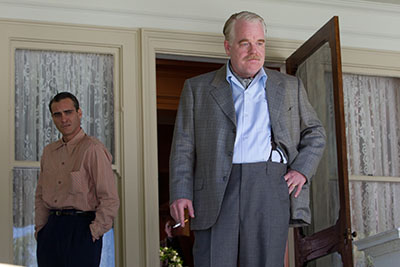 Joaquin Phoenix and Philip Seymour Hoffman (The Weinstein Company)
The Master is about power, and with this theme comes another: creation. The titular mastery doesn’t just refer to man’s search for leaders — be they religious or political — but to man’s urge to tell their stories. The Master is about filmmaking itself. The “processing” of recruits to The Cause feels a lot like a demanding director coaxing a performance from his actors, as much as Freddy directed his portrait subjects. Hoffman is himself a director, and as the film plays out it is as if Anderson is directing Hoffman (as Dodd) to wring one heartbreaking scene after another out of Freddy/Phoenix. The movie-going audience is like a gathering of cult members rapt before the master manipulator. To emphasize this, one processing session is played before a group of Cause members as if they are a stage audience, and the scene closes with a shot that deliberately reveals its artifice.
In an interview with a military psychologist, the image of Quell goes in and out of focus as he talks about nostalgia. One eye is in shadow. This is one of many ways The Master recalls Anderson’s film Punch Drunk Love, which often painted Adam Sandler with a Rembrandt-like light that illuminated part of his character and face while leaving others in darkness. Anderson’s dysfunctional family dynamics have been at play in every one of his films. Like in Boogie Nights, where a lost boy finds a surrogate family in the porn industry, Quell finds a dominant figure in Dodd. And his reaction to the skeptics that raise their concerns about Dodd and The Cause are like Sandler’s reactions to anyone who hurts Emily Watson in Punch-Drunk Love: a protective rage, sudden and out of control.
Anderson veteran Phillip Seymour Hoffman takes the apparent title role, but Joaquin Phoenix is the shoo-in for an Oscar. He’s the only person who could have played Quell, the actor’s very face reflecting his fractured self. He spends the whole film hunched over, curled like an animal, in a performance that must have been terrible for his back. That combination of goofy vulnerability and incendiary rage makes him the love child I’ve always wanted Adam Sandler and Klaus Kinski to have. Is Freddy himself a Master? Even as he apes the lines of his mentor, he’s directing his life. He’s the only one who can master that.
Anderson filmed The Master in the all but obsolete high-resolution 70mm format. In its heyday, the format was most often used for epic entertainments like Lawrence of Arabia, to which The Master pays direct homage. Anderson’s film is epic in scope but also intimate, told in loving close-ups whose high resolution, like the processing to which Dodd subjects his followers, reveals the great scope and detail of its characters. The Cause may be a fiction, but like the visual tricks of the filmmaker, it uses the devices of the trade to search for the truth.
The AFI Silver is one of the handful of venues in the US that will be showing Anderson’s film in 70mm. The preview screening was a digital presentation that was impressive enough, but I can’t wait to see it again the way it was meant to be presented.
—
Written and directed by Paul Thomas Anderson
With Joaquin Phoenix, Philip Seymour Hoffman, Amy Adams.
Rated R for sexual content, graphic nudity and language
Opens today at the AFI Silver (in 35mm and 70mm prints), Angelika Fairfax (35mm and digital presentation), Landmark E Street Cinema and Bethesda Row and AMC Loews Georgetown (digital presentation).