Martin Austermuhle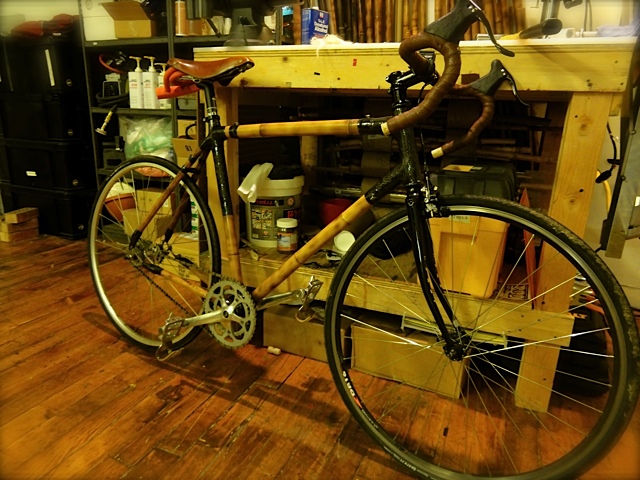
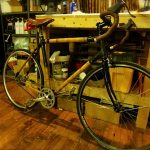
When Philip Ankney worked in a bike shop in Columbia, Md., he often yearned to join the shop’s weekend group rides. But there was a basic problem—he didn’t have a bike. So Ankney, 29, did what any enterprising—or desperate—cyclist might do: he built one for himself. But instead of opting for the carbon bikes that are preferred by roadies for their low weight and high stiffness or steel bikes that are often liked by messengers for their durability and timeless appeal, Ankney chose a material that few people might associate with bicycles: bamboo.
That was a few years ago, and that bike has since been stolen. Now, though, Ankney has launched District Bamboo Bikes, a small bamboo bike-building startup that he funded with a $6,600 Kickstarter campaign and runs out of a shared space on Upshur Street in Petworth.
The former Marine has joined a niche but growing national market for bamboo bikes, many of which are produced by small frame-builders like himself. And in an unexpected twist of fate for a town that has no commercial bike builders at all, he’s not the only one pursuing the idea locally.
David Wendt also builds bamboo bikes out of a studio at First and O Streets NW under the trade name Three Penny Bikes, while Matthew Wilkins works with George Washington University classmates Chris Deschenes and Jon Torrey on bamboo bikes through their startup, Pedal Forward. Though they all use different techniques and have different aspirations, each of them came to the material the same way—through necessity and curiosity.
Just as Ankney needed a bike, Wendt, who now works for an international NGO but formerly worked on construction projects on Broadway, had toyed around with the idea of building a bike and was inspired to try carbon when he saw legendary frame-builder and bamboo bike pioneer Craig Calfee’s designs. Wilkins studied engineering, and only after stacking the different materials against each other and considering the ease of working with them did he settle on bamboo.
“I was thinking what to build it out of, and I could build it out of steel because they taught me in school how to weld. But it’s heavy, it’s boring and everyone has steel bikes. And then I was thinking alumminum, but it’s really difficult to weld aluminum. I’m not that good at it. Titanium is way too expensive. And then I went to Google and saw that people made bikes out of bamboo,” he explained last week.
Beyond the novelty of the idea, Wilkins was attracted by the ease of getting the materials for the bike that he eventually built—he got it from the backyard of his parents’ home in New York. Wendt started with bamboo out of a garden shop, and now sources it from Virginia. Ankney, who spent part of the summer in Maine working with the Bamboo Bike Studio, gets it from the Yucatan Peninsula in Mexico.
And despite what any skeptics might think, all three sing the praises of bamboo as a material for building bikes. “In terms of durability, most solid bamboo will never break. In terms of weathering the elements, it’s probably going to last as long as a steel bike,” said Wendt, who took a hammer to a reed of bamboo while he spoke to prove his point. Ankney pointed out that bamboo has more tensile strength than steel, and said that it’s “very crash-resistant [and] very strong.” His Mexican bamboo is known as iron bamboo, while Wendt’s Virginia varietal is known as stone bamboo.
All three ride their bamboo bikes around town, proving through experience that bamboo bikes can survive the world of urban commuting. “I haven’t gotten a lot of skeptics, since I ride it around,” said Wilkins. “I’m not a big guy, but if people see someone riding on it and not dying,” he added before trailing off, the point made.
Ankney, Wendt and Wilkins say that bamboo bikes offer advantages to the novice builder not only because the material is plentiful, cheap and easy to work with, but also because the styles and techniques are still developing. All three treat the bamboo differently, using a variety of techniques to dry and finish the material. (Wendt flame-treats his, while Wilkins bakes it.) And each swears by their own means of holding the bamboo tubes together—Ankney and Wilkins prefer hemp fiber for wrapping the bike’s joints, while Wendt lays sheets of carbon fiber on his.
“It’s a lot of arts and crafts techniques that you pull together. Everyone has to develop their own technique, and you experiment and learn. All the different builders have different styles. You just have to find something that works for you,” said Wendt.
Bamboo may offer a low barrier of entry for budding frame builders, but the industry is still in its infancy—in 2010, between 500 and 1,000 bamboo bikes were sold in the U.S., a tiny fraction of the estimated 20 million bikes sold each year—and making a full-time job of it remains a struggle. Wendt admits that to remain and excel in the custom market, a builder would have to produce 50 bikes a year and charge at least $4,000 a piece for them, far out of many people’s price range. (He did make a full bike for $250 that was auctioned off by the Washington Area Bicyclists Association, though.) For now, he’s keeping to his day job, and hopes to make five bamboo bikes a year.
Ankney will likely remain small-scale for the time being too, building custom bikes to order and holding weekend sessions one a month where cyclists can build their own frames. He’d eventually like to own his own shop—he started building bikes in his bedroom—and partner with a non-profit organization to create a “socially charged business.” “It’d be nice to do more than just build bikes,” he said.
Wilkins is thinking bigger—with financing from venture capitalists, he and his two partners want to shift production abroad and be able to produce bikes for $50 and sell them for $300. And as part of a broader social mission that won Wilkins and his two partners an award from the Clinton Global Initiative earlier this year, their plan is to mimic the model adopted by Toms Shoes—for every bike sold, they’ll donate one to a developing country. Ambitious as it may be, they’re hoping to start production in 2014.
Even though Wendt doesn’t see himself pursuing his adopted craft on a full-time basis for the time being, he thinks that D.C.—which has seen something of a bicycling renaissance in recent years—is a great place to build custom bamboo bikes.
“I think D.C. is an ideal place because people have money and they spend it and a lot of people bike here,” he said.