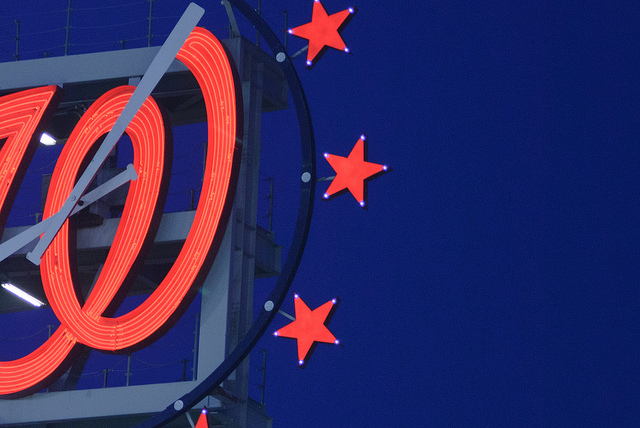
 Photo by MudflapDC
Metro announced this afternoon that neither the Nationals nor D.C. were going to pay for late-night service after the coming playoff games, but instead LivingSocial would cover the $29,500 hourly cost. With the announcement, fans can rest easy knowing that they’ll be able to get home after playoff games.
The fight over who would cover the cost of keeping Metro open late started in August, when fans were left stranded after a 13-inning game against the Atlanta Braves. With the prospect of a playoff berth and the late-starting games that come with it, both D.C. and the Nats said that they wouldn’t front the money for the service; D.C. claimed that other team owners took that upon themselves, while Nats officials said that they were concerned with setting a league-wide precedent.
Despite the excitement over the Nats reaching the playoffs for the first time since 1933, someone was going to have to pay eventually, or Nationals fans could have been dealt the letdown of being stranded outside the stadium after the postseason games. “This is a policy that applies to everyone,” said Metro General Manager Richard Sarles on the payment for late-night service.
Speaking after a press conference, LivingSocial CEO Tim O’Shaughnessy said that he had heard complaints from people worried about being stranded after late games. “I knew it was something people were having frustrations around,” he said. Additionally, paying for the late-night service “felt like the right thing to do” and kept in line with the company’s main function. “Our brand is all about letting people have great experiences in their cities,” O’Shaughnessy said.
Under the terms of the arrangement announced today, LivingSocial will make a deposit of $29,500 for each hour of additional Metro service. For each rider who boards at Navy Yard-Ballpark, Metro will credit LivingSocial back $2.68 (the cost of an average ride), multiplied by two to reflect a round trip. LivingSocial will get a refund of up to $29,500 per hour—it’ll take roughly 5,500 riders to get there—but not more. The arrangement affects service between Sunday and Thursday; Metro stays open until 3 a.m. on Friday and Saturday nights.
Councilmember Muriel Bowser (D-Ward 4), who sits on Metro’s Board of Directors, was happy to have LivingSocial along for the ride. “We can do a lot when we work in partnership with the private sector,” she told us. In a press release, Virginia Gov. Bob McDonnell also celebrated the announcement. “The vision, civic-mindedness and generosity shown by Living Social is a model of the kind of partnerships between government and the private sector to find innovative solutions for the good of our communities that we need more of,” he said.
D.C. recently gave LivingSocial a $32.5 million tax break, saying that the online coupon company was making D.C. a hub for tech companies and producing new jobs for residents. Still, the resolution was negotiated directly between LivingSocial and Metro over the course of the last day; neither Mayor Vince Gray nor Councilmember Jack Evans (D-Ward 2) were said to be in on the resolution, nor were Governor Martin O’Malley or McDonnell.
Aside from a possible avalanche of civic adoration, LivingSocial is not getting anything in return for its sudden generosity. O’Shaughnessy said there won’t be any special playoff packages in his company’s daily offerings, nor would Metro be labeled as being sponsored by LivingSocial. He won’t be getting tickets in return, but he said he’ll try to make it to as many games as he can.
Gregory McCarthy, the Nationals’ Vice President of Government and Municipal Affairs, told us that the team was always looking for a multilateral solution. “We always thought that the best solution has multiple partners,” he said. But in the end, the dilemma over how Metro would get Nats fans full of playoff fever home from Navy Yard was solved by a single payer.