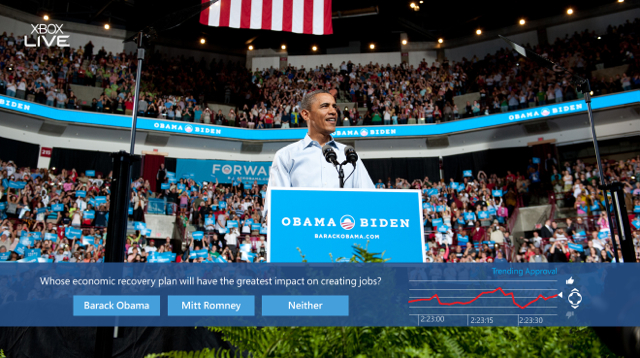
 An Xbox Live poll during a speech by President Obama. (Microsoft)
Presidential campaigns never stop dissecting the latest polling data, always in search of the next wedge issue, affinity group or swing district to help their candidate gain an edge. And while the average campaign flunky for President Obama or Mitt Romney could give you a heady rundown of which group is leaning which way, there’s a new polling mechanism out there, and it could be sitting right in your living room.
This election, Microsoft is getting in the polling business using Xbox Live, its subscription service for owners of its video-game consoles. During the summer, the computing giant introduced political coverage into the service, which reaches about 60 percent of Xbox owners, by offering live video streams of both major-party conventions.
At the same time, Microsoft also developed its own in-house polling model that delivers questions to Xbox Live users browsing the Election 2012 channel. By queuing up the vertical, gamers can weigh in on the issues that factor most in the election with a few taps of the controller. It’s a far cry from the unwanted phone call from some persnickety questioner sitting in some distant phone bank.
But with such a captive audience, Microsoft felt a “civic duty to engage” its Xbox Live subscribers, says Jose Pinero, a spokesman for the company’s interactive entertainment division.
The polling questions don’t just come on a welcome page, though. Microsoft is also experimenting with queries that pop up while a political event is in progress as a way to gauge real-time responses. And that’s what will happen Wednesday, when Xbox Live joins the broadcast networks and cable news channels as a broadcaster of the first debate between Obama and Romney.
Essentially, Microsoft is aiming to turn its Xbox subscribers into the nation’s largest political focus group without sequestering anyone in a drab room with a feedback dial or subjecting anyone to the obnoxious din of MSNBC and Fox News. On Wednesday, as Obama and Romney take Jim Lehrer’s questions on domestic policy, people watching the debate through their Xboxes will be presented with opportunities to react.
The survey is being overseen by David Rothschild, a Microsoft researcher who is working with the polling firm YouGov, which specializes in polling models that don’t rely on the random-dial methods in place since the 1930s. And among Xbox users, both Obama and Romney have the potential to gain a fair deal of ground.
Microsoft commissioned a poll over late June and early July to measure its audience. As of July 3, 40 percent of Xbox Live subscribers who are registered to vote had not yet committed to a presidential candidate. Sixty-one percent said they were favorable toward an interactive debate model.
During a meeting at Microsoft’s office in downtown Washington, Rothschild showed off his real-time polling model using a clip of former President Bill Clinton’s address to the Democratic National Convention. A light-blue bar slid on screen, with the question, “What does Bill Clinton bring to the Obama campaign?” A majority of responses leaned toward “economic credibility.” Clinton’s appearance at the convention was to serve as a validator for Obama’s domestic policies.
The July poll also revealed a few other baseline facts about Xbox users. Most would like to see federal income taxes increased on people making more than $250,000 a year. But it’s in the daily questions that Rothschild’s model makes its big findings. The latest Xbox tracking poll, for lack of a better term, gives Obama a 51 percent to 38 percent lead over Romney, with eight percent selecting “other” and two percent choosing “not sure.” Users can vote only once per day, one of several measures taken to ensure the poll’s integrity.
Monday’s questionnaire was focused on the federal budget. Users were asked about taxes on high-income earners, funding for Medicare and Social Security and the importance of paying down the national debt. That last question was the least in dispute, with 88 percent saying it was very important the United States reduces its federal debt.
Of course, Xbox users don’t exactly look like the rest of America, to borrow a tired political phrase. Two-thirds of gamers are male and 80 percent are over 25 years old, but Rothschild still sees many opportunities for valuable statistical discoveries from that cohort.
“We do have an oversampling of younger males,” he says. “But those are the hardest people for pollsters to get on the phone and we have them in spades.”
As the Xbox polling continues toward Election Day, Rothschild says he and YouGov are building a database of tens of thousands of users who volunteer their political preferences to their video-game consoles. Rothschild also says he is building a “panel” of about 10,000 or so users who will be the standard for which the results are analyzed.
“We’ll report on demographics we have good samples for,” he says. “Maybe we don’t have a lot of power for 65-and-up women. Even if there is an imbalance, the panel helps.”
And as the debates begin, Rothschild also expects an evening out of gamers’ political opinions, as debates tend to draw audiences that are more bipartisan than the ones who tune into party conventions. “During the conventions, everyone liked the guy on the screen,” he says. “During the debates we expect a reasonable split.”
That goes for questions on everything from tax policy to foreign relations to which candidate users would most like to play Xbox with. (Fifty-five percent say they’d prefer to dig into Madden NFL ’13 with Obama, 30 would rather blast away baddies on Call of Duty with Romney.)
As for the novelty of watching a presidential debate on an Xbox, Pinero says it’s just the next logical step for the product, which he says is becoming less of a button-mashing divertissement and more of a versatile entertainment system. With content providers like Netflix, Hulu, Facebook and Google, Pinero says online usage for entertainment has surpassed that for gaming.
Branching into politics, then, just continues the trend.
“We think this will be the first interactive presidential debate,” he says. “It’s the future of TV, and the future of polling.”
But like a good politician, Microsoft still knows its base: Users who watch three of the four debates over their game consoles will be rewarded with gold-plated armor from the Halo series to deck out their Xbox Live avatars. Conveniently, Halo 4 will be released November 6.