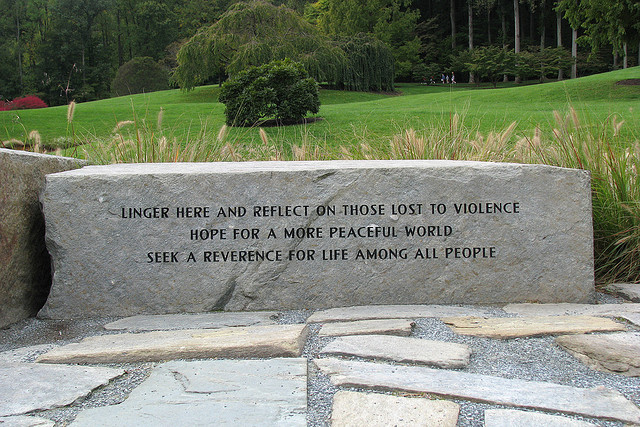
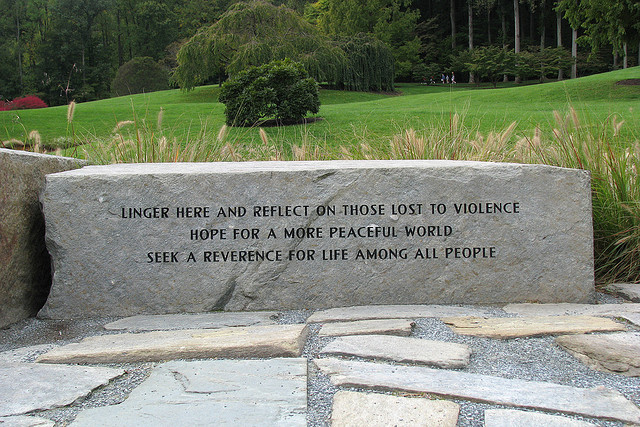
 A memorial to the victims of the Capital Beltway snipers in Wheaton, Md. (Photo by Dan Dan the Binary Man)
Ten years ago today, gunshots blasted through the window of a craft store in Aspen Hill, Md. The bullet came from a sniper rifle poking out of a nearby car. An hour later, another shot in the parking lot of a Shoppers Food Warehouse supermarket in Wheaton struck down 55-year-old James Martin.
For the next three weeks, the D.C. area was gripped in fear of being John Allen Muhammed’s and Lee Boyd Malvo’s next target, as they circled the Beltway firing off bullets at randomly targeted victims. When they were finally arrested on October 24, 10 people were dead and three more were wounded.
Muhammed was executed in 2009; Malvo, now 27 years old, remains in prison for the rest of his life. In a jailhouse interview published Sunday by The Washington Post, Malvo said he was a “monster” during that bloody month.
“If you look up the definition, that’s what a monster is. I was a ghoul. I was a thief. I stole people’s lives. I did someone else’s bidding just because they said so. . . . There is no rhyme or reason or sense.”
For the journalists who covered Muhammed’s and Malvo’s shooting spree, the events were just as harrowing. Of course, not all the coverage was above-boards. For The New York Times, the shootings eventually became a source of great embarrassment when reporter Jayson Blair’s articles were revealed to have been mostly fabricated.
But of reporters who covered the story accurately, The Washington Post’s Crime Scene blog offers some memories today. Bill O’Leary, a Post photographer, lived dangerously close to where the snipers planned their attacks:
After they were apprehended, I learned that the shooters had been using the YMCA in my neighborhood, Silver Spring, literally blocks from my house, throughout their murderous spree. They were right under my nose for almost the whole time
Dorothy Abernathy, who was the AP bureau chief in Richmond, says her daughter was afraid to go to school while the snipers were still on the loose:
“I still remember how uneasy she was about going to school that first day back. My mother wanted me to pack up the kids and go to Ohio until the snipers were caught.”
DCist wasn’t around in 2002, but the Capital Beltway sniper attacks quickly became one of the first stories commanding round-the-clock coverage for a nation still rattled by the events of 9/11 a year earlier. People like Charles Ramsey, then the chief of the Metropolitan Police Department, became household names. College students from the D.C. area fretted about the well-being of their loved ones.
If you lived in the Washington area when Malvo and Muhammed went on their shooting spree, feel free to leave your memories of that time in the comments below.