 Photo by Jeff Chin
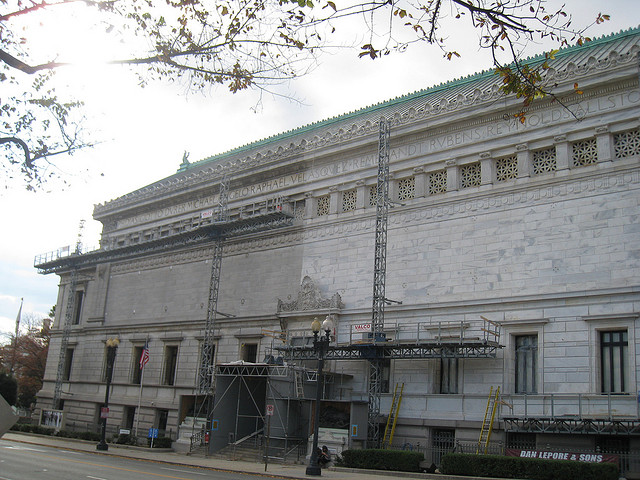
Relocating the Corcoran Gallery of Art from its longtime home on 17th Street and New York Avenue NW, as the museum’s board of trustees is strongly contemplating, wouldn’t just rip a cultural treasure from the heart of downtown Washington. It would also violate District law, according to a letter published yesterday by an organization seeking to block the move.
Save the Corcoran, which was launched after the Corcoran board’s announcement that it is weighing a possible move out of the 115-year-old Beaux-Arts building that has been its home since 1897, argues that moving the Corcoran outside Washington—Alexandria has been mentioned as a potential destination—would violate the museum’s charter. In the deed for the museum, William W. Corcoran stipulated that he wished to create “an institution in Washington City.” And, as nonprofit organizations’ charters fall under the purview of the D.C. Attorney General, any violation of the Corcoran’s founding document would be subject to the oversight of Irv Nathan.
The letter was authored by Andrew Tulumello, a partner at the law firm Gibson Dunn & Crutcher. In it, Tulumello asserts that WIlliam W. Corcoran’s desires were very clear and non-negotiable.
“The Corcoran’s deed is unequivocal,” the letter reads. “It requires the Corcoran to remain ‘an institution in Washington City.’ ” In 1869, when the Corcoran was founded, Washington City was bounded by the Anacostia and Potomac Rivers to the south and Florida Avenue to the north. By that argument, even a move to Georgetown or upper Northwest D.C. would be verboten.
Furthermore, Save the Corcoran is also calling for a shift in the museum’s leadership. The group charges that director Fred Bollerer and board chairman Harry F. Hopper III have been rudderless for months, with too much money and staff time spent on researching a potential move instead of development and preservation of the museum’s current home.
“Incredibly, we understand that the Corcoran has turned away potential donors because the Corcoran lacked a strategic plan and could not guarantee how the funds would be used,” Tulumello writes. Meanwhile, there have been large payments to Bollerer’s former consulting firm, Gibson Dunn’s investigation concluded.
“We reject all false and unfair accusations about the Corcoran and its trustees, officers and staff,” a Corcoran spokeswoman told The Washington Post.
Save the Corcoran is asking for two key remedies: First, that the Corcoran stop investigating a potential move that would take it away from its prized location across the street from the White House. Second, noting that four of the 18 seats on the Corcoran’s board are empty, the group is demanding that three of the vacancies are filled with candidates that meet Save the Corcoran’s choosing. The group would like to pick “experts” in management, fundraising and art.
“Only by engaging in such a partnership does the Corcoran have any hope of surviving this crisis,” the letter concludes.