Roy Lichtenstein Drowning Girl, 1963 oil and Magna on canvas overall: 171.6 x 169.5 cm (67 9/16 x 66 3/4 in.) The Museum of Modern Art, New York, Philip Johnson Fund (by exchange) and Gift of Mr. and Mrs. Bagley Wright, 1971 © Estate of Roy Lichtenstein
By DCist contributor Julia Langley
In 1964, Life Magazine published a story featuring Roy Lichtenstein under the headline, “Is He the Worst Artist in the U.S.?” Critics championing abstract expressionism found Lichtenstein’s appropriation of advertising and comic book images boring and banal. But walking through the National Gallery of Art’s comprehensive retrospective of Lichtenstein’s work, it’s hard to imagine anyone ever looking on his art with anything less than admiration.
Roy Lichtenstein: A Retrospective, opens Sunday at the National Gallery of Art, and is the first major retrospective of Lichtenstein’s work since his death in 1997. The exhibit brings together more than 100 of his paintings from all periods in his long career, and opens with Lichtenstein’s first major pop art painting, Look Mickey, which was given to the gallery by Lichtenstein and his wife, Dorothy. Based on an image from a children’s book, this is Lichtenstien’s first painting without a trace of abstract expressionism. From then on, comics and advertisements were central to a large body of his work. Lichtenstein culled his characters from them, plucking them out of their original contexts and purging them of content.
In Drowning Girl, Lichtenstein presents a heroine who would rather surrender to the ocean then call for help. The painting focuses in on her head, shoulder and hand, which are barely above the water. Her eyes are closed and she is crying. The painting elicits so many questions: What happened? Why is she stranded in the water? Why won’t she call Brad? Who is Brad? The viewer is left with more questions then answers.
From the original comic book used to create this image, Lichtenstein cropped both the image of the girl and her story. From it we learn that Brad is the girl’s boyfriend and the boat they were on capsized. The drowning girl has a cramp in her leg. But still, why doesn’t she ask for help? As with many of the paintings in Lichtenstein’s Romance series, the heroine is shown in a suspended state of distress. The lines of the sea swirling around the waves of her blue hair create a whirlpool effect, taking the viewers around the painting, even as its tangible flatness keep them from entering the heroine’s world.
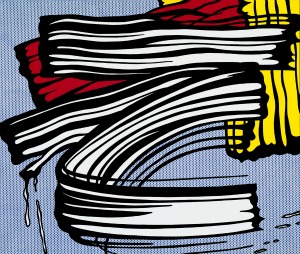 Roy Lichtenstein Little Big Painting, 1965 oil and Magna on canvas overall: 172.7 x 203.2 cm (68 x 80 in.) Whitney Museum of American Art, New York, Purchase, with Funds from the Friends of the Whitney Museum of American Art © Estate of Roy Lichtenstein
Lichtenstein’s work invites us in and stops us cold. He exaggerates and amplifies, only to reject all narrative in exchange for the purity of line, shape, form and color. Aloof and exacting, his art dismisses the hot drama of abstract expressionism and replaces it with cool, calculated intellect.
This can be seen in Little Big Painting, where Lichtenstein takes on the idea of the grand gesture in abstract expressionist art. Instead of forcefully sweeping his brush across the canvas a la Willem de Kooning, Lichtenstein carefully crafts an image of a gesture. Lying on a field of Benday dots, Lichtenstein’s brush strokes are purposefully false. They are reproductions of brush strokes, complete with non-accidental drips. This meticulous simulation allows Lichtenstein not only to capture a symbol of machismo from painters past—it also domesticates that symbol and renders it empty. This is the hallmark of Lichtenstein’s work. His success is found in the absence of content.
Roy Lichtenstein: A Retrospective opens at the National Gallery of Art Sunday October 14. The Gallery is located on the National Mall between 3rd and 7th Streets at Constitution Avenue NW and is open Monday through Saturday from 10:00 a.m. to 5:00 p.m. and Sunday from 11:00 a.m. to 6:00 p.m.