Martin Austermuhle
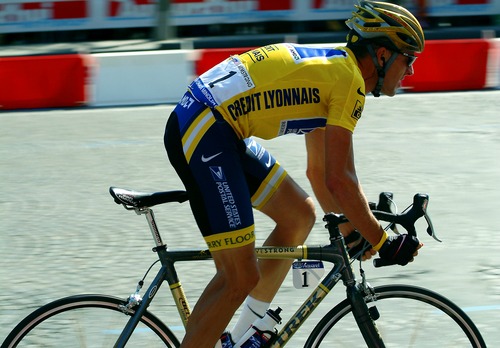 Image from Shutterstock
Lance Armstrong’s fall from grace has been as fast as the climbing he’d do during the Tour de France’s iconic Alpine stages.
While over recent weeks he steadfastly denied that the he had doped at all, this week he resigned his chairmanship of Livestrong and was dropped by a gaggle of sponsors, including Nike, Radio Shack, Anheuser-Busch and bicycle manufacturer Trek. Armstrong’s empire, to a certain extent, has come crumbling down.
Locally, though, the impact has been muted. Jakob Wolf-Barnett, chief operating officer for Revolution Cycles, the largest Trek dealer in the region, said that many new local cyclists don’t see Armstrong the way they may have when he won seven consecutive Tour de France titles.
“This is disappointing for a lot of people—they know who Lance is—but especially in our area there are so many folks who are transportation cyclists, who are just getting into racing. Lance Armstrong, they know who he is but he won’t be a pivotal figure in motivating them,” he said.
Trek and other Armstrong sponsors like Giro and Oakley have used his image less and less in recent years, said Wolf-Barnett, creating enough distance between themselves and the troubled cycling superstar. “At the retail level…I think it’s been a while since Lance has had an impact,” he said, adding that Revolution Cycles hasn’t displayed Armstrong memorabilia—including a signed yellow jersey—in a while.
For Steve Beheler, a manager at Spokes in Alexandria, Lance’s impact on the cycling industry as a whole has been undeniable, but his downfall hasn’t affected the store’s bottom line. “Most of that clientele,” he said, referring to amateur competitive cyclists, “they’ve already formed an opinion. As for new riders, he said. many of them don’t share the same association to Armstrong. “It doesn’t affect business.”
How about all the Livestrong-branded clothing? A manager at the Georgetown Running Store said that they had not yet decided what to do with what they have on hand. “I don’t know what our plan is to do will that the apparel,” he said. Livestrong might survive as a brand, though—in its statement, Nike said that it would keep working with the cancer-fighting foundation. Of course, the question remains if Livestrong will be able to create enough distance between itself and the man who founded the organization and whose story continues to inspire it.
As for Radio Shack, which joined the Armstrong brand somewhat recently, the transition to a post-Armstrong world won’t be hard—an assistant manager at the Columbia Heights store said that it had been months since posters bearing his likeness were used.
Disclosure: In late 2004 and early 2005 I worked as a salesperson at Revolution Cycles in Clarendon.