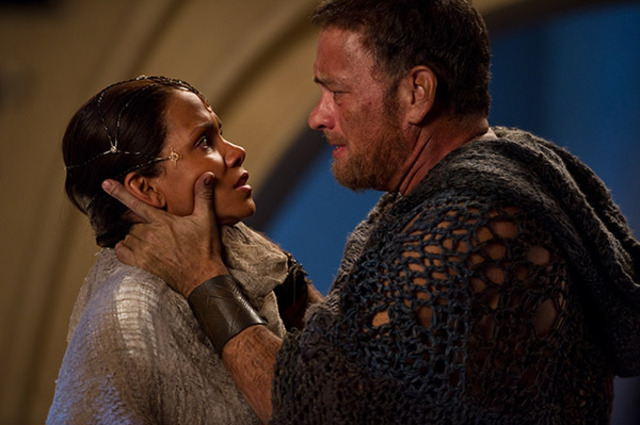
 Halle Berry and Tom Hanks (Jay Maidment/Warner Bros. Pictures)
 Futuristic rebels. An adventure at sea. Forbidden love. Book publishing intrigue. A journalistic mystery. These are the kinds of plot lines that fuel any American multiplex, if perhaps an art-house minded one. But what happens when you stitch all those plot lines together into one ambitious, three-hour piece of entertainment? Do you get challenging, profound ideas that transcend ordinary narrative? Or something as conventional as its parts?
Cloud Atlas, both the “unfilmable” novel by David Mitchell and the adaptation by the Wachowskis and Tom Tywker, means to dazzle the audience with its brilliance. The filmmakers took as their models the disciplined ambiguity of 2001: A Space Odyssey and the strange adventure and rich language of Moby Dick. But while Cloud Atlas — both book and movie — can be entertaining, they work in ways that are more conventional than those claims of “challenging” and “unfilmable” would have you believe. It would ordinarily be grossly unfair to compare any movie or novel to the work of Stanley Kubrick or Herman Melville, but the principals here ask for it: Cloud Atlas isn’t even in the same hemisphere.
Mitchell’s highly regarded book begins with an act of literary ventriloquism. The author begins his novel with a 19th century adventure written as a diary that substitutes Melville’s rhythmic prose for a lot of affectations. If anything, the movie smooths out the literary mannerisms. The stilted dialogue of Dr. Henry Goose plays better when read by actors, and this even goes for the patois Mitchell invented for the post-apocalyptic adventures of Zachry.
Both Dr. Goose and Zachry are played by Tom Hanks. The Wachowskis hit upon the idea of having actors play multiple roles across the time-hurdling narrative threads. The idea of eternal recurrence is a clever narrative strategy (and reminds me of the multiple roles played by actors in Lindsay Anderson superior epic, O Lucky Man!), and it’s not done without a sense of humor. I won’t spoil Tom Hanks’ funniest bit, but let’s just say it’s funnier because he’s not entirely convincing.
It’s all part of our interconnectedness, you see, that the same actor can not only play different people across time, but people of different genders, sexual orientations, and even ethnic groups. That we contain multitudes is a noble and time-honored sentiment, but in Cloud Atlas it can come off as forced, especially in a futuristic New Seoul where actor Jim Sturgess and Hugo Weaving play what some are calling “yellowface” roles. (To be fair, the race-bending goes both ways: Halle Berry plays, not very convincingly, a white 1930s woman, and Donna Bae an even less convincing 19th century one.)
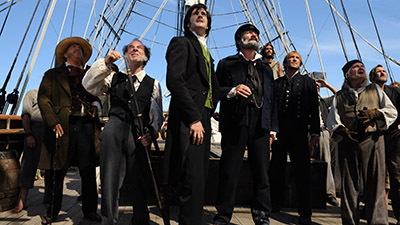 Tom Hanks, Jim Sturgess, and Jim Broadbent (Jay Maidment/Warner Brothers Pictures)
That said, the frequent cutting from plot line to plot line keeps the movie moving along briskly enough. You hardly have time to lose patience with its affectations. But eventually the awkward, sentimental underbelly of this high-profile picture reveals itself: “My uncle was a scientist, but he believed that love was real.” Considering its potential for art house pretentiousness, it’s kind of an accomplishment that it took nearly two and a half hours before I rolled my eyes at Cloud Atlas. Mitchell’s interweaving stories are combined with great attention to recurring themes — of imprisonment and escape; aspirational heights and depths both real and metaphorical; human interconnectedness. The transitions between the eras portrayed bring this home in some clever ways, but too often the movie does the work for the audience. One of the movies Cloud Atlas has been compared to is Inception, and while the screenwriters thankfully spared us an Ellen Page-like character to verbally explain each scenes as it happens, the film is often edited in a way that amounts to a visual laundry list of its themes, as if Page herself was at the editing deck.
The plot arcs to which these threads all lead amounts to familiar tropes of love and redemption. There are plenty of inspirational moments ready for audiences to applaud the way they would at any other multiplex offering. What’s more, the nested narratives make it possible to program those applause-ready moments one right after the other as each plot line nears its crescendo. There’s no reason the movie-going public can’t have its art and applaud it too. But Cloud Atlas plays not so much like a layered work of art but a cleverly stitched collage of typical multiplex fare. It’s the most crowd-pleasing unfilmable novel ever made.
—
Cloud Atlas
Directed by Tom Tykwer, Andy Wachowski, and Lana Wachowski.
Written for the screen by Tom Tykwer, Andy Wachowski, and Lana Wachowski, based on the novel by David Mitchell.
With Tom Hanks, Halle Berry, Jim Broadbent, Hugo Weaving, Jim Sturgess, Donna Bae, Ben Whishaw, and Keith David.
Rated R for violence, language, sexuality/nudity, some drug use, and bad makeup.
Running time: 172 minutes.
Opens today at a multiplex near you.