Written by contributor Julia Langley
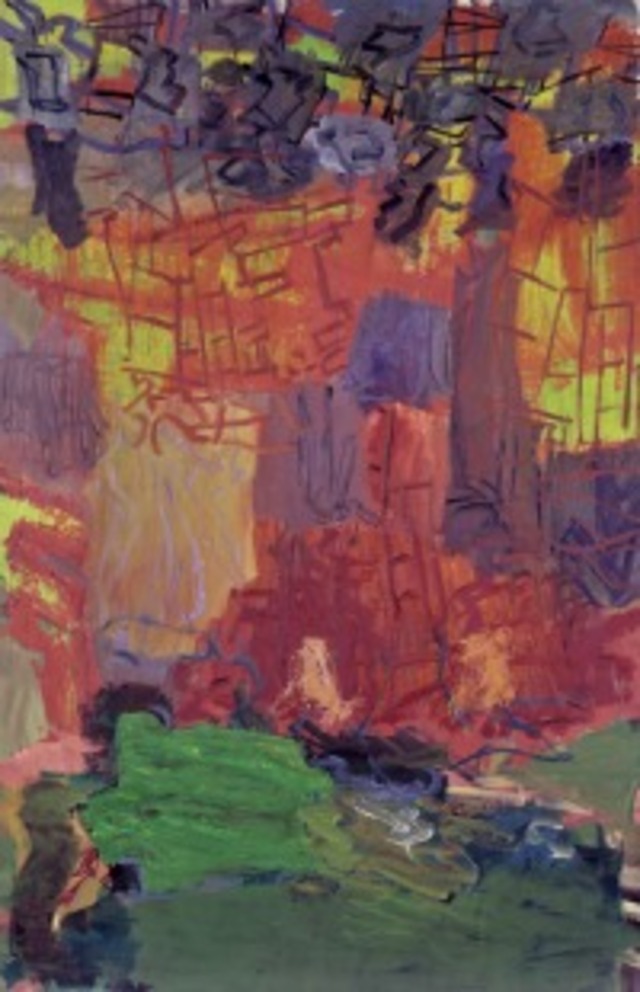
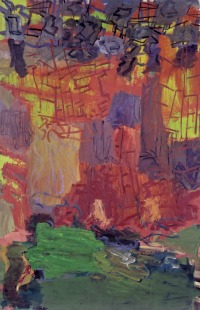 Per Kirkeby, Inferno V, 1992. Oil on canvas, 78 3/4 x 51 1/4 in. The Phillips Collection, Washington, D.C. Gift of Gifford and Joann Phillips, 2009.
Per Kirkeby is a multi-dimensional artist. In addition to being a painter and sculptor he is a set designer, filmmaker, writer, poet and geologist. Seeing the exhibition Per Kirkeby: Paintings and Sculpture now on view at The Phillips Collection, it becomes clear why Kirkeby is considered a national treasure in his homeland of Scandinavia. Billed as the “most comprehensive display” of the artist’s work in the U.S. to date, the 26 paintings and 11 bronze sculptures present you with a solid sense of the evolution and complexity of Kirkeby’s work.
Born in 1938 in Copenhagen, Kirkeby studied arctic geology at the University of Copenhagen and traveled on expeditions to Greenland and South America before enrolling in Copenhagen’s newly created Experimental Art School in 1962. Eschewing tradition, Kirkeby learned about new movements in art such as pop art, minimalism and fluxus, as well as new mediums for creating art including film and performance. He never abandoned his love of geology, however, and this is evident in the works exhibited at The Phillips Collection.
Kirkeby’s canvases are accumulations of paint and gesture that speak to time and its earthly attendants, growth and decay. Scratches, drips, and glops of paint interrupt layer upon layer of brushstrokes. There is order, but there is chaos, as well. Man and nature, light and dark, permanence and the ephemeral coexist in Kirkeby’s paintings, forever locked in tense opposition. Inferno V draws the eyes upward, from a green base of organic matter to a blackening structure consumed by heat. Colors are obscured and revealed as creation and destruction play in the painting. A quote from Kirkeby on a wall reads, “Everything is collapsing and transforming deep inside the picture”.
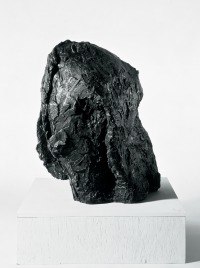 IPer Kirkeby, Large Head, 1984. Bronze, 38 1/8 x 36 5/8 x 27 1/8 in. Courtesy Michael Werner Gallery, New York,
 London, and Berlin.
But where is “deep inside the picture?” It isn’t the traditional depth art historians speak of when discussing perspective. You can’t trip lightly into an illusion of space in Kirkeby’s painting and imagine standing in a renaissance piazza. To understand what is deep inside Kirkeby’s work is to get down and dirty – digging, scraping and yanking paint aside to reveal multiple levels of color and line put down in bursts of energy like passing storms.
Energy abounds. Kirkeby’s bronze sculptures, reminiscent of the works of French 19th century artist, Auguste Rodin, reveal the same tensions alive in his paintings, but without the variations of color. Working in plaster instead of clay, Kirkeby first has to work slowly and patiently while the plaster is wet, then swiftly and forcefully when it begins to harden. The plaster form is then cast in bronze. The feeling of the artist’s hands at work is everywhere. It’s easy to imagine him working quickly to build a form – pushing and pulling, pinching and caressing, scraping, scratching until time runs out and the plaster has dried. The resulting sculptures, like Large Head are expressionistic, but free of narrative. Large Head appears to be a relic from another time, like a precious antiquity, but its origin and meaning can’t be placed.
It’s impossible to look at Kirkeby’s work and not think of time, energy and impermanence. In the end, all the many layers of paint and plaster painstakingly agglomerated by Kirkeby lead right back to yourself. Questions appear in the mind: Where are we in the cycle of time and what will become of us? Kirkeby’s art is a reminder that the world is both more complex and more basic than we can comprehend in our day-to-day lives. There is, and always will be change. Creation and destruction are nature’s twins. In Kirkeby’s art they become sublime.
Per Kirkeby: Paintings and Sculpture is on view now at The Phillips Collection through January 6, 2013. The museum is located at 1600 21st St NW and is open Tuesday through Saturday from 10 a.m. to 5 p.m., with extended hours on Thursdays until 8:30 p.m., and Sunday from 11 a.m. to 6 p.m. Admission is $12, students and seniors; $10.