Martin Austermuhle
 At 8 p.m., polls in D.C. will close. Once everyone has finished voting, precinct captains and election workers will oversee a multi-step process that ends in all of us finding out who won.
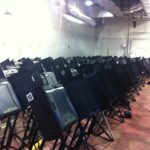
At the precincts themselves, poll workers will start tallying up how many votes were cast and who they went to. Receipts will be printed out from optical scanners and electronic voting machines, and they will be presented to the public. (The receipts are usually hung outside the polling place.)
Once that’s done, they’ll download the results from all the machines onto portable media devices, which will then be packed into bags with printed receipts of the results and prepped to be sent down to the D.C. Board of Elections in Judiciary Square. How does that happen? As simply as you’d imagine—they’re driven down.
All the while, election staff and observers will be in the elections board’s office. Once drivers start arriving from around the city, the bags from each individual polling place is brought up, where the media devices are plugged into computers and the results downloaded. Those results are then uploaded to the board’s website.
So when can results be expected? Well, that’s a tough one. During the mayoral contest of 2010, final results weren’t posted until the wee hours. During this year’s primary, though, most results were uploaded by 9:30 p.m. Unless something goes horribly wrong with the board’s software—it happened in 2008 and 2010—the timing of the results really boils down to how fast those drivers can get from polling places to the board’s offices. If there’s traffic, well, it might take a little longer. As for early votes—and there’s roughly 52,000 of them this time—those get factored into the mix towards the end of the tallying of normal ballots.
That’s not the end of it, though. If a vote is really close, like the April primary fight between Councilmember Vincent Orange (D-At Large) and Sekou Biddle was, the board has 10 days to count all absentee, provisional and curbside ballots. If the end result is a difference between two candidates of less than one percent, then a recount happens automatically. If it’s more than that, the loser can request a recount—but they’d have to pay for it. Once that’s all said and done, the board gathers and certifies the election, which usually happens some two weeks after Election Day.
So, what does this mean? Mostly that we could get really lucky and have the final results pretty early on, or we could be in for another epic night of waiting around.