 “Did I ever tell you the one about …” (DreamWorks)
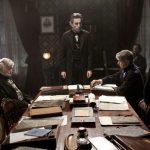
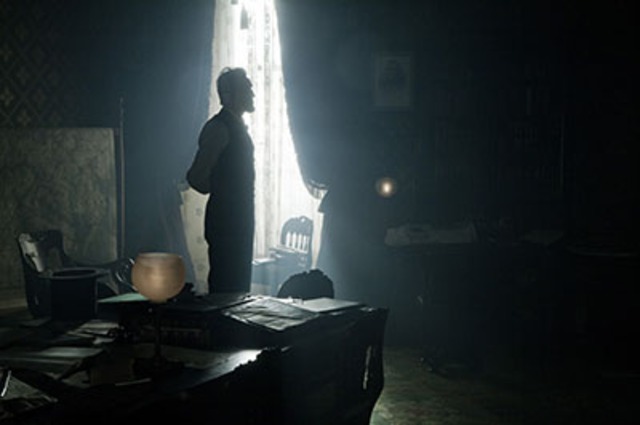
“No! He’s going to tell another story!” A distraught character in Steven Spielberg’s Lincoln cries out as the avuncular emancipator draws back his folksy bow to aim a mildly ribald anecdote at the heart of America. Daniel Day-Lewis is guaranteed to earn an Oscar nomination for his immersion into the character of the 16th president, which is as meticulously crafted as an Italian shoe. But Tony Kushner’s script feeds him so many folksy tales and asides about the sands of time, and scatters expositional asides throughout the movie’s other historical figures, that it feels like any other movie where you know what’s going to happen: safe.
If you want your dead presidents to confirm beliefs you already hold true, you’ll love this Lincoln. But honestly, Spielberg’s epic is a less challenging picture, shedding less insight into a complex character, than the one that imagined a young Lincoln fighting a different kind of evil.
Based on Doris Kearns Goodwin’s 2005 book Team of Rivals, Lincoln is not a complete portrait of a life, but focuses on the political machinations that led to the passing of the 13th Amendment, which ended slavery. With D.W. Griffith’s heyday long since passed, there are unlikely to be any viewers who take issue with the amendment, and if anything Kushner’s script and Spielberg’s direction find that the days that led up to this defining and inspiring piece of legislation was just politics as usual, set in Machiavellian motion for a cause we can all agree with.
Helpfully, Kushner sprinkles this historical pageant with asides that foreshadow the present. Legislators suggest that if slaves were to be treated as our equals, that would surely lead to intermarriage, and, heaven forfend, would women have the vote next? It’s the kind of looking backward that drives me crazy in Mad Men, as from our relatively comfortable perch today we look back on what those before us thought, and pat ourselves on the back in congratulation for how far we’ve come.
Spielberg begins with a scene that looks at history through patronizing and divisive eyes. Lincoln holds court with soldiers on a dreary night. A pair of black soldiers approach the president, and one of them voices his concern that he won’t be able to find work after the war. In contrast, a pair of white soldiers approach Lincoln as a couple of fanboys, reading back the Gettysburg Address to him like autograph hounds handing him their favorite album to sign. Who finishes the iconic address? The concerned black soldier. Cue John Williams’ manipulative score, whose Aaron Copland-isms reliably invoke the barnyard and the cattle call at appropriate moments to remind you to feel moved and inspired by our brave forefathers.
Day-Lewis chose to brook the cinematic tide of stentorian Lincolns with booming voices, as contemporary accounts suggest the president’s voice was actually kind of squeaky. I can’t fault Lewis for getting into character, but that character, as offered up by Spielberg and Kushner, is actually kind of annoying. If I ran into such an august personality, tall and gawky and spewing folksy anecdotes and Shakespearean quotes, I’d just want to avoid him.
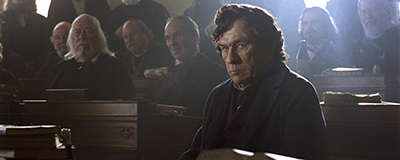 Tommy Lee Jones (DreamWorks)
Lincoln reunites Spielberg with Kushner, a Pulitzer Prize-winning playwright. Their collaboration made Munich a taut thriller, but during Lincoln‘s two and a half hour running time, I could swear my watch stopped.
The script is full of clunky exposition. Characters make helpful statements about timeframe: “Mr. President, it’s four days till the vote …” Mary Todd (Sally Field, probably bound for her third Oscar) makes sure that history doesn’t judge her a crazy woman. Confederate principals and Ulysses S. Grant are introduced with subtitles that may as well be name tags, timed so that the historical personages have a chance to pause mid-stride as their name is displayed.
Some have suggested that Spielberg’s Lincoln is a refreshing antidote to political hagiography, but what else would you call a movie that has the President at a crucial moment in history, look at a picture book about insects with his doting son, sitting in his lap?
I love Abraham Lincoln, and Tommy Lee Jones. But I love them as humans, not as the mistily-photographed, respectable heroes on view here, men whose foibles give them not depth but cuddle factor. Abraham Lincoln, Vampire Hunter, was not a great movie, but even in it’s seeming irreverence it had more interesting things to say about the man and the president. The pulpy framework makes viewers thing in a new way about how Lincoln battled the evils that faced his administration. Blood-sucking monsters are a vivid and not inapt metaphor for evil and cut-throat politics. Spielberg’s movie, with its programmed inspirations and tone of Hallmark prestige, is but a pale and fairly lifeless approximation of the conflicts that tore the nation apart. Its layers of biopic gauze smooth out the complexities of a man who was more than just an emancipator.
—
Directed by Steven Spielberg
Written by Tony Kushner
With Daniel Day-Lewis, Sally Field, Tommy Lee Jones, David Strathairn, Joseph Gordon-Levitt
Running time 150 minutes
Rated PG-13 for an intense scene of war violence, some images of carnage, brief strong language, and ostentatious avuncularity.
Opens today at Landmark Bethesda Row