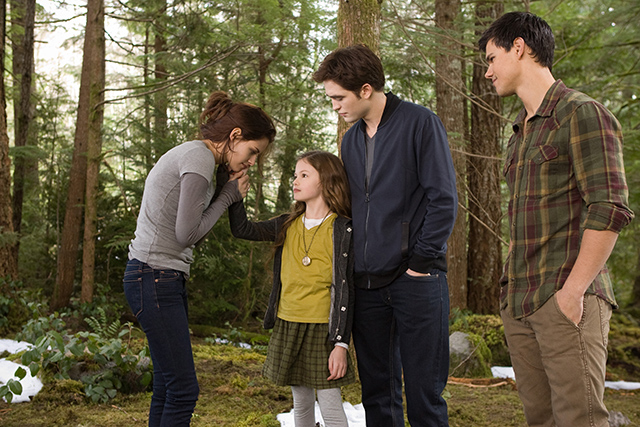
 Kristen Stewart, Mackenzie Foy, Robert Pattinson, and Taylor Lautner (Andrew Cooper/Summit)
What can you say about a 22-year-old girl who died and became a vampire? The story of Bella Swan, as told in Stephenie Meyer’s four Twilight books, comes to a cinematic end with The Twilight Saga: Breaking Dawn, Part 2. The franchise pulled a Harry Potter by splitting the final book into two movies. (The better to drink your money by.) The melodramatic series began in the awkward throes of adolescence, and as we have watched Edward and Jacob compete for the affections of an young human woman, they’ve all grown into something like maturity. But what price young adulthood?
I took a crash course in Twi-dom just this week, and the first film remains my favorite, despite and even because of its awkwardness. Its tale of teenage why-is-my-body-changing anxiety as expressed through competing strains of mythological hunk has a certain cheese appeal. The supernatural melodrama gets at the natural experience of growing up, finding yourself, and falling in love, with or without a shirt.
The trio of young leads are easy on the eye but still have limited ways of expressing themselves. Time and again, in response to anxiety, Kristen Stewart bites her lip, Robert Pattinson furrows his prominent brow and Taylor Lautner takes off his shirt. The Twilight sequels grew more accomplished and the lead actors grew a few more facial expressions, but as Stewart, Pattinson and Lautner grew more comfortable in their roles and shirtlessness I missed something of the innocence of young love and tentative filmmaking. So it’s fitting that the series ends with what may be a very dark reference indeed.
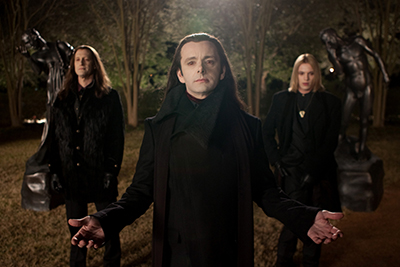 Christopher Heyerdahl, Michael Sheen, and Jamie Campbell Bower (Andrew Cooper/Summit)
Breaking Dawn Part 2 picks up from the shot that closed the previous film. Bella’s eyes are seen in extreme close up as they flood with the creepy red that indicates her body has changed for eternity. In vampire parlance, she’s a newborn — a newborn immortal, that is — and has to relearn how to be herself. The movie proceeds slowly, as Bella learns how to be superhuman as the newest member of the Cullens, having married into this family coven of, I note without ethical or aesthetic judgement, non-cannibalistic bloodsuckers. We watch Bella learn to make the most of her heightened vision and newfound strength and range of physical movement. The idea of freedom and control comes up throughout the film, as characters wrestle with their emotions and try to deal with uncertainty.
Bella’s relationship with her father Charlie (Billy Burke) naturally changes as well. She’s just gotten married to Edward, has an unusual child, the awkwardly named Renesmee (Mackenzie Foy), and must decide how much to tell dad. Burke’s performance as a father who has difficulty communicating with his daughter is the strongest in the series, and almost makes you hope for a spinoff, My Daughter was a Vampire, in which the anxieties of growing up are switched out for the anxieties of parenting and the fears that your teenage daughter will bring home a Goth boy. Burke brings the series a much-needed grounding. But, just like parental grounding, it’s not always enough.
Bella is an ordinary young woman who gets caught up among extraordinary people, and the growing pains that cut across shape shifting species to find a common bond
is part of what made the first Twilight a touching love story. Successive films have expanded on the werewolf and vampire mythology (hint: only one of them sparkles!), and the scenes of relatively ordinary life and relationships take a dramatic back seat to the fight between good and evil. But it’s the intimate relationships that make you invested in the larger spectacle.
The final battle pivots around Renesmee, the child born of a vampire father and a human mother. But the specifics are less interesting to me than the way the battle unfolds, in a manner that I’m told deviates wildly from the book. If you know the reference, this will be a spoiler, but the movie takes a narrative page from a movie that was in my day a staple of high school English class: “Occurrence at Owl Creek Bridge,” Robert Enrico’s film of the Ambrose Bierce’s short story. The story and film are set during the Civil War, an apt reference for a battle between divided factions of vampires.
A even darker reference is suggested by a pair of uninvited Russian vampires, Vladimir (Noel Fisher) and Stefan (Guri Weinberg). These particularly mischievous bloodsuckers seem like they could have walked out of Michael Haneke’s Funny Games, which like “Occurrence at Owl Creek Bridge” plays with time. The Twilight books and films are named, from darkness to light, for the passing of celestial objects by which we mark time and tide, and it’s no spoiler to say this is how the movie finally ends: with a retrospective look at the actors who have appeared throughout the series, and at the love story of Edward and Bella. Breaking Dawn, Part 2 will not be the time of everybody’s life. But after the brief time in which I’ve gotten to know them, I’m sort of sorry to see them go.
—
The Twilight Saga: Breaking Dawn, Part 2
Directed by Bill Condon
Written by Melissa Rosenberg, based on the novel by Stephenie Meyer
With Kristen Stewart, Robert Pattinson, Taylor Lautner, Peter Facinelli, Billy Burke
Rated PG-13 for sequences of disturbing images, including vampiric sensuality and forlorn gazes.
Running time 115 minutes