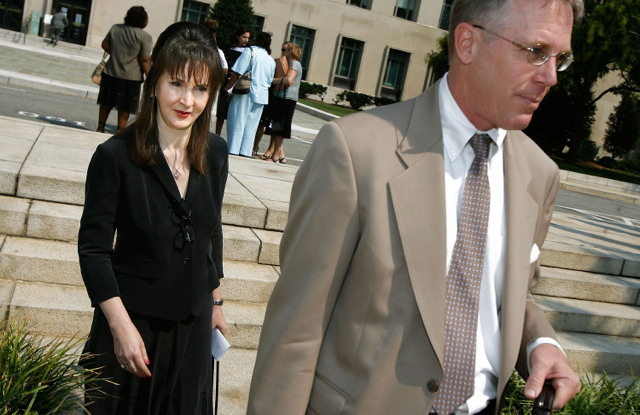
 Sibley, right, with “D.C. Madam” Deborah Jeane Palfrey, whom he represented in a 2007 case. (Getty Images/Chip Somodevilla)
The D.C. lawyer who keeps filing lawsuits questioning the veracity of President Obama’s birth certificate acknowledges that some might find his crusade to disqualify Obama a little absurd, but he has no plans of quitting any time soon.
Montgomery Blair Sibley, whose first case against the president was breezily dismissed by a federal judge in June, is headed to D.C. Superior Court next week in hopes of preventing the District’s three Electoral College members from casting their votes to give Obama a second term.
In an interview, Sibley says that this time around, he expects he has far better legal standing to challenge Obama’s legitimacy. In the June case, Judge John D. Bates of U.S. District Court ruled that as Sibley was not personally harmed by Obama’s election in 2008, he had no legal standing to dispute the president’s credibility.
Sibley waged a myopic—and certainly oddball—write-in campaign for president, including policy planks like a 2,300 percent increase in the size of the House of Representatives. Though the District Board of Elections does not release vote totals for individual write-in candidates, Sibley says he’d be shocked if he received more than one. But winning the White House wasn’t the point of his run; rather, it was to solidify his newest case.
“I was a candidate, and therefore I do have standing,” he says in a phone interview. “Only someone who has an interest in the office can challenge a quo warranto suit.” Figuring Obama is interested in retaining the office he currently holds, Sibley argues this set of lawsuits will be seen as legitimate as he believes the president’s identifying documents are phony.
But Sibley v. Obama—round 2—won’t go before a federal judge until early December, if it gets a court date at all. First, Sibley is looking to get a preliminary injunction next week in D.C. Superior Court that will prevent the District’s electors from carrying out their ceremonial duty when the Electoral College meets on December 17.
Moreover, Sibley also calculates the lawsuits will cost him nearly $80,000, though he is acting as his own counsel in this matter. In a memorandum to undisclosed recipients dated November 8 and discovered by DCist, Sibley estimates $34,400 for the direct cost of court filings, printing documents and actual litigation, as well as another $45,000 stipend to cover six months of expenses. In his explanation for the stipend, Sibley writes that he is getting Sibley’s legal services for a bargain:
In order to pursue the above described course of litigation, I will need to devote my full time and attention to these matters for a period of six months. If properly publicized, a fair amount of media attention should be created requiring my time to address. As such, I am willing to commit my time to this endeavor for six months for $7,500/month which works out to $45/hour, cheap for the legal skill I bring to this party.
“I always return my own phone calls,” he says in the interview.
 Why does Sibley keep pushing this issue, though? Every case challenging Obama’s birth certificate has been bounced out of court. Aside from a few pissy tweets on November 6, even the most famous birther—Donald Trump—has tamped it down since then, or at least tried to make his position less overt.
Not Sibley.
“I don’t know what Donald Trump’s motivations are,” he says. “I have no animosity toward Mr. Obama.”
But Sibley says his is strictly legal. It was November 2011 started questioning the Hawaii-issued birth certificate—a so-called “long-form” document—the White House published that April 27. Sibley says he was convinced by arguments that the certificate did not hold up to the scrutiny of visual editing software like Adobe Photoshop, and that it then fell upon him to uphold the rule of law.
“I do believe he has never proffered proof to demonstrate that as a factual matter,” Sibley says. “All anyone saw is what was posted on WhiteHouse.gov. There is credible opinion that what was posted are forgeries. I don’t know, and that’s the point.”
Sibley also questions that even if he is convinced that Obama was born on August 4, 1961 in Honolulu, he would still be uncertain about the president’s ability to serve. “If the father was from Kenya, could he be a natural-born citizen?” he asks.
And while Sibley would be correct in contending that the U.S. Constitution does not specifically define the term “natural-born citizen,” U.S. law has for more than a century upheld that any person born on American soil—even the son of a Kenyan graduate student—is granted citizenship at birth.
As Sibley sees it, though, decades of such rulings are just a history of legal evasions. He says that all attempts to define natural-born citizenship were ignored by the judiciary.
“The courts were not addressing the issue,” he says. “We’ve lost access to the courts and therefore lost rights as citizens.”
Quixotic as he seems, Sibley no apparent plans to back down until the very last court available—in this case, the U.S. Supreme Court—tells him to buzz off. Until then, he’s pressing the matter, and doesn’t particularly care how ridiculous his argument comes off: “I’m very comfortable being the person who says the emperor has no clothes if he, in fact, has no clothes.”
Montgomery Blair Sibley’s memo and dismissal of June 2012 lawsuit against President Obama