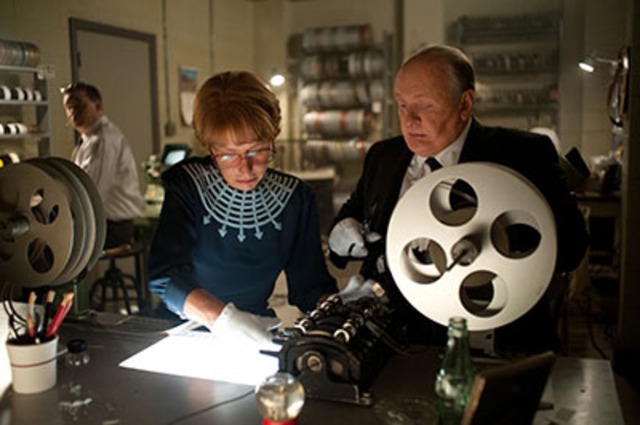
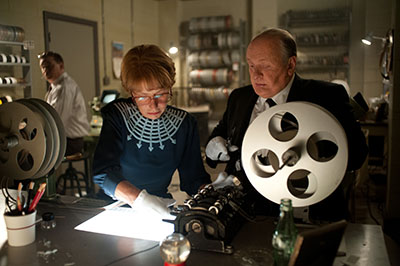
 Helen Mirren and Anthony Hopkin (Suzanne Tenner/Fox Searchlight)
“There’s a story here.” Crime writer Robert Bloch said this about Ed Gein, who somehow escaped notice in his small Wisconsin town and turned out to be a killer whose grisly m.o. still brings chills more than fifty years later. Bloch shaped that true crime story with Freudian overtones into the book Psycho, which Alfred Hitchcock adapted for one of his most celebrated films. You’d think there would be a story there. Sadly, Hitchcock, a behind the scenes biopic, takes a potentially intriguing background and weaves a dull, poorly written tale completely undeserving of its subject.
John L. McLaughlin based his screenplay for Hitchcock in part on Stephen Rebello’s book Alfred Hitchcock and the Making of Psycho. The source has plenty of good material: an aging director trying to stay relevant in a changing cinematic time, a battle with censors, and a look into the creative process of the master of the macabre. But the script takes this ripe set-up and turns it into, wait for it: a love story. Hitch is presented as a jealous but kind of cuddly perfectionist who finally gives his supportive wife Alma her due.
But here’s the thing. Rebello’s book reveals that much of McLaughlin’s attempts to put Alma in the spotlight are mere fictions. It’s insulting to the Hitchcocks, and to the audience. You can see it in the trailer, where over breakfast Alma suggests to her husband that Janet Leigh should be killed off not an hour into the movie, but thirty minutes in. The character of Mary Crane (changed to Marion Crane for the movie because of a Mary Crane living in Phoenix) was in fact killed a third of the way into Bloch’s book. Alma Reville is seen in the film as standing in on the set when Hitch fell sick, but in fact it was an assistant director who took over. Reville did in fact catch a few frames where a supposedly dead Janet Leigh blinks, but the screenwriter’s inventions (including suggestions of an affair with Whitfield Cook (Danny Huston) for which there is no basis) are so out there that you don’t trust anything you see.
If inventions were the only sins of the biopic screenwriter, all might not be in vain. But the screenwriter’s fiction is dull and cliched, the writing clumsy and obvious from the beginning. Like Rebello’s book, Hitchcock opens with a look at Ed Gein. But here the screenwriter’s laziness already creeps in, as Gein is off-handedly dismissed as a mama’s boy right before he claims another victim. The mama’s boy is one of the true clichés of serial killer lore, and invoking it so casually is just the kind of shortcut that this script takes, along with exposition like “you mean that TV show that pays you $29000 an episode and ownership of negatives?” Don’t they hire script doctors for this kind of thing?
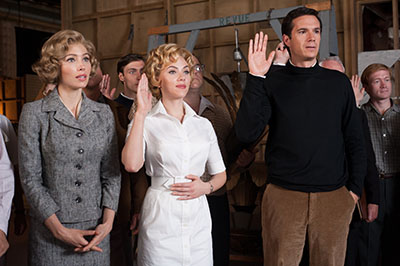 Jessica Biel, Scarlet Johansson, and James D’Arcy (Suzanne Tenner/Fox Searchlight)
Director Sacha Gervasi made the wonderful documentary Anvil: The Story of Anvil, one of my very favorite films about music. Gervasi made the most out of his access to an aging heavy metal band who had been toiling in obscurity, and drama, on a level that you would not expect from a hair band, just happened around him. Gervasi has you invested in these little-known musicians from the start. Alas, he doesn’t fare so well with the already iconic.
The pair of Oscar-winners who lead the cast should know better. Helen Mirren as Alma Reville retains some kind of dignity in restraint. But despite all that makeup Hopkins doesn’t look much like Hitchcock other than in girth, and his performance doesn’t capture the sensitive, morbid artist that the filmmakers want so badly to put over. Hitchcock plays with facts, which may be expected from a biopic. But who would have ever thought a Hitchcock biopic would be so boring?
—
Hitchcock
Directed by Sacha Gervasi
Written by John J. McLaughlin, based on the book, Alfred Hitchcock and the Making of Psycho, by Stephen Rebello.
With Anthony Hopkins, Helen Mirren, Scarlet Johansson.
Running time 98 minutes
Rated PG-13 for some violent images, sexual content and thematic material, and gratuitous expository writing.