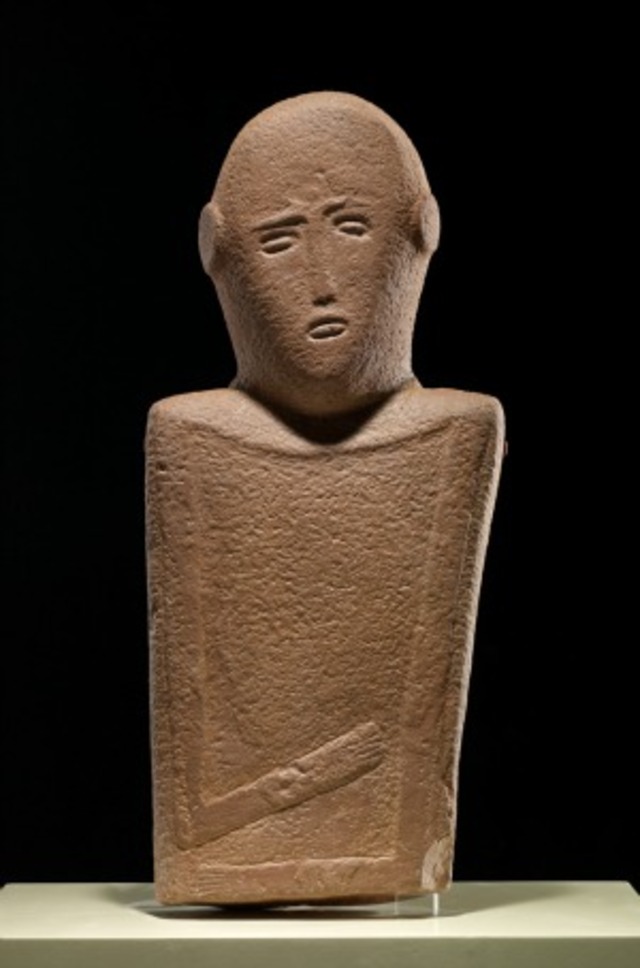
 Anthropomorphic stele. El-Maakir, Qaryat al-Kaafa, near Ha’il, Saudi Arabia, 4th millennium BCE. National Museum, Riyadh
Written by contributor Julia Langley
Little is known about the ancient history of Saudi Arabia before the rise of Islam in the seventh century CE. Until recently there has been scant evidence from which to piece together a narrative. New archeological discoveries, however, cast light on a vibrant trading culture that existed as early as 1200 BCE between the people of Arabia, Africa, the Mediterranean, and the Near East. Roads of Arabia: Archeology and History of the Kingdom of Saudi Arabia, now on view at the Arthur M. Sackler Gallery, examines both ancient trade routes leading from Arabia and later pilgrimage routes leading to Arabia—especially to Mecca. More than 300 breathtaking objects, many on view for the first time, bring attention to a region whose richness is beginning to be revealed.
The first part of the exhibition shows the impact of trade on the early culture of Saudi Arabia. The Arabians had a near monopoly on the cultivation and production of incense, particularly frankincense and myrrh. Frankincense was known for its sweet fragrance, as well as medicinal properties known to reduce the effects of arthritis, for example. Myrrh, employed by the ancient Egyptians for the embalming of mummies, was used in funerary and religious rituals. Both frankincense and myrrh are derived from the sap of trees grown in Arabia’s dry, rocky climate.
Arabian traders provided frankincense and myrrh to the temples and courts of the ancient Near East—Egypt, Syria, Mesopotamia, and Iran—and the Greco-Roman world. Along the trade routes, towns and businesses flourished by providing goods and services to traveling merchants. Eastern ideas and objects went west, while western ideas and objects went east. Viewing the exhibition is a reminder that art is never mute. Of cultures past and present, it tells what is valued and by whom.
At the entrance to Roads of Arabia three anthropomorphic steles dating to the 4th millennium BCE greet visitors. Originally associated with religious or burial practices, these highly abstract sandstone sculptures appear surprisingly modern. The tactile nature of the stone and absence of detail bring to mind twentieth century artists like Japanese sculptor Isamu Noguchi. The stele from El-Maakir, Qaryat al-Kaafa is both sweet and sad. Its simple abstract form—an oval on top of a rectangle, seems at first childlike. But there is something about the tilt of the head, the asymmetrical features and the slight lift of the right forearm and hand suggest a transcendent knowledge that is anything but childlike.
A later artifact, from the first century CE, indicates the impact Alexander the Great had on Northeastern Arabia. A luminous gold funerary mask found in a Royal Tomb of a young girl shows the influence of Greek culture on Northeastern Arabia. Funerary masks were commonly present in ancient Greek tombs, along with the type of jewelry and adornments found in the Royal Tomb from Thaj. And while no Greek settlements have been unearthed, other aspects of Hellenic culture have surfaced. The girl was found resting on a Greek bed. The way she was laid out and the objects she was found with indicate that not only trade, but also certain customs had traveled to Thaj from Greece.
With the rise of Islam in the 7th century CE, Mecca became the focus of the Arabian Peninsula, as well as of the Islamic world. Pilgrims flocked to the holy city, bringing gifts to honor the prophet Muhammad. A seventeenth century incense burner commissioned and donated by the wife of the Ottoman sultan Ahmed I and made of iron, gold and silver shows the abstract patterning and delicate floral decoration characteristic of Islamic art. Members of the ruling elite throughout the Islamic world regularly sent precious gifts to the holy cities of Mecca and Medina in order to publicly proclaim their faith and devotion. Other devotional objects are on view, as well as tombstones dating from the eighth to the sixteenth centuries and revealing a wide variety of calligraphic styles.
Roads of Arabia ends with a couple of rooms devoted to the creation of Saudi Arabia in 1932. Vitrines filled with photographs, maps, travel books and objects are an unfortunate distraction from the beauty of the exhibition and a reminder that the business of politics and public relations lurk behind every artifact. It’s a shame to end the exhibition with the Propaganda Road, because up until then the exhibition is a triumph.
Roads of Arabia: Archeology and History of the Kingdom of Saudi Arabia is on view at the Arthur M. Sackler Gallery now through February 24, 2013. The Arthur M. Sackler Gallery is located at 1050 Independence Ave SW and is open 10 a.m. to 5:30 p.m. every day except December 25.