 Photo by Chris Bennion courtesy of Arena Stage.
By DCist contributor Alexis Hauk
Now at Arena Stage, Pullman Porter Blues follows three generations of black porters on an overnight train from Chicago to New Orleans on a summer night in 1937, the same night Joe Lewis knocked out “Cinderella Man” James Braddock to become the heavyweight champion of the world.
Though the uniforms worn by our protagonists are crisp and clean, the story dives into our country’s biggest stain—institutional racism. And this piece of it might very well disappear from current consciousness were it not for bold playwrights like Cheryl West. In 1870, George Pullman began hiring former slaves to work on the train cars, a job that was an appealing escape from terrible circumstances, but came with its own issues.
“While the work was grueling, the salary meager, and the hours nearly endless, most porters valued the job and many passed it down to sons and grandsons,” the play’s program reads.
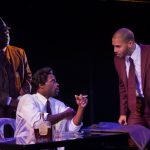
West’s musical opens with a steel guitar and a stark image of the rails extending into the barren earth horizon, shadows pounding with hammers to the beat. Cephas (Warner Miller), the youngest generation in the Sykes family and the first to attend college, is confident, whip-smart and excited about the journey to come.
“I’m not afraid of white folks,” he tells his grandfather, who’s running circles around he as they prepare to embark. “And that’s the problem,” his grandfather, Monroe (Larry Marshall), a longtime, seasoned porter, says firmly. His grandson may have memorized the 127-page porter manual, but there are a lot of unwritten rules, too; rules that keep you alive.
Monroe, who’s from Mississippi and whose family was enslaved, knows these rules all too well. He knows that once you get to the deep south, the threat of death for a black man who steps out of line (by appearing independent or educated, for instance) is very real. The Ku Klux Klan was hardly subject to legal repercussions. And according to Tuskegee Institute data, 4,749 lynchings occurred between 1882 and 1968; more than 70 percent of those murdered were black. (Billie Holiday’s haunting “Strange Fruit” was released in 1939.)
Cephas’s father, Sylvester (Cleavant Derricks), is less willing than Monroe (and others of Monroe’s generation) to participate in this dance. He’s part of the Brotherhood of the Sleeping Car Porters movement, a union that was finally recognized in August of 1937, thanks to leadership by civil rights leader A. Philip Randolph.
Monroe has learned how to put on a veil of friendliness that disarms the bigots all around him; people that spit tobacco on the floor of the train for him and the other porters to clean up—something Sylvester notes bitterly as the product of “nasty white folks.”
Along with the Sykes family, we get Sister Juba (the radiant, show-stealing E. Faye Butler), a Bessie Smith/Ma Rainey composite, who enters regally atop a stack of suitcases, drunk and singing “Wild Women Don’t Have the Blues,” letting her legs dangle freely. Juba has a million and one humdingers, including, “Sh** just may be my way of putting a period on a sentence.”
She’s also got a mysterious past, which is unleashed in a series of brutally painful revelations in the second act. Juba’s strength and wit (and alcoholism), like Monroe’s smile, have been starkly necessary to survival. Later, we meet stowaway Lutie Duggernut (Emily Chisholm, a dead ringer for Deadwood‘s Calamity Jane), whose harmonica skills, spunk and tomboyishness are a thin shield from the perils of being a woman in this world.
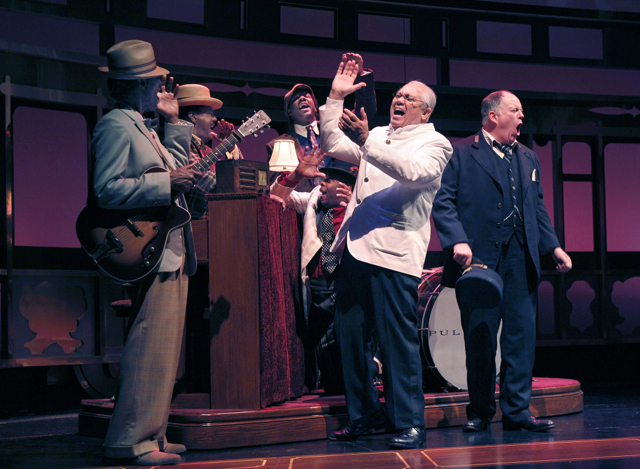
While the meat of the play can be tough to handle, there are also numerous moments of joy throughout — from when Monroe is goaded into shaking a leg when the train’s resident blues band strikes up “Sweet Home Chicago” to the euphoric celebration scene after Lewis’s victory.
But you do feel, along the two-plus-hour journey, like you’re being pulled toward some unsettling business (aided by some nice pacing and excellent lighting work). When we arrive at that place, director Lisa Peterson gives us one haunting final image, reminiscent of another final moment that sticks to your ribs—the solitary prisoner in Sam Mendes’ 1993 revival of Cabaret—right before the curtain drops.
Packed with blues standards (particularly sumptuous is “Trouble in Mind”) and dynamo performances, this jukebox musical could very well rest on those two facets alone. But it’s West’s unrelenting writing that packs the last knock-out punch. This train isn’t bound for glory, but it is a glorious ride.
***
Pullman Porter Blues runs through January 6, 2013 at Arena Stage (1101 Sixth Street SW). Tickets $45-94.