Martin Austermuhle
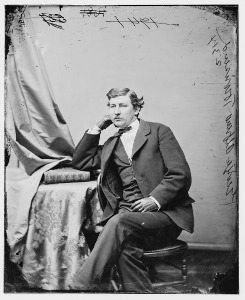 George Alfred Townsend. Photo from the Library of Congress.
By DCist contributor John Muller
Following the Civil War, Washington flooded with journalists and out-of-town correspondents. President Andrew Johnson’s impeachment in early 1868 helped perpetuate the modern-day system of interviewing. Two newspapermen who roamed Washington and took form during this time were George Alfred Townsend and Mark Twain, who while living in the city wrote for the Alta California, Virginia City Territorial Enterprise, Chicago Republican, New York Herald, and Galaxy, a national monthly magazine. (On Tuesday President Obama signed a bill on Tuesday to mint commemorative $1 and $5 coins of Twain.)
George Alfred Townsend, known as “GATH,” was a prolific journalist and author, writing more than a dozen plays, novels, and non-fiction books which examined the local and federal intricacies of Washington and the surrounding Chesapeake Bay region.
GATH took his craft and reputation seriously; in March 1874 he pummeled a reporter from the Chicago Times who he charged with libel. Anecdotes aside, Townsend, whose home in Western Maryland, “Gathland,” was recently made a Maryland State Park, may be best remembered for his 1873 book, Washington, Outside and Inside: A Picture and a Narrative of the Origin, Growth, Excellencies, Abuses, Beauties, and Personages of Our Governing City, which regularly surfaces at antiquarian book sales.
In Chapter 40, of Washington, Outside and Inside, Townsend drops knowledge and a brief history of scribes who have at one time or another been shaped by the District and contributed to its literary inheritance.
ART, LETTERS, AND BOHEMIANS AT THE CAPITAL.
Around the Capital of a great nation the artistic and literary spirits have always assembled, and this has been the case with Washington. It has been from the beginning of its history a place of resort for tourists and literary men, and a place of abode for journalists, scholars, and artists. The kindly Paulding was both Secretary of the Board of Navy Commissioners and Secretary of the Navy, and the air of the latitude of Washington appears in his style. William Wirt gave scarcely less time to literature in this District than he had given in Virginia. Robert Walsh, perhaps the founder of review literature in America, was educated at Georgetown, and spent much of his life in Washington. Here Joel Barlow, the author of the Columbiad, built himself a mansion in the Jeffersonian day. For many years the publishers of that most useful repository, now unhappily discontinued, issued Niles Register, on Louisiana Avenue. Sparks, Irving, Kennedy, Poe, Legaré, Cooper, Motley, Bancroft, Ross Brown, and Mark Twain are amongst the hundreds of notable men who have at periods been tenants of the city. Have resided Schoolcraft, Stanley, Catlin, and others who have transmitted the wild Indian to wonder and fame. Here Peter Force, the pious book collector, lived until the Government took his library, and then died for employment and want of responsibility. The most influential novel in the world was published in monthly parts by Mrs. Stowe in a Washington newspaper. The diplomatic and official history of the country has been almost wholly edited and collected here, and the journalism of the country has been in great part learned here.
John Muller is the author of forthcoming “Mark Twain in Washington, D.C.: The Adventures of a Capital Correspondent” (The History Press, Fall 2013).