Martin Austermuhle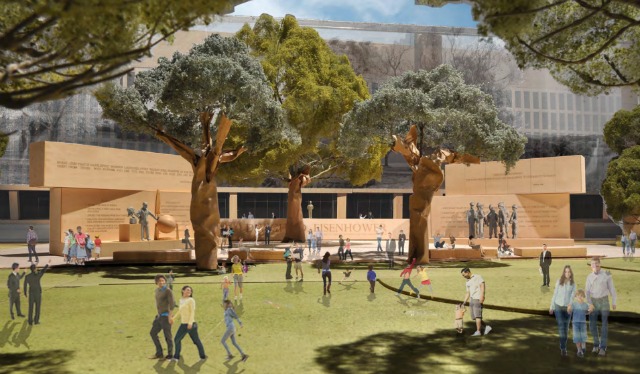
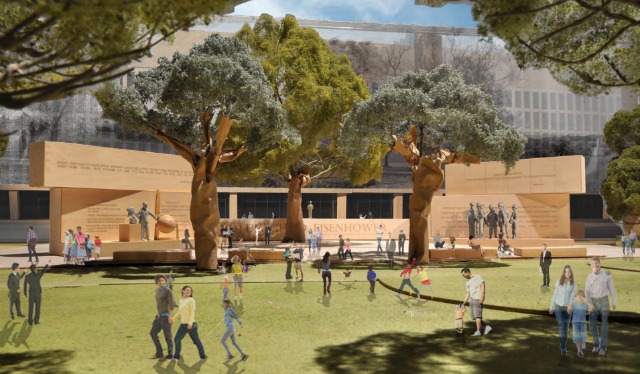 A rendering of what the Eisenhower Memorial will look like from the ground level, with the 80-foot-tall metal tapestries rising behind and around it.
There have been plenty of complaints and criticisms of the Frank Gehry-designed Eisenhower Memorial; some say that the 80-foot-tall metal tapestries that will frame the site are too much, while others argue that the proponents of Gehry’s design haven’t been particularly forthcoming over how and why he was chosen for the project. (The design does have its fans, though.)
Last week, though, Sabin Howard, a sculpture who was in the running to work with Gehry on the now-delayed memorial, offered an insight into the design process—and had some harsh words for Gehry’s proposal:
On August 10th, I was flown to L.A. to see the project plans for the Eisenhower Memorial and to meet with Frank Gehry.
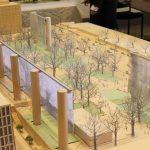
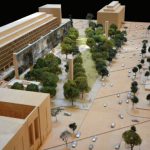
When I saw the memorial models, my heart sank. The project was trying to reinvent the wheel with newness, and it was missing the point entirely. Components were stiff and compartmentalized like a natural history museum exhibit. There was no focal point, but a lot of elements that did not work together to deliver a unified visual message.
How could I tell the famed Gehry that the design and sculpture of this project had to lead our world and to direct us towards our potential? The sculpture must serve as a focal point in a sacred space that transforms the viewer, just as Eisenhower transformed the world through his actions as a leader. Perhaps Gehry was unaware of what could be.
My first question to Gehry partners was: Did you bring me in to be your in-house sculptor, or are you asking me for my creative opinion and 30 years experience as a figurative sculptor? They replied that they were basically unhappy with their current design and that they wanted to know what I thought.
Howard goes on to write that he shared his misgivings with Gehry, telling the designer that a smaller relief with Eisenhower as the focal point would more appropriately memorialize the 34th president. Gehry seemed to agree; Howard was asked to produce to models of his design proposal.
In mid-November, though, Howard was called and told that he was off the project. Saying he was “disappointed” to hear the news, Howard added that he thought he wasn’t booted because his proposal lacked merit: “I was never given a chance to show my sculptural skills in an honest competition. Things were decided with the submission of paperwork, and perhaps, with behind-the-scenes political concerns in mind,” he wrote.