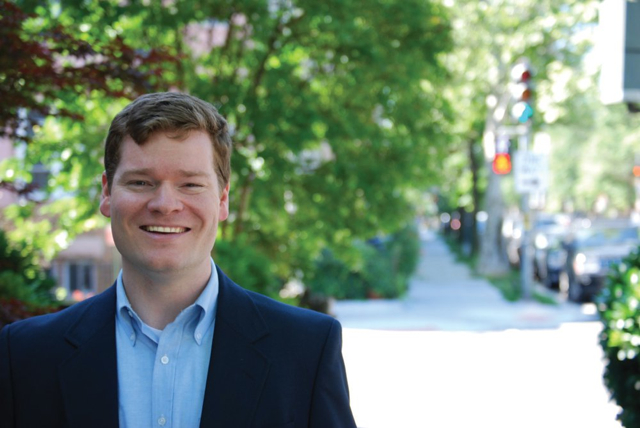
 Mara, in a 2011 campaign photo.
Patrick Mara, a Republican who has run for citywide office multiple times before, is getting into the race for the April 23 special election for an At-Large D.C. Council seat. Though his possible run was widely rumored, he confirmed his decision to DCist this week.
While he has come up short in the past, Mara believes his chances of landing a seat on the top floor of the John A. Wilson Building are as good as they’ve ever been. When voters choose a successor for the seat vacated by now-Chairman Phil Mendelson and currently held by newly selected interim At-Large Councilmember Anita Bonds, Mara thinks he’s got the best shot in an open field.
“I’m definitely not someone who runs for the sake of running,” Mara, a 37-year-old political consultant, says. “Things have changed since the last time I ran.”
The last time there was a special election to pick an At-Large member of the D.C. Council, in 2011, Mara finished second, trailing the eventual winner, Vincent Orange, by roughly 1,700 votes. But that field also included a fractured Democratic pack; in addition to Orange, there was Sekou Biddle, an interim councilmember who had been picked to fill in for Kwame Brown after Brown was elected chairman in 2010; Ward 1 activist Bryan Weaver; and three more Democrats.
Mara, Weaver and Biddle all appealed to reform-minded progressive voters, splitting a common base. (Though Mara overlapped with Biddle far more than he did with Weaver.) And while Mara becomes the eighth person to declare his candidacy for next April’s election, none of the other seven have as much previous exposure in District-wide contests.
Last time around, Mara stuck out—and likely lost votes among some progressives—in part because of his opposition to tax hikes. A day before announcing this run, Mara doesn’t talk taxes during a conversation over breakfast at The Coupe, a restaurant in Columbia Heights, but he figures he can still be a member of the GOP appealing to voters who in any other election would be dyed a deep, dark blue.
“I defeated a Republican in a primary who was opposed to marriage equality,” he says, reflecting on his 2008 primary defeat of the Council’s last Republican member, Carol Schwartz. “I supported marriage equality in a Republican primary, and the nice thing about all my positions is I get to say what I believe, which is a rarity. But at the same time I was pro-Michelle Rhee, I was pro-charter, very pro-education reform and fiscally responsible.
“And I think it’s hard for anyone to argue this government is fiscally responsible,” he continues. Though the District has finished the past few years with budget surpluses, Mara finds plenty of faults in how the money is spent. Of particular concern to him are city’s workforce development programs, which he says go unaccounted for despite annual spending of some $100 million spread across nearly all government departments.
But reforming workforce development programs is also something Mara sees as a strength in parts of D.C. where one might expect Republicans not to tread. Between wards 5, 7 and 8, Mara netted just 563 votes in his 2011 run; still, he says he’ll be campaigning in every ward, banking on his experience the past few years representing Ward 1 on the State Board of Education.
“I’m not elected to this lily-white board,” he says. “I’m elected in the ward with the most racial diversity, economic diversity, educational diversity.” Mara, who plans to make the education reforms started under Rhee one of his boilerplate issues, says he approves of how D.C. Public Schools Chancellor Kaya Henderson has done well, particularly with the current round of school closings.
He also wants to promote more entrepreneurial opportunities east of the Anacostia River. “If we don’t create a greater culture of ownership, that’ll be an issue down the line.”
Still, Mara’s chances will largely hinge on what other reform types enter or refrain from the April 23 race. While Mara is getting underway on collecting the 3,000 signatures needed to appear on the ballot, there are rumors Biddle, who in April barely lost a Democratic primary to Orange, could jump in. Biddle did not return DCist’s request for a comment.
Weaver seems less likely to run, though he has not ruled it out entirely.
“I don’t have any plans at this time,” he says in an interview. “Several people have approached me. Unless things break a certain way, I won’t get in. I’m 75 percent not there.”
But he’s not ready to openly embrace any one candidate, either, though he says, “I consider Pat a friend.”
Elissa Silverman, a former Washington City Paper columnist and Washington Post reporter who now works for the D.C. Fiscal Policy Institute, has also been mentioned as a potential candidate with progressive appeal.
And though they haven’t filed their candidacies yet, there are two potential Democratic Party heavyweights who could command a large portion of what will likely be a small electorate. (Only 46,967 voters, or 10.3 percent of registered voters, participated in the April 2011 special election.) One Bonds, and the other is outgoing Councilmember Michael A. Brown (I-At Large), who was defeated last month by David Grosso, but has expressed interest in mounting a comeback as a Democrat.
“It’s up to Michael,” Mara says of Brown. As for Bonds, however, Mara does little to mask his contempt with how she was tapped for her new seat—by the vote by 71 members of the Democratic State Committee.
Mara thinks the feeling is shared by many of the Democratic voters he’ll need to get to cross party lines in order to win. “Most Democrats are disgusted by that,” he says. “I was thinking this is something they should have fixed in the past two years”—Biddle temporarily won a Council seat in the same manner—“but they didn’t, and this is one of the reasons we keep doing this. No Democratic [Council] member spoke out against this process.”
Weaver, a Democrat, concurs. “Last night was the last stand of people who carried influence in D.C. for a generation,” he says.
When it comes to how he might govern, though, Mara is less concerned with donkeys and elephants. If elected the lone Republican in a chamber full of Democrats (and one former Republican who was exiled from the party nearly a decade ago), he sees himself as a swing vote on just about any issue.
“At the end of the day, to get anything passed, you have to count to seven,” he says. “You are a vote for or against every single thing before the council. If I vehemently disagree with someone on one issue, they know I might be needed on the next issue to get something passed, or vice versa.”