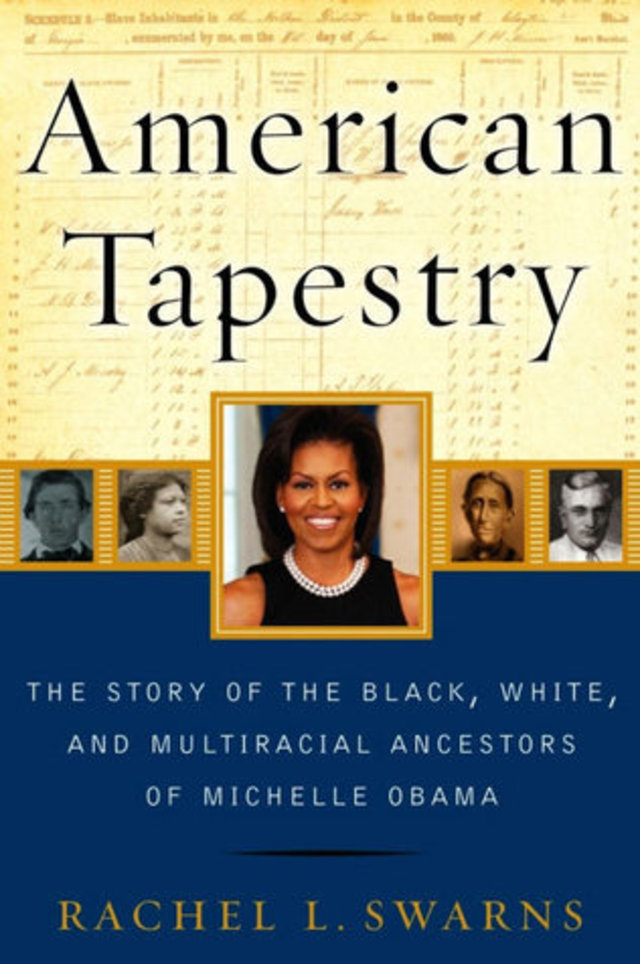
 First Lady Michelle Obama is renowned for encouraging healthy eating habits, being a devoted wife and mother, having impeccable style, and her push-up prowess. But as Rachel Swarns will discuss today, she also represents a monumental journey taken by many African Americans since the 1800s. The New York Times journalist will speak about her book American Tapestry: The Story of the Black, White, and Multiracial Ancestors of Michelle Obama (Amistad, June 2012) tonight at 7 p.m. at the National Archives’ William G. McGowan Theater.
Swarns dug deep into Obama’s family tree, beyond what the first lady knew herself. The story of her diverse ancestry starts with her great-great-great-grandmother, Melvinia, as an enslaved young girl in South Carolina and Georgia in the 1850s. She later had the child of her owner’s son, whose grandfather, Irish immigrant Andrew Shields, fought the British in the Revolutionary War. In six generations, Melvinia’s descendants would migrate north to Chicago, rise into the working class, and Obama would move into the White House.
American Tapestry shares the specific ordeals faced by this family line — including sexual exploitation, abandonment, and bold escapes to Northern free states — but they are unfortunately not uncommon in many Americans’ personal histories. Swarns’ account helps us get to know the first lady and better comprehend the enormous undertaking to attain liberty and the pursuit of happiness.
Researching for the book was no easy feat: very few letters or journal entries from slaves exist, since they were barred from reading and writing. The census did not include them by name until after they were freed.
The author interviewed several of Obama’s white distant relatives, who still live in the South, and had no idea of their shared lineage. “You can imagine what it might be like,” Swarns said, “if someone were to knock on your door and say ‘hi, I think your family owned the first lady’s family.’” Some of these relatives come from very modest means, and never knew their families had owned slaves. It led to mixed reactions; the thrill of learning you are related to American royalty, but also the difficulty of knowing it results from a painful past.
They’re not alone in this feeling. Obama has also spoken of family stories being “buried” because they are “hard to want to remember.” These unspeakable events and relationships are what compelled a couple of her ancestors to hide their background for their entire lives. They’re part of what makes race still a sensitive, complicated topic today.
Swarns has reported for the Times since 1995, writing about domestic policy, immigration, and the 2004 and 2008 presidential campaigns. She lives in D.C. with her family.