Photo by Craig Hudson
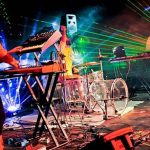
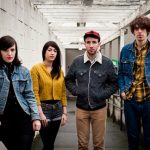
Guitar, drums and keyboard with canned vocal samples tossed on top—it’s a different way of mixing the body-moving urgency of dance music and the innate raw power of rock ‘n’ roll. We’ve seen people fuse dance and rock before, but not in a way that sounds as unique or as exciting as Heavy Breathing. The band (which consists of keyboardist Amanda Kleinman, drummer Jeff Schmid and guitarist Erick Jackson, all formerly of The Apes) does not spare us any weight—their heavy riffs borrow from kraut rock, punk and metal, and the band occasionally sounds like they’ve been dragged through the sludge. However, the keyboards and canned vocals all sound inspired by a Saturday night radio dance party. The result is something unlike what we’ve heard either inside or outside the Beltway. We talked to Jackson about the band’s visual aspect, their intense performances and their fluid songwriting methods.
Find them online: http://www.heavybreathing.net
Next show: Tonight at Comet Ping Pong with Prince Rama at 9:00 p.m.
How did you all meet each other?
We just all grew up together. I knew the drummer Jeff in sixth grade and then Amanda I met when I was fifteen, so I think we all tried to play music but we all played with different people for awhile. We were all in different bands and stuff but probably around the ‘90s there was a point where I think we decided to play with each other just because we could picture actually sitting in a van together and not murdering each other. That was the only reason!
Have you had any potentially nightmarish road stories either with Heavy Breathing or with The Apes?
Oh, thousands! There’s many, many. I guess my favorite one, I suppose was our first singer Paul—he was roofied. We were in Mobile, AL and the club promoter never showed up to open the club up so he was looking for somewhere to go to the bathroom. So, he went next door to this gay club and it was really, like, biker gay guys. The bartender offered him a drink and he started drinking and then he was feeling out of it and he said, “Oh, I’ve got to go” and they grabbed him and said, “You’re not going anywhere.” And then we didn’t know where he was because he didn’t tell us. He was like, “Oh, I’m going to go walk around until they open this place up.” Then we found him paralyzed laying outside the van, like, stiff as a cardboard. We didn’t know what happened to him. He was just like, “I was roofied.” We didn’t know if we should’ve taken him to a doctor. This band from Mobile, AL was kind enough and said, “Oh, come back to our place and we’ll keep him going.” It was just weird because earlier that day we were listening to Deliverance on tape in the van. And it was in Alabama, too. We have a lot of stories like that.
With Heavy Breathing you went with the decision not to have a singer and to occasionally have some pre-recorded vocals. What was your decision-making behind that?
It was just trying to play with extra people over the years for so long. Sometimes it was great, at times. But the three of us all knew each other so well and we just do what we do. We didn’t have anything else going on in our lives whereas anytime anyone new would come in, just — life takes its toll on people. They have partners and they make incomes and such. We didn’t even know it was going to work. We were just like, “Let’s try doing it this way.” At least we could focus on the music rather than personalities. So, it was like, even if it doesn’t work, let’s just try. People have told us in the past to do a three piece, but none of us want to sing because none of us were interested in singing. But, in the past we’d always work with our vocalist even though none of us sang. We always ended up working with people that never really sang before, or sang much. But, it’d be like, “Oh, we’re friends. Let’s just do this!” I think we figured that if people go see DJs and it’s not like there’s anything to see, then what’s the difference if they hear some vocals that are piped out there while the music’s real life music.
The difference of course being that with Heavy Breathing, there is something to see. There seems to be a very strong visual aspect to you.
When we were doing it, we always wanted to have more. A lot of why we still keep playing music is because we still sort of envision — you want a live show to create an environment and a lot of it is, “Ooh! Let’s get a smoke machine!” “Well, how are we going to get one?” How are we going to do this or how are we going to do that? A lot of it is excitement in figuring out how we are going to pull this off. What would we want to see on a Saturday night? Because a lot of times you go to shows and the band might be great but it doesn’t necessarily have the energy of having a good time. You’re supposed to be very serious when you listen to them or I feel like a lot of bands are afraid to be more confident, maybe? Or there’s no empowerment in the music. When I think of rock shows, there’s an element of empowerment and energy. I think that’s what’s behind the live show.
I do know that your live shows have also involved costumes and masks.
Oh, yeah. Amanda used to always do a little comedy in the beginning of shows. And she still does. She does her character and she does her banter just to warm people up and get people up to the stage because in the past, when you’re playing out of town in a weird place and no one knows anything about you, it’s good to break the ice that way and have some sort of humor. And when you’re touring and there’s ten people there, you have to humor yourself. That’s a lot of it. Her character just came about because we were like, “How are we going to entertain ourselves tonight?” I mean, besides playing a show. Everyday before you play, you have a story. She enjoys that kind of ad libbing/bantering.
Since it is a multimedia performance of sorts, has this been difficult to set up in any venues where you’ve played?
Well, yeah. We do have a lot of equipment. What we do now before we play a show is we’re like, “Do you think we can pull this off?” So, like, if there’s too many bands on the bill and it takes us a long time to set up, we couldn’t pull it off. So, we try to feel it out. We ask a lot of questions before we play. We bring our own sound guy so we don’t have to deal with stuff. We always try to bring friends along to help with it so that it goes smoother. One of the big things we learned over the years is that you can play a ton of shows and it gets to the point where some of them you remember really well and some of them you don’t even remember playing because so much of it was just damage control. “Oh, this kid didn’t have a working PA system” and “This place couldn’t handle this.” So, we put on a show that we feel good about putting on instead of going, “Well, they don’t have any microphones. How’s this going to happen?” That’s fine too because you learn a lot. You become like MacGuyver. But at a certain point you want to be able to present something a certain way and so it becomes the band’s responsibility to ask questions to whoever’s putting on a show. A lot of people think it’s cool like, “Yeah, yeah! I’ll invite people and then it’ll happen!” Sometimes it does but at a certain point you have to be somewhat responsible for how it comes across and putting on sound and are you doing what you’re trying to do or are you just trying to work with crutches on.
So, does this make DIY spaces more difficult or does it just depend?
It just depends. The first time you put on a show anyplace you don’t notice the small little details about things. Like that bands need a place to set up and if there’s a party going on it’s like how do they get their equipment out of there. It’s just little things that come into play after you do it a bunch. I think a lot of people think, “Yeah, it’s fun! I’ll put on a show!” and they don’t realize or they get out of putting on shows really fast because they’re like, “Yeah, this is kind of a hassle.” Some of the best shows we’ve played have been in basements but other times it’s been like a living nightmare. Like, you get to the person’s house and it’s like, two kids on the sofa. And they’re like, “Hey, we can fix you some food.” That happens a lot. But it’s still fun.
I know for awhile that Heavy Breathing was putting out a song a month with an accompanying work of art. Did that change when it came time to recording your album?
At first when we were doing it, every month or so, we’d be making a song. And we’re like, “Let’s just put it up because at least people will hear it.” Maybe we’d write three songs in a month. So we’d always be saving up songs. Two of them we originally put out way early and we’re like, “Oh, let’s do diffferent versions.” After a year or after a few months we might play it really differently. So, what you get on the record is much more live. After we played it a ton or worked different ways out, it’s more like a live recording, kind of. I think the first things that we put out on the net was kind of like sketches. Polished sketches but stuff we kept working on so it wasn’t just us reacting to stuff.
How would you describe the sound of what came together?
When we were making the album, we were very much in the idea of the rock music that we enjoyed growing up with from all our various interests and influences over the years. It could be anywhere from more classic rock music to Kraftwerk. There wasn’t any one particular thing we just like riffs and heavy beats and melody. So, it’s just combining it. We’ll start out with a sound when we’re practicing. Like, I’d start off with a weird sound I made with the keyboard and then we start riffing. Then we’d add a vocal piece into it by adding different samples, but that’s how we’d do it. But we’d always ask, “How does this feel when we’re playing it live. Does it have energy? Does it make me move?” And if we didn’t record it that night, would we remember enough about it to be able to play it again? We’ll jam and then we’ll jam again and say, “Hey, remember what we did last week?” and if we can’t then we won’t use it. It must not have been good. We don’t remember it.