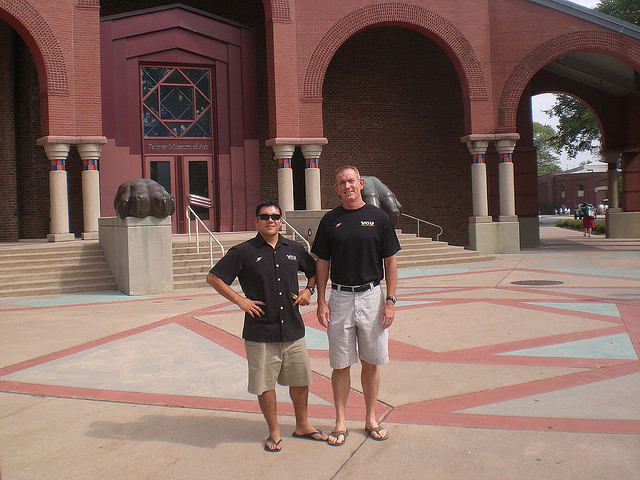
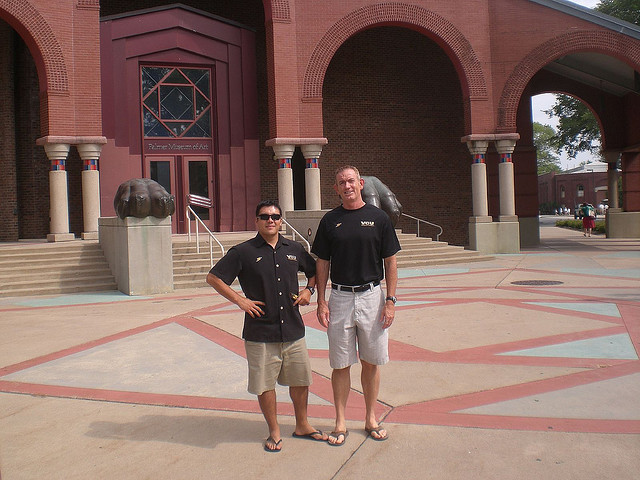
 Finley, right, in September 2007. (Photo by Sean Leahey)
The recently sacked coach of Virginia Commonwealth University’s volleyball team says he was dismissed from the job he held for eight years because he is gay. In an interview, James Finley, who led the Rams to a 25-6 record in 2012, claims that despite taking his team to the Atlantic 10 semifinals, the Richmond school’s new athletic director instituted a culture of isolation and eventual termination because of Finley’s homosexuality.
Ed McLaughlin was hired as VCU’s athletic director in July. Soon after, Finley says, McLaughlin began icing him out.
“After he arrived it didn’t take long for me to notice something was going on,” Finley says. “I was isolated. He never came to our games. Never introduced himself to our players or coaches.”
GetEQUAL, a gay rights organization that is working on Finley’s case, also says that McLaughlin demoted Patricia Stauffer, who formerly oversaw VCU’s women’s teams, without explanation in October. Stauffer is also openly gay. “She said she had introduced her partner to him 10 days before and he had reacted strangely,” Finley says.
Finley, 52, says he was notified of his dismissal in late November shortly after the Atlantic 10 tournament. As the season was drawing to a close, Finley says McLaughlin finally took note of the volleyball squad, but only perfunctorily.
“We get to the end of the season,” Finley recalls. “[McLaughlin] comes to the game 25 minutes before the game and came out on the court and just pointed his finger on the floor and pointed, ‘Coach, come stand beside me.’ ” McLaughlin stood for a photo with the team and immediately left the gymnasium, Finley says.
McLaughlin, through a university spokesman, declined to be interviewed for this article. University administrators are currently investigating Finley’s claims; he has asked for his reinstatement with the guarantee of a multi-year contract and the ability to report to a superior other than McLaughlin. Once complete, the report will be turned over to VCU President Michael Rao, who is also the target of a Change.org petition calling for Finley to get his job back.
But Finley says that VCU’s athletic department was once a far more accepting workplace. In eight years coaching the Rams, Finley amassed a record of 151-116. Finley says VCU, which hired him after stints at Niagara University in Lewiston, N.Y. and Merrimack College in North Andover, Mass., was always aware of his sexuality.
Virginia Commonwealth also did not mind it when Finley became politically active. He spoke at a 2010 campus rally against a move by Virginia Attorney General Ken Cuccinelli to say that the state’s colleges and universities cannot protect gay students and employees from discrimination without the express consent of the General Assembly. “First athletic department I worked in where I could feel safe,” Finley says.
Moreover, McLaughlin’s predecessor, Norwood Teague, never made an issue of Finley’s personal life. When Teague was hired in 2006, Finley came out to him.
“Yeah, I already know. Nobody better ever give you any problem or they’ll have to deal with me,” Finley remembers Teague saying. Teague became the University of Minnesota’s athletic director earlier this year, leading to McLaughlin’s hiring.
Finley was married in July 2010 in D.C. He and his husband have three boys, and Finley says that until recently, he and his family were frequently spotted at athletic department events. McLaughlin’s tenure, he says, has undone that.
“Never thought because that would change because the AD changed,” he says.