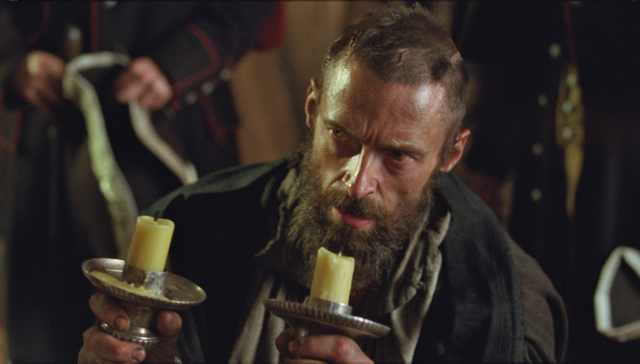
 Hugh Jackman in the movie version of ‘Les Misérables.’ (Universal Pictures)
By DCist contributor Matt Cohen
Les Misérables is like Star Wars for theater nerds. It’s something of a time-honored commodity with an ardent fan base is so large and devoted, it can overlook its most glaring narrative flaws for a cult-like appeal. But, whereas Star Wars nerds have Episodes I–III to thank for questioning the fabric of their entire being, Les Mis devotees have decades and literally hundreds of mostly untarnished adaptations—from stage to screen—on which to clinch. That is until now, in which Academy Award-winning director Tom Hooper has turned the beloved musical adaptation of the classic 1862 Victor Hugo novel into a over-produced, over-indulgent and over-bloated mess. Les Mis fans now have their own Episode I.
Les Misérables roughly translates from French to “The Miserable”, which is exactly how I felt while watching Hooper’s excruciating 165-minute adaptation. (In theaters everywhere Christmas Day!) Luckily for Washingtonians who are smart enough to take heed to critic reviews, they have the chance to catch it live at the National Theatre through December 30—the proper (and much better) way it was meant be seen. But even Producer Cameron Mackintosh’s production isn’t without its flaws, though most of those flaws come from my problems with the source material (more on that later), and utter irritation with sing-speak (a lot more on that later). Still, whereas Hooper’s film ignores basic filmmaking techniques as it spends nearly three hours jumping from one uncomfortably tight close-up of an actor’s face to another, Mackintosh takes full use of a breathtakingly detailed stage design in order to give each actor the proper venue to deliver their songs with emotional heft. It’s quite an achievement what Mackintosh can do with 80 feet of stage that Hooper can’t do with $61 million dollars worth of cinematic tools at his disposal.
Somehow, I had managed to miss out on the world-wide “musical phenomenon” of Les Mis up until I saw Hooper’s film and Mackintosh’s production. Which is quite spectacular, given that, since the mid-80’s Les Mis has played in D.C. nine times for a total of 78 weeks (three at the Kennedy Center, five at the National Theater and once at Signature Theatre).
The story, in case you’re not familiar (I wasn’t), is a somewhat ridiculous and overwrought tale of Jean Valjean and his life-long guilt of stealing bread, and Javert, the viciously dedicated policeman who will stop at nothing to ensure he’s punished for that, even though he technically served that punishment in jail already. Eventually, Valjean is released from prison, breaks his parole, and changes his identity, in order to make a better life for himself. This pisses off Javert to no end, who makes it his dying goal to bring him to justice, even though that already happened. Over the decades of their cat-and-mouse-like relationship, Valjean adopts a daughter from a dying but good-willed whore, raises her, and then fights in a war years later to ensure the man who loves her will live. A lot of other things happen, but that’s the easiest way I can summate a 1,400-page novel and three-hour musical into a single paragraph. Also, every line of dialogue is sung, not spoken, so there’s that.
I cannot emphasize enough how annoying sing-speak is. Though I quite enjoy most of the musical numbers in Les Mis, stretching out every tangible word as a note does not do service to help an audience understand the intricate plot points of a narrative that stretches over 30-plus years. Especially if the actor doesn’t have a good voice (which is the case with some of Hooper’s cast, but luckily, none of Mackintosh’s), it’s even more grating. Not to mention that it requires the audience to pay extra attention to the already confusing plot, a plot that I may add is full of holes, ridiculous characterization, and impossibilities.
Here’s everything that I found somewhat absurd about Les Misérables‘ plot. Most of these questions are probably answered by Hugo’s novel, but there’s no way I’m reading that long-ass shit:
- Jean Valjean is sentenced to 19 (nineteen!) years of imprisonment for simply stealing bread — fucking bread!
- He’s released on parole and is shunned by society, only to be welcomed with gracious hospitality by a priest who gives him food and shelter. He then steals his silver, like a jerk. He’s later caught red-handed by police, who bring him back to the priest. The priest covers for him and tells the police he gave Valjean the silver. Valjean does not thank him and goes on his way with the silver, like an ASSHOLE.
- Eight years later Valjean has broken parole and is living under a fake identity as a wealthy and powerful factory owner and town mayor. He is now nice and empathetic. How? It seems that a crucial part of Valjean’s story is glaringly absent. I know we’re supposed to suspend disbelief to a certain point, but exiled ex-con to rich mayor in eight years? I call bullshit. (Also, Marion Barry only needed four years.)
- Javert has made it his dying goal to track down the escaped Valjean and bring him to justice. Why is he so concerned with a guy who once stole bread instead of, you know, murderers and other actual criminals? Does he not have a commanding officer to instruct him to just let it go?
- What exactly is the cause of Fontine’s death? It’s never explicitly explained (Or it might have been, but, you know, sing-speak)
- How does Éponine know where to find Cosette and Valjean, even though Javert, the Thénardiers, and literally no one else seems to recognize or know who they are? Again, I call bullshit.
- Javert disguises as one of the rebels, yet he shares previous scenes—in full fucking military uniform—with said rebels. How do the rebels not recognize him? Are they that dumb?
- Again, why is Javert so dead-set on bringing Valjean to justice? So dead-set, I may add, that he decides to kill himself because he let Valjean go. A bit melodramatic, no?
In short, the narrative of Les Misérables is kind of like a ouroboros of misery that you wish would just end, but never does. Which makes it probably the worst movie or musical to see during the holiday season. (But if you’re going to go, I highly recommend the stage production over the film). However, the story ends on a somewhat happy note, with Cosette and Marius getting married, poised to live “happily ever after.” But at what cost? Pretty much everyone they knew and loved is dead, thus suggesting their “happily ever after” is more likely “lonely, miserable and guilt-stricken ever after.”
Les Mis certainly has its fair share of narrative problems, and Hooper’s film only serves to make those more glaring. Though, I know I could probably make an equally long list about everything that’s wrong with the Star Wars films. But I wouldn’t bother with that because, after all, George Lucas, unlike Tom Hooper, knows that the key to filmmaking is something more than showing an close-up of an actor’s sobbing sad fucking face for three hours. A miserable Merry Christmas, indeed.