Martin Austermuhle
 Nam June Paik, Zen for TV, 1963/1982, manipulated television set; black and white, silent, Collection of Marcel Odenbach, © Nam June Paik Estate. Photo by Lothar Schnepf.
There may be no place better to contemplate the passing of time at the year’s end then the exhibition Nam June Paik: Global Visionary, now on view at the Smithsonian American Art Museum. Paik, who died in 2006, is known as the father of video art. Through his adoption of video as an artist’s medium, Paik developed a vital new art form that challenged and changed our understanding of visual culture. Global Visionary follows the development of Paik’s art over four decades, surveying some of the Paik’s best-known works created in media including sculpture, painting, installation and performance art.
Born in Korea in 1932, Paik’s family fled to Hong Kong during the Korean War and later moved to Japan, where he studied the history of art and the history music at the University of Tokyo. He completed his graduate work in music history at Munich University before settling in Western Europe and the United States. His eastern sensibility never left him, however, and its influence is on view throughout the exhibition. In Zen for TV (1963/1982), Paik condenses the flickering light of television into a single white line running down the center of a vertically rotated screen. He invites the viewer to focus and meditate on the very existence of television instead of passively accepting, watching or worshiping the glowing box,
Consistent themes of Paik’s work are meditation, activation and time. In contrast to the meditative quality of Zen for TV, Paik’s work with longtime collaborator, Charlotte Moorman, asks for an active involvement in the world of technology. In a performance piece called TV Bra for Living Sculpture (1969), Moorman, a professional musician, played cello while wearing a Paik-designed bra made from two small television sets placed over her breasts and attached with vinyl straps. By connecting television directly to Moorman’s body and to the act of nurturing, Paik set out to humanize technology.
He also cautioned us to think about technology’s temporal nature. In a series of works: Whitney Buddha Complex: TV Buddha, Whitney Buddha Complex: TV Rodin and Whitney Buddha Complex Stone/Buddha/Burnt TV from 1982, Paik asks what we are doing when we look at the television. Are we thinking? Are we watching nature evolve? Are we staring at ourselves? Is there a difference between Buddha time and TV time? Two Buddha sculptures and a replica of Rodin’s Thinker are sited so they appear to be watching TV. The Buddha sculptures (and Thinker) are made of durable materials—bronze and stone, but the televisions—especially the broken down one juxtaposed with the stone Buddha, are obsolete. Their time and usefulness have come and gone.
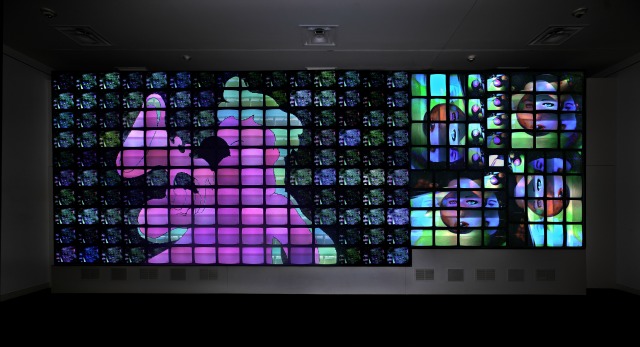
In their place comes Megatron/Matrix (1995), an eight-channel video installation the size of a billboard that pointed the way to all the giant-screen, super-jumbo, mega-multiple screen action and distraction we take for granted in the 21st century. Megatron/Matrix, whose title refers to both the vast reach of the media and its impact on each individual presents a non-stop assault of images that spiral and flow in a riot of color and sound. Paik, who coined the term, “The electronic super highway,” saw both the helpful and harmful aspects of technology. He predicted that television, and by extension the Internet, would help dissolve boundaries in the electronic age. But he also warned against allowing commercial interests to dictate how the medium was used.
Paik had many great assets, including an impish sense of humor and a keen mind. However, it is the breadth of his foresight and imaginative abilities that make Global Visionary a deep and delightful experience.
Nam June Paik: Global Visionary will be on display at the Smithsonian American Art Museum through August 11, 2013.