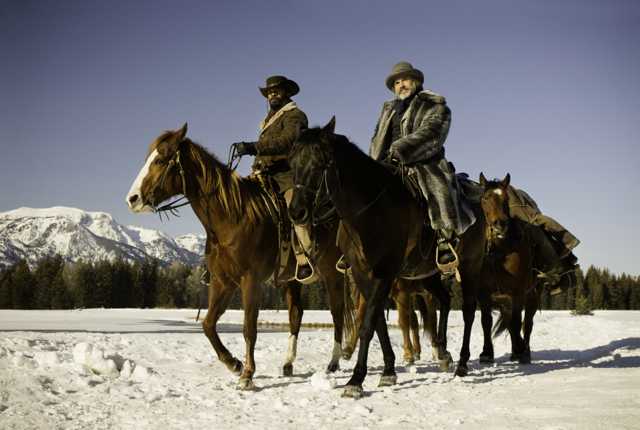
 Jamie Foxx and Christoph Waltz. (The Weinstein Company/Andrew Cooper)
Two heroes ride horseback against the backdrop of an iconic American landscape, with Jim Croce playing on the soundtrack. In 1973, this would have been a conventional image. In 2012, it’s pastiche. But it’s really great pastiche.
Quentin Taratino’s Django Unchained is generously peppered with the director’s signature brutality and self-conscious references to his cinematic forebears. The more sensational aspects of his celluloid personality have a lot to do with the praise and blame heaped upon his output. But gentler scenes such as this singer-songwriter-cooed pastoral get to the heart of what he does so well, and what I wish Django Unchained did more often.
Tarantino channels a movie past but imprints it with his own style. He tells a story with precise craft and stunning visuals. He filters American myth through memories of its cinematic past. With epic composition and a perfectly engineered bassline, Tarantino conveys even more than the excellent dialogue he is capable of writing. Unfortunately, much of the dialogue here is an excuse for a certain racial slur that he already uses more than a white man should.
Tarantino’s self-works some of the time, but often it pulls back from pure story-telling. It’s in the first line of Django Unchained, in which a man asks somebody what they’re doing there in the dark. Coming just as the theater goes dark, it could easily be addressed to moviegoers wandering in late with a bucket of popcorn. As the line is addressed to a group of slaves, it launches the film with a bold metaphor: Are we who wish to be entertained in chains ourselves?
As with his previous movie, the more ambitious and more successful Inglourious Basterds, he took as his inspiration a title from his video-store geek heyday and transformed it. The writer-director’s source here is Sergio Corbucci’s 1966 spaghetti western Django, from which Tarantino appropriates a theme song and a title font. Corbucci’s film is available in its entirety on YouTube, and will be screened at the Landmark E Street Cinema in January.
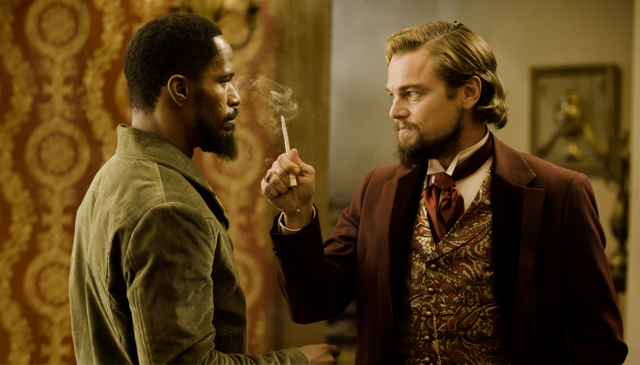 Jamie Foxx and Leonardo DiCaprio. (The Weinstein Company/Andrew Cooper)
The parallels between Django and Django Unchained give Tarantino’s pastiche a resonance beyond the sensational surface of a slave narrative-cum-revenge fantasy. He took a story of a drifter (Franco Nero, who has a cameo in the new film) who happens upon a group of men whipping a prostitute, and transformed it into a story of slave rebellion.
Much has and will be made of the director’s portrayal of the horrors of slavery, from brutal punishment to Mandingo fighting. Basterds‘ casting of Nazi hunters as violent heroes put the audience in the morally uncomfortable position of rooting for the savagery, and Django Unchained both raises and lowers the bar on this discomfort with the bloodiest of bullet-torn revenge. Granted, the vividly explosive entry wounds will probably provoke as much laughter as disgust with audiences, fueling our basest instincts for bloodlust and payback.
The moral ambiguity that makes his films disturbing and provocative is cheapened by that self-consciousness. The kind of self-consciousness that named a character Brunhilda Von Shaft, and that interrupts a charge of hooded attackers with men complaining that the eye-holes in their masks make it hard for them to see. Sure, it makes fools out of racists, and ponders foreign sets of values the way Pulp Fiction mused over the Royale with Cheese. But it stops a compelling story dead in its tracks for a joke that isn’t that funny.
But it’s Tarantino, and cinematic literacy demands that his films be seen, to be admired or to be appalled by, but most of all to be debated. Django Unchained is in the lower echelon of Tarantino films, and its 165 minutes is bloated. But I’m glad I saw it, and you will be too.
—
Written and directed by Quentin Tarantino.
With Jamie Foxx, Christoph Waltz, Leonardo DiCaprio, Kerry Washington and Samuel L. Jackson
Running time 165 minutes
Rated R for continuous violence, including a death match in a smoking parlor, salty language, some nudity, questionable racial stereotypes and other Tarantino trademarks.
Opens Christmas Day.