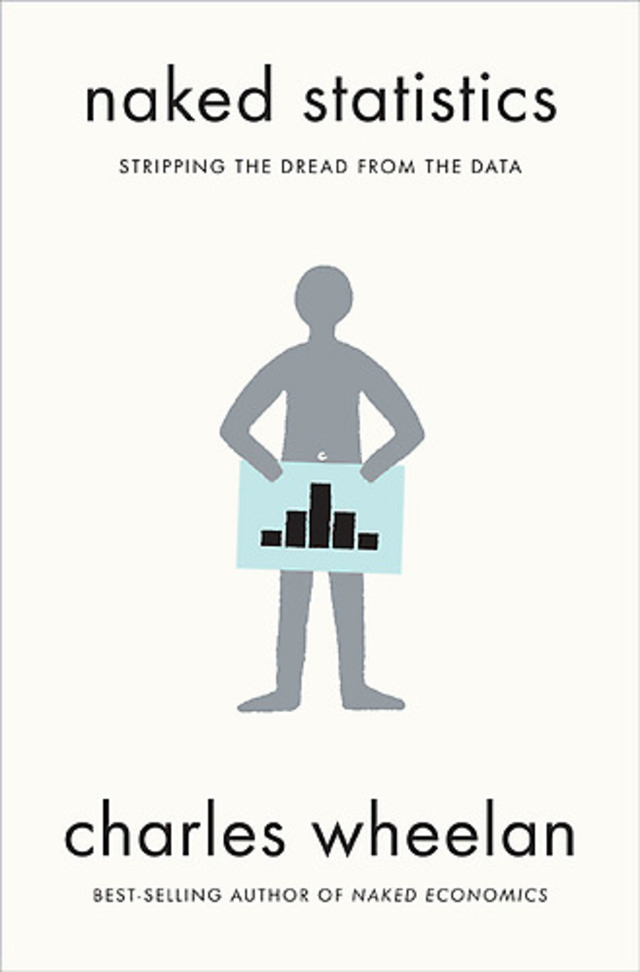
 Some of us—we shall remain nameless—took introductory statistics in high school (okay, and in college) in hopes of relating ever-important hard numbers and formulas to their many applications in daily life. Some of us still sat perplexed in the face of chi-squares and confidence intervals. But in a world where data mining and Nate Silver-esque predictions have real meaning, statistical understanding is more essential than ever. Enter Charles Wheelan, author of the best-selling Naked Economics: Undressing The Dismal Science, and the newly released Naked Statistics: Stripping The Dread From The Data (W. W. Norton, January 2013).
Wheelan will be speaking on his new book at Politics and Prose on Friday, January 11 at 7 p.m. He succeeds in explaining technical ideas in accessible ways, and statistical concepts become familiar as they are tied to what we are exposed to all the time. Some are relatively inconsequential: television shows such as “Let’s Make A Deal”, batting averages, and movie preference recognition software. Others are far more serious, like the long-term benefit of higher education, reasons for the rising rate of autism, and learning what causes cancer without subjecting people to possible carcinogens.
Naked Statistics compares statisticians to detectives examining a crime scene, since both often are “building a circumstantial case based on imperfect data.” He gives the example of Schlitz beer’s 1981 marketing campaign as one of basic probability. Schlitz conducted a blind taste test between their beer and Michelob’s with 100 participants. Schlitz played with statistics to ensure their win: participants were selected on the basis of their previously expressed preference for Michelob, so that even if only 30 percent of them chose Schlitz, Schlitz could still tout that Michelob drinkers chose Schlitz in a blind taste test.
The author also employs statistics to outline major life decisions, such as purchasing insurance and warranties on products. Insuring a $40,000 car means losing a small amount in yearly charges to protect you from paying the huge cost of a car. When Best Buy pushes an extended warranty on a printer, they profit because the cost of the warranty usually exceeds the cost of fixing the printer. “One of the core lessons of personal finance,” Wheelan says, “is that you should always insure yourself against any adverse contingency that you cannot comfortably afford to withstand. You should skip buying insurance on everything else.”
Wheelan teaches public policy and economics at Dartmouth College. He was formerly the Midwest correspondent for The Economist, and has also contributed to the Chicago Tribune, The New York Times, and The Wall Street Journal.
There is a 100 percent chance that this will be an intriguing and eye-opening talk. The event is free and open to the public.