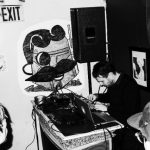
 When I first saw Ivan Khilko perform as Immanent Voiceless, I quipped that he should rename himself “Imminent Deafness” since his performance was one of the loudest things I’d ever heard, rendering my earplugs nearly useless. However, the soundscape that Khilko created on his laptop was enthralling, and not solely due to the high decibel level. If he were solely a drone act, it would still work as the background sounds are very effective at creating senses of either meditative peace or (more often) unease. But it’s easy for a listener to just close their eyes during such a song and let a continuous sound wash over them. Immanent Voiceless does not allow for such a reaction. Khiko will add in vocal samples, found sounds or jarring, crashing sounds to keep anyone from getting too comfortable. Or he’ll drop the sound entirely. DCist spoke to Khiko about this music making philosophy, playing in metal bands and why the spelling of “Immanent Voiceless” is actually correct.
Find him online: https://soundcloud.com/immanentvoiceless
See Him Next: Tonight at the Beta House with Olivia Mancini, Mariner Project and Humble Fire
One thing I noticed when looking at the name Immanent Voiceless is that Immanent is misspelled…
It’s not! It is a different word that not a lot of people use. It’s a word that means existing only within itself. Which is an interesting concept and it’s even more interesting because the way that I got the name was from a spam email. You know those total gibberish spam emails that you get sometimes. But the name on it, like the “From” line was Immanent Q Voiceless. So, I looked up what “immanent” meant and thought, “Holy shit, this is kind of deep.” Like, existing within itself and voiceless. I was like, “Fuck it. I’m not going to find anything better.” Cause the previous name I was using for my project was Digital Penetration, which has a sort of maybe double meaning…? So, Immanent Voiceless sounds a lot cooler and weirder. But everyone thinks it’s misspelled.
How long have you been doing this project? I know that I can see things for Immanent Voiceless back through 2009 but now I know that you were using a different name earlier.
I was, yeah. I was doing stuff under Digital Penetration up until maybe ’07 or ’08. And it’s the same thing. The music didn’t change substantially. I guess if anything, I started collaborating with people more under Immanent Voiceless. Cause I remember I got that Immanent Voiceless email in what must have been ’06 or ’07. That’s when I was like, “That’s it. Digital Penetration is done.” And I was living in New York for awhile and I came back here a couple years ago. And up there it was pretty much always a full band. Like, I had a cellist. I had a couple of my friends that were doing guitar and bass. Once, we even had a drummer. It was great, my friend Lev who plays in this black metal band called Krallice who’s one of the most insane technical drummers that I know, and I had him doing these plodding beats and it was awesome. Here, these days it’s more of a solo thing.
You play in some other metal bands too, right?
In Drugs of Faith I play bass. And that one, I just recently joined. They’ve been going for awhile. I want to say six or seven years. Their bassist left and the main guy in the band, I’ve known for about a year and when he knew the bassist was leaving, he contacted me and said, “Hey, would you be interested in playing bass for us?” I said fuck yes because I’ve known this band for awhile. It’s kind of a huge thing. So, that’s been a lot of fun. It’s been a lot more techincal than what I’m used to. The other band, Forgetting, I play guitar in and I sing. In that one, I write a lot more. It’s basically me and this guy Daniel. We write for it. And then, the other guy in it, Jeff, has his own project called Keep. I guess the interesting thing about Forgetting…
All of you are also into noise…?
Well, yeah. Also, do you know Jason Mullinax? So, the guy Daniel that’s the bassist in Forgetting, he plays in Pilesar now. He’s the guitarist. And he also does this weird sort of Xiu Xiu-esque electronic thing called Timmy Sells His Soul. So, we all do our own electronic things and other bands on the side. It’s like a doom band that comes from three noise geeks. Because I remember when I met Jeff, who I’d played with in another band five years ago, it was actually at a show over at DC9. I think it was White House. Jeff came up to me and said, “Hey, I do electronics. Here’s a CD of my stuff.” I said, “Sweet.” And I listened to it and it sounded great and we kind of didn’t do anything with it for awhile. Then he emailed me and said, “Let’s do a Swans-esque doom band.” I was like, “Oh my god! You pretty much hit everything that I want to be doing.” Then it went on, our shared obsession with Coil* and all the weirder, darker ‘80s/early ‘90s stuff. We both love getting super heavy with just guitar bass and drums and then also pure synth noise and found sounds.
Obviously, people who are into music aren’t into necessarily one type of music but that does help shed some light as to how these multiple styles of projects would coexist. Has it always been a coexistence or did interest in one come first and sort of feed into the other?
That’s kind of a good question. I think I’d always been interested in electronic music since I was in high school, just fucking around with the computer, coming up with loops and stuff. And I played guitar forever. I think the first sort of metal-ish band was in college and definitely college was when I started making electronic music and just fucking around with tapes and field recordings. I remember buying a minidisc recorder and ordering these microphones from online and just walking around recording everything. This must have been the last year of high school, just getting into that world of just being able to take a field recording and find some melodic aspects of it and turn that into a bigger piece that doesn’t just sound like the brakes on a car squealing or something.
I remember a huge thing for me was—I grew up around here and there was a CD store in Georgetown right on M Street called CD Warehouse that was run by these really sweet gay British dudes, Richard and John. One summer, I remember that I had nothing to do and I always used to frequent it and we’d bullshit about Underworld or PJ Harvey or something and I was like, “Hey Richard, can I have a job here for the summer?” He was like, “Yeah. You want to buff out our used CDs so we can sell them?” This was back when that was a viable business model. I remember he got in the store a Steve Reich remix CD. At this point, I must have been sixteen or something. I was like, “What’s this?” He was like, “Oh, Steve Reich was this guy who realized that you could slow things down and fundamentally change the relationship between parts of music.” And that really blew my mind, that idea. Because I remember listening to those early Steve Reich tape pieces and just being like, “What the fuck is going on here?” and then, listening to his later more composed stuff and realizing how informed that was by that early stuff. So, I think that has always stuck with me — the fact that electronic and just non-tonal music can inform the way you make music on live instruments.
So, you grew up in this area. How long were you in New York?
Three years. That was a fucking ton of fun. I remember the first week that I got there, my friend Tony had kind of recently moved there and he was like, “You have to check out this space, Issue Project Room. It was like a venue and I guess he had seen Tim Hecker there and was like, “Dude, there’s this place that’s in this converted grain cellar that you have to go to. They book amazing shit.” But at this point it wasn’t in a grain cellar anymore, but it was still in a really cool space. It was in this place called the Old American Canned Factory. It was this super old warehouse where I guess they’d had a fire at some point. You could see that these old beams were charred but somehow still there. It almost made them stronger in some bizarre way that I don’t understand. It’s been there forever. That thing has got to be 150 years old. And Martin Bisi who produced Swans and a lot of that No Wave stuff has a studio there. It’s a really old kind of storied place. Anyway, I went there for a show and I looked at the calendar and I was like, “I want to check out a good 75% of the shows on there.” I went up to the owner who was this sweet lady named Suzanne Fiol — she unfortunately died of cancer a few years ago — but I went up to her and asked, “Can I volunteer here? Because this place is amazing.” She said, “Yeah. Totally. Just come in. Do you know how to run sound or anything?” I said, “Yeah. I’ve done that before.” I did that the whole time that I was living in New York. It was an incredible eye-opening experience as far as experimental music and free jazz and video. I just met so many amazing people – fucking Genesis Peorge* from Throbbing Gristle. Just hanging out there, doing shows, interacting with these people one on one and seeing this amazing stuff. For awhile, before she passed away, Suzanne was dating Tony Conrad so we’d go out drinking with him. I actually had a monthly — at this place Public Assembly that I ran with a friend of mine — where we booked a lot of metal and a lot of weirder more experimental stuff as well.
I was looking at your Tumblr and the description of your project that you have is that it works with continuity and discreteness.
My friends have been giving me so much shit about that. They’re like, “You pretentious fuck! Why would you write something like that about yourself?” The worst is that I used “liminality.”
What do you mean to say by that?
I guess what I’m trying to get at with that is I’m interested in combining more droney drawn out stuff and really discrete musical events and seeing how they can kind of interact especially in a live space. One of the most powerful things that you can do — you can do the post-rock thing where you build up or you can step on a distortion pedal and everything gets heavy all of a sudden. But to me, it’s almost more interesting to me to have something kind of lull you into a sense of, “Oh, this is a droney kind of thing” and then just have the bottom drop out and be complete silence. Because you don’t know what’s coming next. So, I think that’s the most interesting direction where it’s not all one thing. It’s constantly going back and forth but in a not pre-determined way that you get when you’re playing live.
But yeah, bios are terrible. Maybe I should have my next one written by somebody who’s never actually heard my music, like one of my parents’ friends or something. I’ll be like, “Write me a bio!” It’d be like, “Ivan is a really nice boy. I’ve known him since he was five.” [laughter]. God, bios.
The other interesting bit of information that I found from your Tumblr is that you’ve done film scores. What films?
All fairly small stuff. I did a bunch of stuff in college for friends. More recently, a couple friends in New York did a short that had kind of an interesting concept. It was a dystopian thing where people take drugs not to sleep and the main character decides to go off the drugs and kind of the implications therein. That was a fun little thing. I don’t know if they know this, but I definitely kind of ripped off the score to Dead Man by Jim Jarmusch. That awesome Neil Young-like improvised guitar shit.