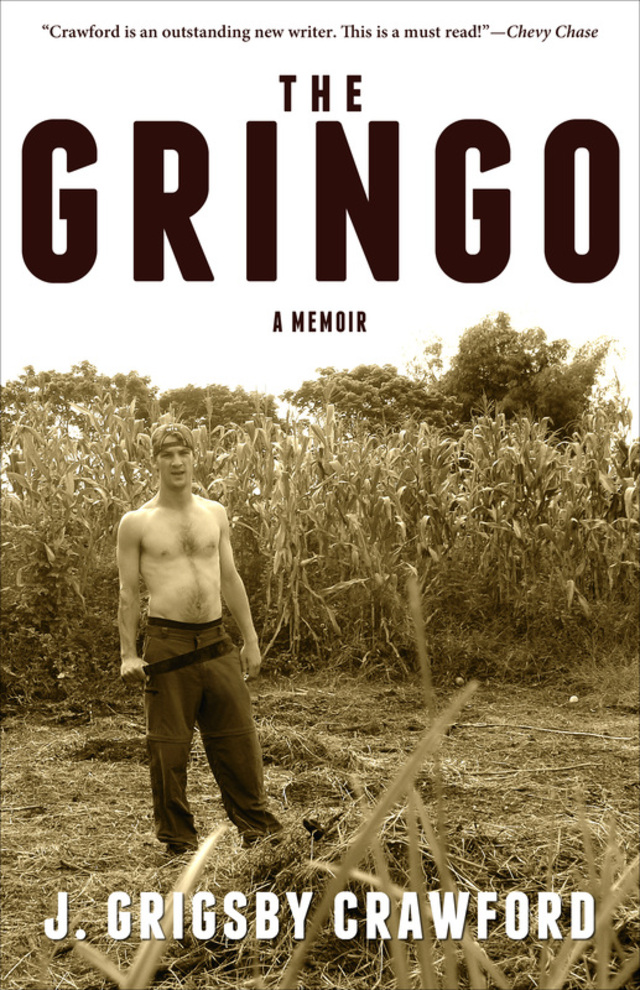
 Nothing like a vicarious trip of “danger, drugs, sex, and alarming illness” in a foreign locale to beat DC’s winter blues and flus. You can go through it all alongside J. Grigsby Crawford in his first book, The Gringo (Wild Elephant Press, December 2012). Potter’s House Books in Adams Morgan will be hosting his upcoming reading on Saturday, January 19 at 4 p.m.
After graduating from George Washington University in 2008, Crawford left for Zumbi, Ecuador to be a National Resource Conservation volunteer with the Peace Corps. Once there, it soon became clear he would have some serious storytelling to do. Between the grave mishandlings of the national service program and the unparalleled experience of being a stranger in a strange land — “the gringo” — the author says “it got dark so quickly, I knew I’d have to write about it.”
Taking a cue from literary heroes Tom Wolfe and Hunter S. Thompson, he began to document his adventure through notebooks and post-its on the bedroom wall. The resulting book can be described as half first-person journalistic account of what really happens in the Peace Corps, and half coming-of-age memoir by an earnest traveling man in his 20s. The title is based off the racially-charged nickname Crawford was given in Zumbi. It sums up his conflicted role as an American seeking to fulfill a service mission, but also a constant “other” who often wound up isolated with little to do.
The Gringo starts with Crawford’s “narrow escape from a kidnapping plot hatched by the people he was sent there to help,” and continues to takes your mind and body for a spin while rehashing encounters with similarly lonely women, psychedelic mountain plants, and exotic bacteria. The realities he faced are relayed with eloquent and engaging brutal honesty. Though he won’t sugarcoat the events as sentimental tales of virtue, Crawford does say he hopes readers take away that “compassion should be the #1 human trait that connects us. From all the bitterness I experienced down there, I was able to come away with that.”
He also specifies some of the failings of the Peace Corps’ operation. One chapter highlights a small town in the northern Amazon region where suicide rates were several times higher than the world average. A nearby news station revealed that the town’s signature product, the naranjilla fruit, was cultivated using an incredibly toxic pesticide. Those growing and eating the fruit were poisoning themselves, and it may have contributed to the suicide rate. Simply switching to an organic pesticide could have saved lives. There was a Peace Corps volunteer stationed there, but she was working on the less pressing, more popular issue of ecotourism.
Crawford lives in DC, working by day at a small PR firm. He has written for The Huffington Post, Congressional Quarterly, the Colorado Daily, Mile High Sports, and various blogs about a wide range of topics. He hopes to author more books in the narrative nonfiction style, and will only consider fiction “when real life stops being as weird as it is.”
At Saturday’s open event, Crawford will read select passages, answer questions, and sign books for attendees.