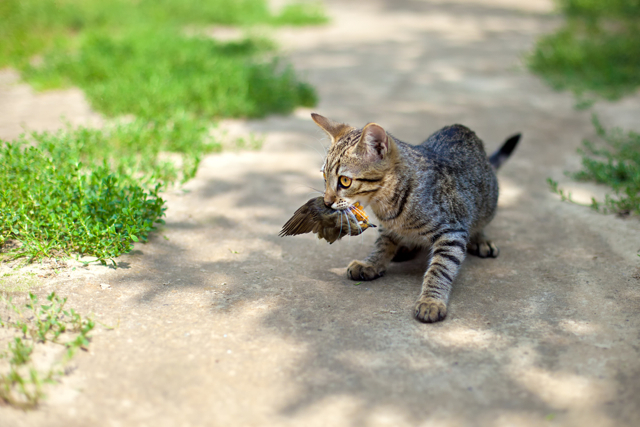
 Cat eats rabbit. (Via Shutterstock)
Everyone loves cats, right? They’re proudly independent, they can be a warm friend under the right care, and they give good Internet. But don’t for a second think that under that blanket of fur and low-rumble purr, there isn’t lurking an indefatigable killing machine.
In an article published in the newest issue of the journal Nature Communications, a group of researchers at the Smithsonian Biology Conservation Institute estimate that domestic cats across the United States are responsible for killing tens of billions of animals each year. The authors estimate free-ranging cats kill between 1.4 and 3.7 billion birds each year, and another 6.9 to 20.7 billion mammals.
Felis catus is already listed as one of the most invasive species in the world, and cats that roam, say, small and relatively unsettled islands are credited with part or all of 33 modern extinctions. But even among the local population, cats are merciless creatures that harvest other wildlife without pause.
The article estimates that Americans own 84 million cats, of which between 40 percent and 70 percent are allowed to roam outside. Combine that with a range of between 30 million and 80 million unowned cats, nearly all of which are predatory on other species. In fact, the Smithsonian researchers write, cats could pose the greatest threat to small mammals:
The exceptionally high estimate of mammal mortality from cat predation is supported by individual US studies that illustrate high annual predation rates by individual un-owned cats in excess of 200 mammals per year and the consistent finding that cats preferentially depredate mammals over other taxa. Even with a lower yearly predation rate of 100 mammals per cat, annual mortality would range from 3-8 billion mammals just for un-owned cats, based on a population estimate of between 30 and 80 million un-owned cats. This estimated level of mortality could exceed any other direct source of anthropogenic mortality for small mammals; however, we are unaware of studies that have systematically quantified direct anthropogenic mortality of small terrestrial mammals across large scales.
Pet cats are still responsible for their share of kills, with the paper estimating owned cats hauling down 1 billion birds and 1.5 billion mammals annually.
But most of the killing is done by the unowned cats, which in urban areas often live in colonies that are actually tended to by humans. The study estimates more than 300 of such communities exist in the D.C. And even though many of those managed colonies are “trap-neuter-return” groups that attempt to control the feline population, neutering feral cats isn’t having much of a deleterious effect on the rate at which cats kill other animals.
The study’s authors—Scott R. Loss, Tom Will, and Peter P. Marra—conclude by writing that the wildlife mortality rate caused by cats “far exceeds all prior estimates.” And even though feral cats do most of the bloodsport, an increasing pet cat population is not expected to drive down the slaughter: “This mortality is of particular concern within the context of steadily increasing populations of owned cats, the potential for increasing populations of un-owned cats, and an increasing abundance of direct and indirect mortality sources that threaten wildlife in the United States and globally.”
Basically, the more cats there are, the more other animals are going to die. Remember, if you want to stop a cat from killing another creature, the best defense is always a laser pointer: