
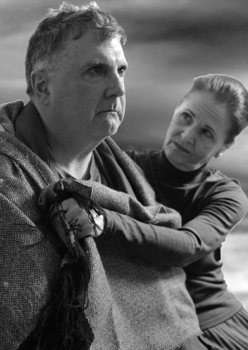
 John Brennan and Wendy Wilmer in “Embers.” (Arcturus Theater Company/J. Michael Whalen)
It’s encouraging that small theater companies around the city are doing some challenging, interesting productions. And while such endeavors don’t always go off without their hitches, it’s a worthy pattern. Two recent examples are Arcturus Theater Company’s 3 by Samuel Beckett, a trio of shorts by the Pulitzer-winning absurdist that finishes its brief run tomorrow at DC Arts Center; and Kafka on the Shore, by Spooky Action Theater, which runs through February 24.
Arcturus’ Beckett trilogy opens with “That Time,” a 20-minute monologue performed by a nicely understated and controlled Brit Herring. Alone on stage, Herring gives off three different personas in one glowing, shape-shifting face, questions and streams of consciousness all fading into one another, repetitiously, circularly, piecing together faded memories in a style that might remind one of Beckett’s compatriot James “Yes I said Yes” Joyce.
“Embers” was originally written as a radio play and director Ross Heath cleverly twists this by having actor John Brennan yell for sound effects now and then—“Again! Again!” There’s a wife, a daughter, a maybe-ghost-father (or maybe everyone is already dead). There’s anger; there’s chess.
And finally we get “Rough for Theatre II,” which is like an echo chamber of “Waiting for Godot,” inhabited by the distant cousins of Vladimir and Estragon.
Arcturus Theater Company’s 3 by Samuel Beckett runs through Sunday at D.C. Arts Center. 2438 18th Street NW, (571) 239-2871. Tickets $10-15.
—
Spooky Action Theater got its name from an Einstein term that describes quantum mechanics (“spooky action at a distance”). So that’s where we’re starting.
In this adaptation of the Japanese author Haruki Murakami, “Kafka on the Shore” follows a teenage boy called Kafka, and his escape from home for unnamed reasons.
He is followed around by “Crow,” an odd mix of of The Tempest‘s Ariel and Jiminy Cricket, with a dash of Jason Lee, played with intense grace by fan dancer Dane Figueroa Edidi.
Like dreams, the story has its own bizarre but beautiful logic. There are deliberate image and scenery parallels—a whole chunk of scenes take place in a library, while a completely separate character later compares his inner emptiness to being “a library without any books.”
Throughout, we are delighted to find surprising connections between at-first disparate elements—whether the horror and evil of Hiroshima and Adolf Eichmann or the bittersweetness of first love.
The acting is uneven. Poor Michael Wong as the lead seems to have stumbled into the Dawson’s Creek school of acting when tasked at portraying an age much younger than he looks—biting his lip, slouching, and speaking annoyingly slow, but never really making us care about him.
While it might have been ill-advised to cast an actual 15-year-old—given the themes of incest and molestation—surely there might have been someone in the local acting ranks who could have given us a clearer picture of a complex youth.
But for the most part, the cast is quite capable—particularly Steve Beall, who’s menacing and funny, channeling Dennis Hopper in “Speed” as a neighborhood psychopath (“I’m so sick of killing cats!””), and then all buttery sleaze asKFC’s Colonel Sanders.
Some of the most enjoyable moments were between Beall’s Sanders and a delightful, Jack Black-like Steve Lee, as a truck driver seeking Sanders’ help, who blurts, “Oh, I get it, you’re a pimp! That’s why you’re all dressed up!”
Also turning in nice work here are ensemble members Al Twanmo, as slow, lost old soul Nakata; Sarah Taurchini in dual turns as a siamese cat who loves Puccini and a southern-fried prostitute philosophy major who takes Hegel’s “absolute knowledge” to another level; and Tuyet Thi Pham, as a strong, insightful transgender librarian who may be the only authority figure genuinely capable of parenting Kafka.
In the end, it’s difficult to say exactly what all you just watched—the digestion is ongoing for me. But I suspect that final conclusiveness doesn’t matter, neither for the Beckett nor the Murakami. That’s just not the point.
Bottom line: It does make you appreciate the theatrical calisthenics undertaken by both companies to bring these authors’ material into some kind of accessible form.
Spooky Action Theater’s Kafka on the Shore runs through February 24 at Universalist National Memorial Church; 1810 16th St NW, (202) 248-0301. Tickets $10-25.