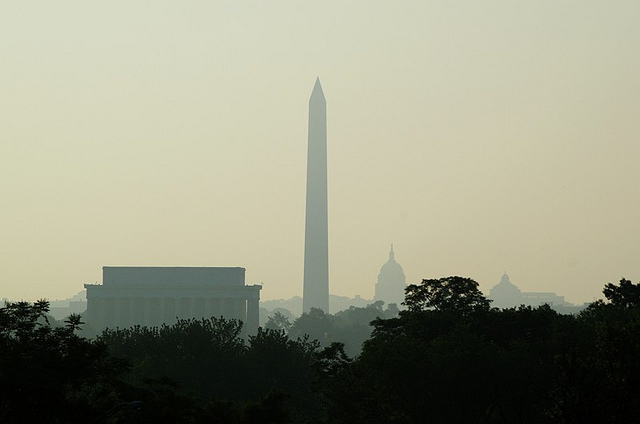
 Photo by philliefan99
There’s a new city rising on the American lanscape to counter the economic and cultural might of New York, and it’s, well, us. That’s what Aaron M. Renn, an urban affairs analyst, writes in the newest issue of City Journal.
According to Renn, the Washington area’s population and economic growth over the past decade or so—driven in part by expansions in federal spending (which, by the way, we’re not denying)—is moving this city ahead of Los Angeles and Chicago in relative importance.
Renn doesn’t seem to pleased with that. “In fact, we’re witnessing the start of Washington’s emergence as America’s new Second City,” Renn writes. “Whether that’s a good thing for America is another question.” He also mentions D.C.’s post-Revolutionary founding as “an artificial capital.”
As phony as we might be, we are doing quite well. Like Sean Hannity before him, Renn says D.C. is a boomtown, what with our increasingly high housing costs, crops of new restaurants, and increasing demand for multi-modal transportation systems:
Rents are high, with lower-cost apartments disappearing rapidly as investors pay current residents as much as $10,000 to move out so that their apartments can be rented to others at higher rates. In 2011, buoyed by robust demand, builders broke ground on more than 15,000 new apartment units throughout the Washington region. “Much of the building is taking place in the District,” noted the Washington Post, adding that “the vast majority are ‘Class A’ units aimed at young professionals eager to live in walkable communities near shopping and public transportation.”
All this, and more, Renn argues, is because the federal government continues to expand. And like a true conservative parrot, he pins it on the 2010 health care law. Even though federal spending is set to be cut back later this year, Renn fears that Washington will continue to grow because of “Obamacare, an annexation by the federal government of one-sixth of the American economy via 2,000 pages of byzantine legislation, not counting the thousands of pages of implementing regulations still to come.”
The upshot of all this increased regulation and continued defense spending—there’s still a war on!—in Renn’s estimation is that big military contractors are moving closer to D.C. to be closer to the government. He cites Boeing’s move from Seattle to Chicago, which actually happened in 2001 thanks to the Chicago and Illinois governments shelling out $50 million in tax breaks, and Northrop Grumman’s relocation from Los Angeles to Northern Virginia. (OK, that actually happend in 2010 so Northrop executives could be closer to the federal government, though effectively only 300 people were moved to join a regional workforce that already numbered some 40,000 employees.) But Renn’s claim that post-Obamacare, health care companies will have to follow suit or, at least, that “they’ll need to be represented” in D.C. is something of a laugher. The health care lobby has been here for years.
Anyway, as far as Renn is concerned, our gain is everybody else’s suffering:
Washington’s fortunes and America’s are increasingly at odds. The region is prospering because it’s becoming something that would have horrified the Founders: an imperial capital on the Potomac.
Well, at least he didn’t call us a District of Crapola.