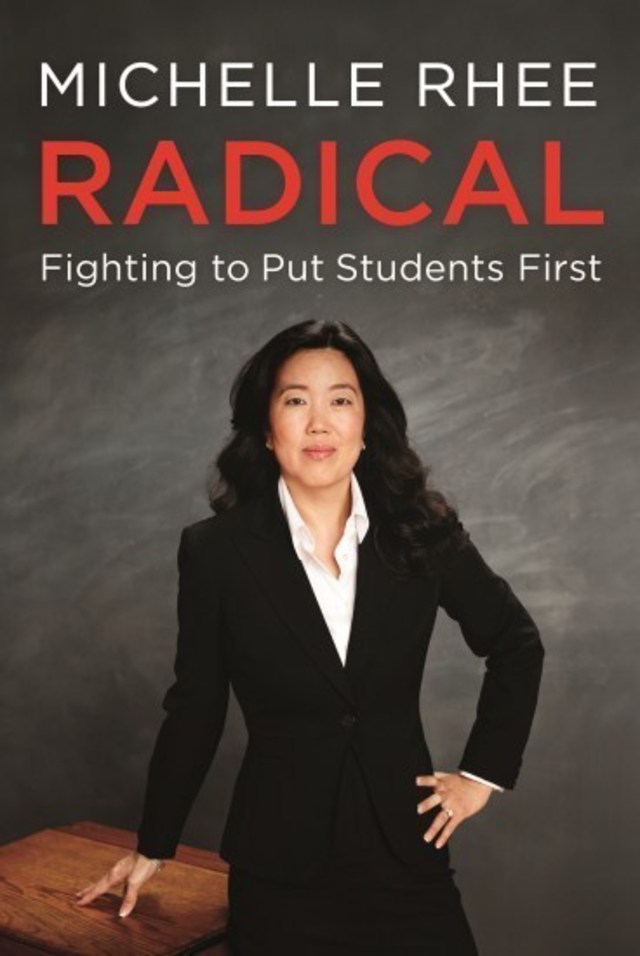
 Michelle Rhee has moved and shaken the education world since she became chancellor of D.C. public schools in 2007. District schools were the lowest performing in the nation, and with credentials like Teach for America service and founding The New Teacher Project, Rhee quickly made what she considered “obvious changes.” Some of her bold and contentious decisions included closing 23 schools and firing hundreds of teachers, relying heavily on standardized test scores as an indicator of progress. She negotiated a new contract with the Washington Teachers’ Union and began a teacher evaluation program in an effort to reward effective teachers and weed out ineffective ones. These moves, for better or worse, prioritized the conversation about D.C. school improvement. Rhee’s takeaways and mission are articulated in her book out this week, Radical: Fighting to Put Students First (Harper, February 2013), which she will be discussing at Sixth and I Historic Synagogue Thursday, February 7, at 7 p.m.
Radical takes the challenge Rhee fought for in D.C. to a national level: that although the United States is the greatest country in the world, students’ achievement is falling behind, and their lack of preparedness is hurting them and the economy. She blames fumbling bureaucracy and programs that deny resources and energy to students. Her antidote is dramatic action, and the book presents a deeper context for what and why this is. It is presented in three parts. In Part I, “The Journey,” Rhee writes on her personal background, and how “hard-driving” parents and initial job frustrations drove her ambitions and shaped her values as an educator, chancellor, daughter, and mother.
In Part II, “The Movement,” Rhee further describes her encounters with broken school systems that she says incentivize negligent teachers with the security of tenure, devalue good teachers who deserve to be compensated, and “rob students of their futures.” She speaks of the struggles students face in both rich and poor environments and puts the onus on teachers to inspire their students.
Part III’s “The Promise” outlines Rhee’s vision for what American schools could be: focused on student success (largely measured by data), with credit where its due to the educators. She names concrete steps to be taken by lawmakers, administrators, and citizens in order to enact this vision — also that of Rhee’s political advocacy organization, Students First, which she started in late 2010. A full description of Students First’s goals and policy initiatives can be found at StudentsFirst.org.
After Rhee left Washington, various controversies have arisen, such as investigations into whether heightened emphasis on test scores resulted in teachers or principals cheating for their students by changing incorrect test answers. Radical does not address these allegations. It will be interesting to see if any questions are asked on Thursday about the potential motivation to improve students’ scores using any means necessary when keeping one’s job is wholly dependent on those scores.
Rhee’s “memoir/manifesto” reaches out to readers who seek to understand her actions in D.C., and apply them to education policy and philosophy at large. Among all the voices out there on what to do about slipping schools, few have captured the public attention that Rhee has. D.C. student performance seems to have ticked up in recent years, so despite skepticism and criticism of Rhee’s aggressive style, many see her approach as the means to justify the end.
Rhee is married to Sacramento mayor Kevin Johnson, and has two daughters who live in Nashville, Tenn.
Tickets for the event are $12, or two tickets are free with a $28 book purchase. They will be available at will-call starting at 6 p.m., and seating is first-come, first serve.