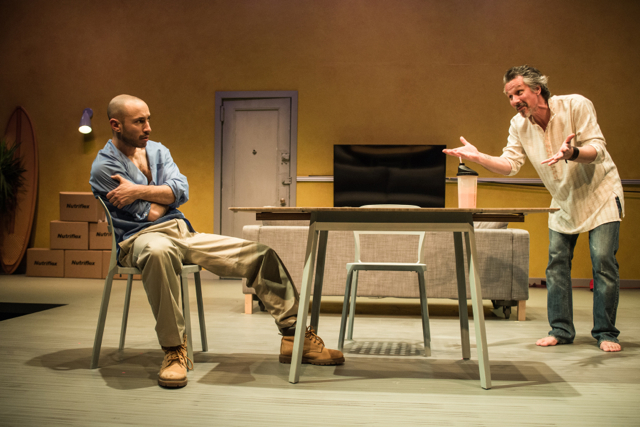
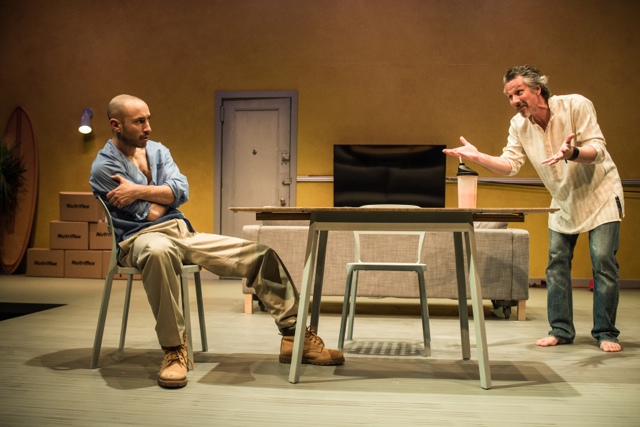
 Drew Cortese and Quentin Maré. (Studio Theatre/Teddy Wolf)
Most stories about addiction and love sound like survivor accounts from the Titanic: You had to take the last available spot on that lifeboat, even as others around you sank. Because what choice did you have? It’s die, or be saved, alone.
These sad, failed rescue missions are seen over and over in films—take the 1962 Jack Lemmon melodrama Days of Wine and Roses. More recently, last year’s Smashed, in which Mary Elizabeth Winstead and Aaron Paul play a couple at odd ends of the recovery spectrum, forced apart inevitably by the life crutch they no longer share.
The thing about addiction, and about ending addiction, is that it’s a pretty lonely, confusing endeavor. This is no more evident than in the Studio Theatre’s production of Stephen Adly Guirgis’s unapologetically funny and insightful The Motherfucker With the Hat.
Motherfucker came into being on Broadway in 2011, as the debut of Chris Rock’s stage chops. Sadly, I didn’t see the New York production, but under the direction here of Serge Seiden, this iteration feels just as unwavering in its bullshit shattering as I imagine it must have been two years ago.
We open on Veronica (Rosal Colon, a standout in a consistently high-caliber cast), who’s making the bed while admonishing her mother for poor romantic choices over the phone (“Atila the Hun had his good points, too,” she snaps). In between military folds, she’s also doing lines of cocaine.
As almost anyone will attest—it’s much easier to dole out advice than to follow it.
That theme emerges over the show’s course. It’s clear that while everyone in this story has the ability to tag each others’ actions with alacrity, they can’t muster up even the most basic boundary setting of their own.
Veronica’s boyfriend and the default protagonist, Jackie (Drew Cortese), enters for the first time riding out a kind of boozeless high, having just landed a job. (A good thing for his parole.) He of course manifests the joyous news by showering his lady love with flowers, candy, and even marriage talk.
Of course, in a matter of minutes, things get ugly, once Jackie notices the key component to the play’s title and its themes: a man’s hat he doesn’t own, sitting in their bedroom, full of implications and betrayal.
Veronica gets angry and defensive — and the ensuing fight becomes increasingly more extreme and therefore hilarious, culminating in a series of insults hurled at Jackie’s dead mother, in which Veronica promises, “I’d strap on a fucking dildo and fuck her”).
Eventually, all is resolved—but not really, as Jackie continues to rage, looking up at the ceiling in his own exasperated Judy Blume moment, “God — hello again!”
The language of these characters’ world—rough, Noo Yawk, Puerto Rican—is almost always the right blend of theatrical embellishment and real-sounding dialogue.
Veronica and Jackie’s lives have been entwined for a long time—since middle school, in fact—and it’s evident from the opening minutes them that this is a roller coaster they ride often without any hesitation. Their sexual attraction is constant, but so is the risk that Jackie, who’s sober in a house filled with temptations (booze, marijuana, coke), will relapse.
And it’s that correlation between love and self-destruction that is so interesting. After all, Jackie doesn’t crumble under the weight of those that treat him badly, but under the ones that shower him with unconditional love.
Later, we meet Jackie’s sponsor, Ralph (Quentin Mare), Ralph’s wife Victoria (a skillful Gabriela Fernandez-Coffey, whose part is unfortunately the least developed) and then his cousin Julio (Liche Ariza, amazing, stealing the show at every turn). As Ralph, Mare eerily channels Breaking Bad‘s Walter White, who balances deranged actions with his appeasing words.
But everything comes from somewhere, and in leaps and bounds we begin to see how much damage someone so even keeled as Ralph can inflict on the vulnerable emotions circling all around him.
More troublingly, everything that Ralph says is basically true. Lines like “People only attract who they’re ready for” and “It takes courage to change.” But they ring hollow and self-serving when he says them, so what’s the point of these insights, if they’re only co-opted by those who don’t mean them?
As a play about people who get lost in their own senses, Motherfucker makes sense that food (almost as much as sex) plays a central role. A scene in which Ralph makes pancakes for his wife, for instance, does more to demonstrate the dynamic between them than any of the acrimonious battering preceding breakfast.
And then there’s the extraordinary contrast between the real nourishment coming from Julio’s kitchen (correlating with his deeply rooted, genuine love for his cousin) and the prescribed new agey health food schlock that Ralph peddles, which rings as hollow as the slogans he spouts.
Guirgis, a native New Yorker, is a talented writer who makes astute observations but doesn’t mind occasionally throwing something in for fun like a delightful wink at The Godfather in which one character advises another to “Take the gun, leave the empanadas.”
Guirgi’s writing is moved along nicely by each element in this show, especially by Eric Shimelonis’s urgent music and sound design, Michael Giannitti’s lighting, and Debra Booth’s stage design.
Each scene change subjects the audience to images of toxic substances on a television screen—a black and white shot of clear liquid pouring in slow motion, tauntingly, over ice cubes in a glass. But as the show progresses, these shifts are marked by other video images, like surfing, which might seem innocent enough but can still be used as a way to escape.
There are some nice observations on class, too. The kind of lifestyle that Ralph and Victoria lead—upwardly mobile, with a huge flatscreen and their yuppie activities (“Yoga and soymilk – that’s for assholes. Well, I’m an asshole,” Ralph says)—may at first make them come across as more stable than the less financially soluble Veronica and Jackie.
But throughout the script, Guirgis’ characters are forever imbuing seemingly mundane things—ice-making refrigerators and Commodores albums—with more meaning than they are truly worth.
We’re also endlessly mourning something that didn’t pan out the way we wanted. One of the more touching scenes is when Veronica breaks down and issues a laundry list of squandered dreams, from finishing school to having children.
And Guirgis seems to know the potential that blind adherence to any dogma has to wreck just as much havoc. Alcoholics Anonymous can be a lifeline for many people, but it can also put one face-to-face with a lot of temptations; with a lot of people who are also looking for ways to break.
In the end, what really is the difference between imperfect and irredeemable? Perhaps it all comes down to choice. Or maybe empathy.
Ok, so if all of this sounds heavy, and it is. But it’s also fresh and crisp and shocking as that first puff of a cigarette when you’ve gone a whole day without one. Not that I would know—I’ve been quitting since December.
The Motherfucker With the Hat runs through March 10 at The Studio Theatre (1501 14th Street NW); (202) 332-3300. Tickets $39-72.