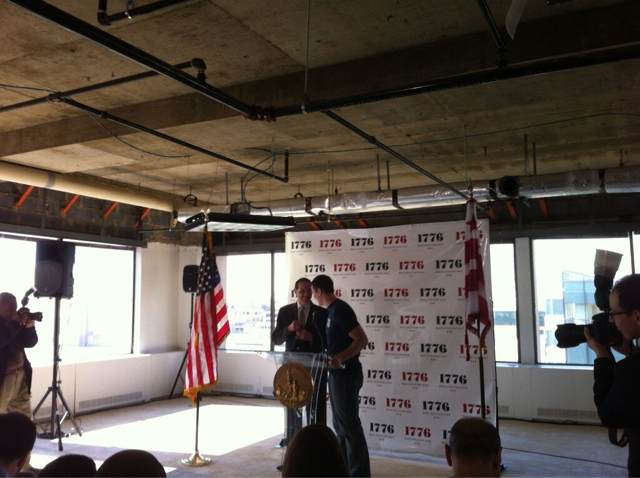
 Mayor Vince Gray with 1776 co-founder Evan Burfield.
The newest outfit geared toward turning D.C. into a hub of high-tech activity launched today. Called 1776, the new “accelerator” facility bills itself as an office environment where newborn companies can grow their legs and develop their practices.
The opening of 1776 also provided Mayor Vince Gray with another opportunity to promote the District’s gradually expanding tech industry, and one not associated with the struggling daily deals company LivingSocial. Currently occupying a full floor of the office building at 1133 15th Street NW, with plans to expand to four floors, 1776 is an outgrowth of the Startup America Partnership, an association of tech developers and their venture capital funders. The new facility also got started with a $200,000 grant from the D.C. government, Mayor Vince Gray said at the launch event today.
“Ultimately as we thought about the D.C. startup community, we’re living in one of the most powerful cities in the world,” Donna Harris, one of 1776’s founders, said in an interview. “Every country, major corporation has a presence here. Bringing all that to work on behalf of startups has enormous potential.”
In remarks to a crowd full of the startup founders and financiers 1776 intends to attract, Harris’ cofounder, Evan Burfield, said the new venture is necessary to bring D.C. to a competitive level with more wired cities.
“We continue to punch tremendously below our weight,” Burfield said. “The federal government is the single largest buyer of entertainment technology. D.C. has been the place where inspired young people come to change the world.”
Whether or not the federal government or other entities with national or international reach will be buying up all the innovations 1776 intends to produce will remain to be seen. Among the companies Harris mentioned as joining up with the new facility are Hinge, an online dating platform, and Social Tables, which produces event planning software.
“We’re interested in companies that are working on progressive solutions to our nation’s challenges,” Harris said. “Our fundamental premise is that we obviously want 1776 to be a convening place for the community. But the best place for that is around America’s big national challenges.”
Ideally, in addition to the occasional dating app, Harris said 1776’s member companies will be tackling issues like education, health care, energy production and conservation, and the way government operates.
This isn’t D.C.’s first startup “accelerator” in which city taxpayers have a vested stake. Last year, the District snagged The Fort—launched by the venture capital firm Fortify.vc—from Sterling, Va. with a $100,000 grant. The Fort, which currently operates out of office space on K Street NW, is actually moving into 1776’s 15,000-square-foot office space.
But is the city’s startup community so robust that there are enough ambitious developers and burgeoning companies to fill such a large “accelerator” campus? Harris said yesterday that D.C. has more startups per capita of any major city in the United States, and added today that once 1776 is fully open next month, it will be at capacity.
In addition to the backers like Scott Case, a founder of the travel website Priceline, and the grant from D.C., 1776 intends to fund itself through membership fees, classes and events. Members can pay for semi-regular or dedicated spaces, ranging from $150 to $450 a month, Harris said. The build-out will also include the construction of a stage and auditorium area which 1776 will rent out from time to time.
At the very least, the $200,000 grant, which requires 1776 to remain based in the District for five years and have at least 20 percent of its membership filled out by D.C. residents, could be a safer bet than the Gray administration’s other major tech-industry investment—LivingSocial. Though the daily deals company is slated to start receiving the benefits of a $32.5 million tax incentive deal in 2015, it is coming off a year in which it lost $650 million and laid off 160 employees in its D.C. offices. The silver lining of the LivingSocial deal, however, is that the company is required to be profitable in order to receive the tax benefits, a stipulation that Gray pointed out in his State of the District address last night.
Gray’s office is a bit more sanguine about 1776, though. “We’re two for two,” in establishing “accelerator” organizations, Gray’s spokesman Pedro Ribeiro said today. “We want to compete.” (At a combined cost, so far, of $300,000.)
Though its office is currently stripped away to bare concrete and drywall, 1776 is bringing in some aesthetic guidance to flesh out its eventual look. Maggie O’Neill, a designer who created the interiors of Lincoln, Sax, and other restaurants around D.C., is set to fill out the space with accents intended to suggest the new tech facility’s late-18th-century name. Lounge areas and conference spaces will have a “rustic feel,” Harris said, including reclaimed barn doors for tables and a “faded flag motif.” She said 1776’s first batch of clients will be able to move in by the end of March.