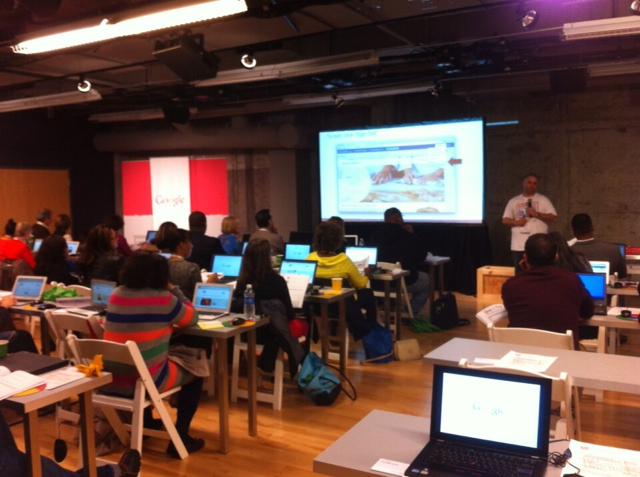
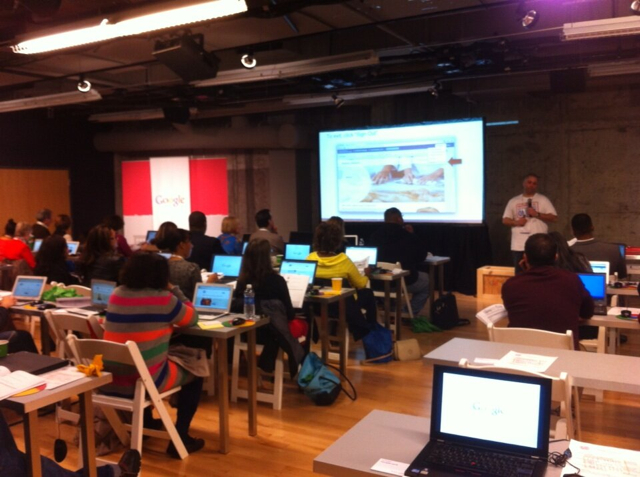
 A Google employee teaches D.C. area business owners how to make webistes.
One of the biggest challenges for any new company is establishing an online presence. Difficult as it is to believe in 2013, 58 percent of small businesses across the United States have no Internet footprint, be it a website, online directory listing, or social media engagement.
At a seminar today at the Woolly Mammoth Theatre Company, though, representatives from Google are attempting to change that for a few hundred small businesspeople dropping by from across the D.C. area.
“These are smart, creative people,” Marie G. Johns, the deputy administrator of the U.S. Small Business Administration, says of the dozens of entrepreneurs hunched over laptops in a conference room while a Google employee talked about the building blocks of establishing a company website. Participants in todays workshops got schooled in obtaining a domain name, setting up company email accounts, and developing basic, but functional, user experiences.
The point of the exercise, Johns said, was to “demystify” the task of getting one’s business on the Internet. “Any small business owner can create a website,” Johns says. “Most of these people will have websites by the end of the day.”
Valda Wisdom Brown, who drove in from Manassas, recently retired and is setting up a second career as a professional coach and organizational trainer. With a target launch date of April, she came to the Google seminar to learn the tricks of getting her new venture online.
“Looks pretty comprehensive,” she says of the booklet Google provided with the free training session. “I wanted to get a website to attract customers. And the website can do a lot of the work for me.”
Mayor Vince Gray stopped by one of the day’s earlier training sessions, and agreed that a large percentage of small businesses in D.C. have no self-driven Web identity. “There are small businesses everywhere,” Gray says in an interview. “East of the river businesses are definitely not as connected.”
On a large map in Woolly Mammoth’s lobby, seminar participants applied stickers to their business’ locations; most were in Northwest D.C., but a decent portion lied across the Anacostia River.
As for why Google—and Intuit, which is providing the Web hosting for the attendees’ new sites—is helping so companies get online free of charge, representatives of the search giant put it directly.
“Ninety-seven percent of people online are looking for local services,” says Scott Levitan, Google’s director of small business engagement. “If you’re not online, you’re invisible.”
According to Levitan, many people assume it is difficult and time-consuming burden to create a company website. “Truth is, it’s more like a hike over a hill” than scaling Mount Everest, he says.
Of course, a big company like Google wouldn’t be giving its services away for free if there weren’t the prospect for new business for itself. Inside Woolly Mammoth’s main theater, a Google employee ran through the ins-and-outs of AdSense, Google’s platform that allows advertisers to buy search-generated ads. “For Google, our mission is to connect people and information,” Levitan says. “They might start advertising at some point.”
For D.C. officials, the Google seminar offers a chance to get next to a tech company that, while not locally based, has a considerable presence in the city and is not shedding employees or income. Google opened up its federal policy and lobbying operation in 2005. More recently, it has been investing directly in cities, such as Kansas City, Kan., where it is developing an ultra-high-speed Internet service called Google Fiber. Gray says he exchanged notes on the topic with Kansas City Mayor Sly James at a conference last month. A Gray administration official today also says that there have been preliminary talks about getting Google to invest in the startup incubators 1776 and Fortify.vc.